
(Photo by Andrew Leyden/Getty Images)
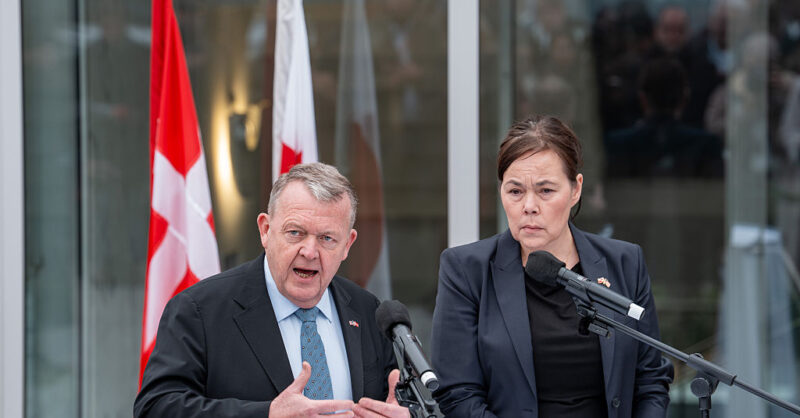
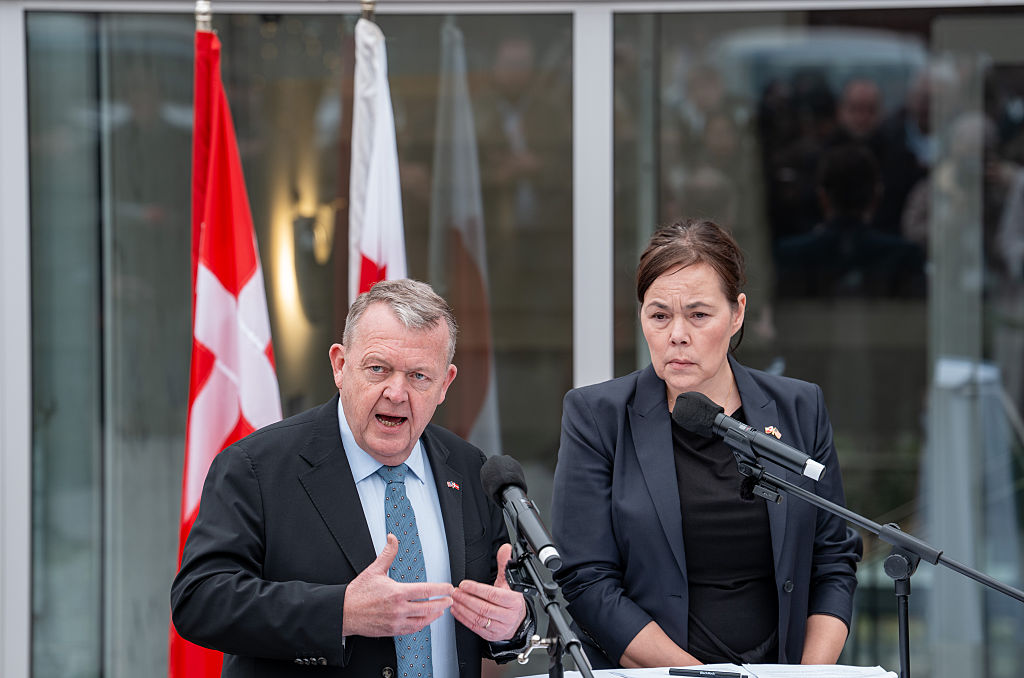
Emerging from talks with JD Vance and Marco Rubio in Washington on 14 January, Denmark’s foreign minister Lars Løkke Rasmussen was variously seen fist-bumping the Danish ambassador and smoking a pipe. Later, at a joint news conference with Greenland’s foreign minister, Vivian Motzfeldt, outside the Danish embassy, he attempted to put a diplomatic spin on their encounter with the Americans.
He and Motzfeldt had held a “frank, but also constructive” discussion with their US counterparts,” Rasmussen said. They welcomed the opportunity to try to “take down the temperature” and “challenge the narrative” presented by Donald Trump. While the security situation in the Arctic was clearly evolving, for instance, there was no immediate threat from China and Russia towards Greenland, they had explained. In fact, according to Danish intelligence, the last time a Chinese warship had been seen near Greenland was around a decade ago. Rasmussen said they had agreed to establish a high-level working group to continue the dialogue, which is what diplomats do when it is clear there is no viable solution within reach.
But despite his best efforts, there was no glossing over the fact that, as Rasmussen put it, “we still have a fundamental disagreement.” He acknowledged that they had been unable to change the American position. “It is clear the president has this wish of conquering Greenland,” he said, which would cross both Denmark’s and Greenland’s “red lines”. Motzfeldt similarly stressed that Greenland was open to strengthening co-operation with Washington, “but that doesn’t mean we want to be owned by the US.”
“Of course, it’s very emotional for all of us, for people living up in Greenland and for people living in Denmark,” said Rasmussen, 61, who is a former Danish prime minister and experienced diplomat. He noted Denmark’s centuries-long relationship with the US and history of fighting alongside the Americans, including in Afghanistan, where Denmark lost more troops than any other US ally as a proportion of its population. “It is not easy think innovatively about solutions,” he added, “when you wake up every morning to new threats.”

New year, new read. Save 40% off an annual subscription this January.
“We agreed to disagree,” Rasmussen concluded. But that is not a sentiment Trump has ever been known to express.
That morning, even before the meeting, Trump reiterated his stance in a social media post, declaring that the US “needs Greenland for the purpose of National Security” and that it was “vital for the Golden Dome [missile defence shield] that we are building”. If the Americans did not take control of the territory, he insisted, “RUSSIA OR CHINA WILL, AND THAT IS NOT GOING TO HAPPEN!” Anything less than having Greenland “in the hands of the UNITED STATES” was “unacceptable.” (In fact, a forcible US takeover of Greenland, which would shatter Nato, would be a strategic gift to Russia and China and likely weaken America’s regional security capabilities.)
Shortly after the talks got underway, the official White House account on X posted a cartoon of two sled dog teams with Greenlandic flags contemplating two different paths ahead – one leading towards the White House and clear blue skies, the other towards dark storm clouds, lightning bolts and the Russian and Chinese flags. The accompanying caption read, confusingly: “Which way, Greenland man?”
These do not seem like the actions of a president who will be content to “agree to disagree”.
Denmark and Greenland, too, are clearly not prepared to trust the territory’s future to the prophesied working group. As their diplomats went into battle in Washington, Demark’s ministry of defence announced that it was immediately bolstering its military presence in Greenland. An advance command had already arrived in the territory’s capital, Nuuk, on 12 January to prepare the way for a larger contingent of troops. The deployment was framed as part of an exercise to strengthen Nato’s footprint in the Arctic in response to “geopolitical tensions.”
Shortly afterwards, Sweden’s prime minister announced that a small contingent of Swedish military officers was en route to Greenland at Denmark’s request. Norway, Germany, France, the Netherlands, and Canada all confirmed that they would also send small, but symbolic, numbers of troops.
This is a smart, and sadly necessary response. On the one hand, Nato allies can show that they take Trump’s purported security concerns seriously and demonstrate that if his pursuit of Greenland is genuinely motivated by fears over Russian and Chinese encroachment, the most effective solution is to work within their existing alliance. At the same time, deploying European and Canadian troops to Greenland, if only, for now, as part of an exercise, complicates the calculus for a president who does not like to do hard things and would then have to weigh the prospect of a military confrontation with America’s oldest and closest allies rather than a bloodless fait accompli.
Perhaps fittingly, the exercise is known as Operation Arctic Endurance, as Denmark and its allies now seek to outlast Trump’s current obsession with gaining control of Greenland and deter him taking an irreversible step. “If the sovereignty of a European ally were affected, the cascading consequences would be unprecedented,” French president Emmanuel Macron reportedly told his cabinet on 14 January. He vowed that France would “act in full solidarity with Denmark and its sovereignty.”
Copenhagen is similarly underlining its resolve if Trump ultimately declines Rasmussen’s invitation to agree to differ. Pressed as to whether Danish soldiers would fight back against an American military assault as he announced the latest deployment, Denmark’s defence minister refused to be drawn on hypothetical scenarios. But he confirmed that a standing order from 1952 remains in effect for all Danish troops: “If you are attacked, you must defend the Kingdom.”
[Further reading: Only strength can save Greenland]
Content from our partners