
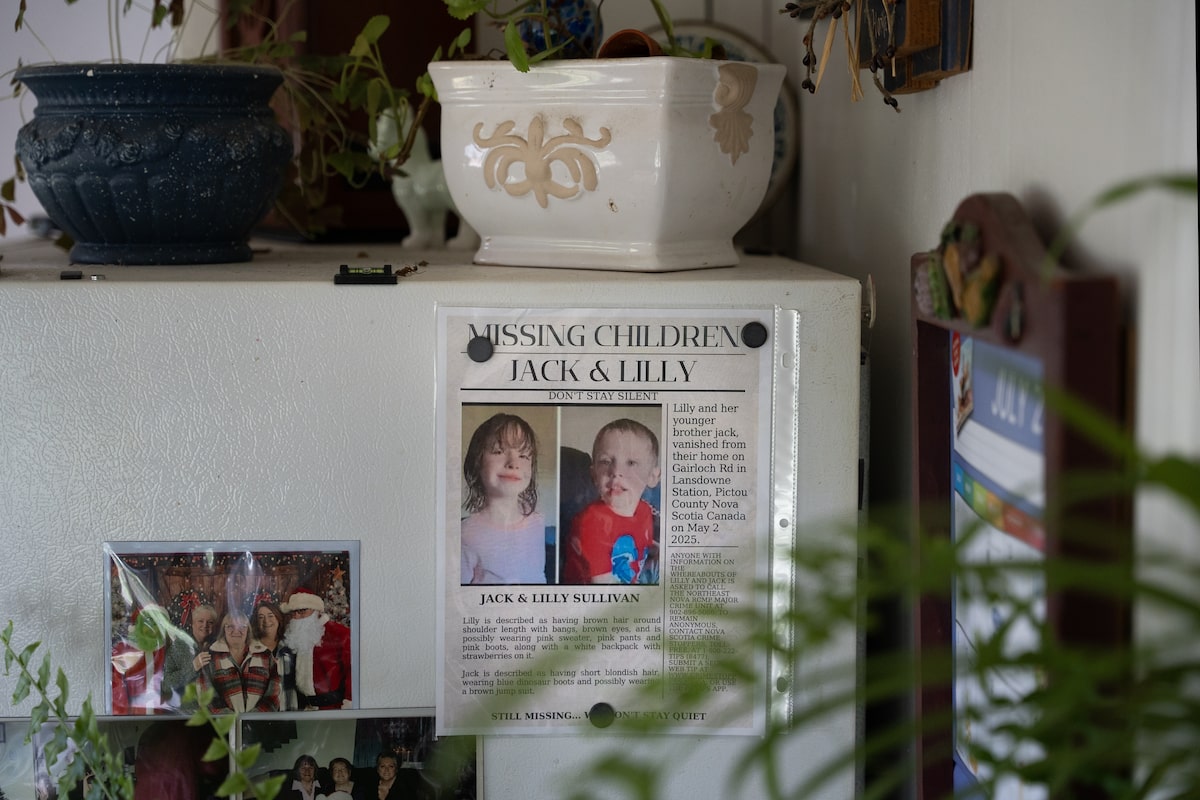
A notice of Jack and Lilly Sullivan, who remain missing since May 2, is seen on the fridge of Belynda Gray, the children’s paternal grandmother, at her home in Middle Musquodoboit, N.S., in August.Darren Calabrese/The Globe and Mail
The mother of Jack and Lilly Sullivan, the missing Nova Scotia children who disappeared more than eight months ago, told police in the early stages of the investigation that her common-law partner had, at times, been physically violent with her in the home, newly unsealed court documents show.
When RCMP major crime investigators asked the children’s mother, Malehya Brooks-Murray, whether her then common-law partner Daniel Martell was physically abusive, she alleged that “he would try to block her, hold her down and once he pushed her,” police wrote in an application to request records to help with their investigation into the missing children.
“She said he would also take her phone from her when she tried to call her mom, which would sometimes be physical and hurt.”
Mr. Martell, however, told police that the former couple yelled at each other when fighting, but there was no physical violence, the court documents show. He also told police they had been “recently fighting about money.”
Court documents reveal items seized and found by police during search for Jack and Lilly Sullivan
Mr. Martell denied the account of physical abuse that Ms. Brooks-Murray gave to police. “I did not ever abuse Ms. Brooks-Murray!!” he wrote in a text message to The Globe and Mail. He described the allegation as a personal attack that unfairly casts suspicion over him when he’s been the only one raising awareness about Jack and Lilly.
“If I remain in the public eye as a monster, the public’s choice is guilty until proven innocent!!” he wrote, adding that neither he nor his family had anything to do with the children’s disappearance.
The abuse allegation has not been tested in court and Mr. Martell has not been charged with any offence.
The documents show that Ms. Brooks-Murray told police about the alleged abuse during her fifth statement – almost a week after she broke up with Mr. Martell and moved away with their toddler.
The allegations were recently unsealed after a legal application by The Globe and CBC to a Nova Scotia judge to release more information concerning the early stages of the investigation into the children’s disappearance.
Daniel Martell holds photos of his stepchildren Lilly and Jack.Chris Donovan/The Globe and Mail
Lilly, 6, and Jack, 4, were reported missing by their mother and stepfather on the morning of May 2. Ms. Brooks-Murray called 911 around 10 a.m. to report they had wandered away while she and Mr. Martell were sleeping with their toddler at home in the remote hamlet of Lansdowne, N.S.
A massive search led by RCMP turned up few clues. Police have been tight-lipped about the case; however, they recently explained that the large volume of information they’ve gathered is helping form pictures of what may have taken place. They declined to share their theories.
In the early stages of the investigation, the RCMP made 12 applications in court, under the Missing Persons Act, but those applications were sealed by court order. At the request of the media outlets, the RCMP consented to release some information in August, but redacted significant portions of the affidavits. The Globe and CBC went back to court to argue in favour of lifting more of the redactions, and the RCMP consented to releasing more – but not all − of the information in the records.
One of the reasons cited by the RCMP for maintaining the redactions is the possibility that the investigation could turn criminal and that the release of such information could compromise an investigation.
“When an investigation is ongoing it is difficult to know what information, if made public, would compromise future investigative steps. While at this stage, we do not have reasonable grounds to believe a crime has been committed, that assessment could change as we move forward with our investigation,” wrote RCMP Corporal Charlene Curl in a Jan. 8 affidavit.
Corp. Curl said in the document: “The RCMP continues to explore all avenues and are leveraging technologically-based investigative police techniques which may provide information to support criminality and uncover the whereabouts of the missing children.”
The newly released information shows that investigators were focused on learning about the home life of Jack and Lilly in the early stages of their disappearance. The Globe previously reported on their family situation, including alleged coercive control that affected their mother, the parents’ financial struggles as well as admitted drug use by their stepfather, multiple black eyes on the children, and a visit from a provincial child protection social worker to investigate a report of abuse or neglect.
Ms. Brooks-Murray did not respond to a request for comment. Previously she has denied involvement in the children’s disappearance.
A growing memorial for the missing siblings outside the RCMP detachment in Stellarton, N.S., in June.Ingrid Bulmer/The Globe and Mail
Other information in the documents that is still sealed relates to the wording of questions asked of Jack and Lilly’s parents and others during polygraph tests. Cpl. Curl said she anticipates more people will be asked to do polygraph tests and if the exact wording is released, it could seriously risk the integrity of the results of any future tests.
RCMP and Ms. Brooks-Murray also opposed releasing highly personal information that pertains to Ms. Brooks-Murray and Mr. Martell’s relationship, parenting and financial situation.
Cpl. Curl wrote that despite intense media coverage and social-media speculation, the highly personal information to the best of her knowledge hasn’t been made public or confirmed by either Ms. Brooks-Murray or Mr. Martell.
“We want people who may be witnesses to feel comfortable coming forward and sharing information with us to assist investigations without fear that everything they say may become public,” she wrote.
Ms. Brooks-Murray opposed releasing her personal information because it’s “highly personal, biographical core information that reveals intimate details about her as a person,” wrote her lawyers Jennifer Cox and Samantha Allen in submissions dated Jan. 9.
Ms. Brooks-Murray, whose father is Mi’kmaq, is a member of Sipekne’katik First Nation. Her lawyers asked the court to consider harm to her dignity through an Indigenous lens, noting that anti-Indigenous stereotypes are pervasive and harmful.
“Releasing information about Ms. Brooks-Murray causes a greater affront to her dignity as it may breathe life into these stereotypes,” wrote Ms. Cox and Ms. Allen.
Mr. Martell did not take a position in court about the release of the information.