
Denmark delivered two significant messages to U.S. President Donald Trump on Wednesday.
The first came during a high-stakes diplomatic meeting in Washington, where top Danish and Greenlandic diplomats told Trump’s emissaries that under no circumstances will they permit the U.S. to acquire, control or otherwise take over the huge, ice-encrusted Arctic island that’s been part of the Danish realm for centuries.
“We still have a fundamental disagreement,” said Danish Foreign Minister Lars Løkke Rasmussen, who also served as Denmark’s Prime Minister for part of Trump’s first term in office.
“It’s clear the president has this wish of conquering … Greenland”
“Its important to work with the United States, not be owned by them,” said Greenland’s Foreign Minister Vivian Motzfeldt at a news conference at Denmark’s Embassy.
The Danish delegation was in Washington for a highly anticipated meeting with U.S. Vice President JD Vance and Secretary of State Marco Rubio.
While Trump has spoken frequently about wanting to take over Greenland, this was the first formal discussion of the topic since the U.S. captured Venezuela’s leader Nicolás Maduro, and Trump has declared that he intends to expand U.S. influence over the Americas.
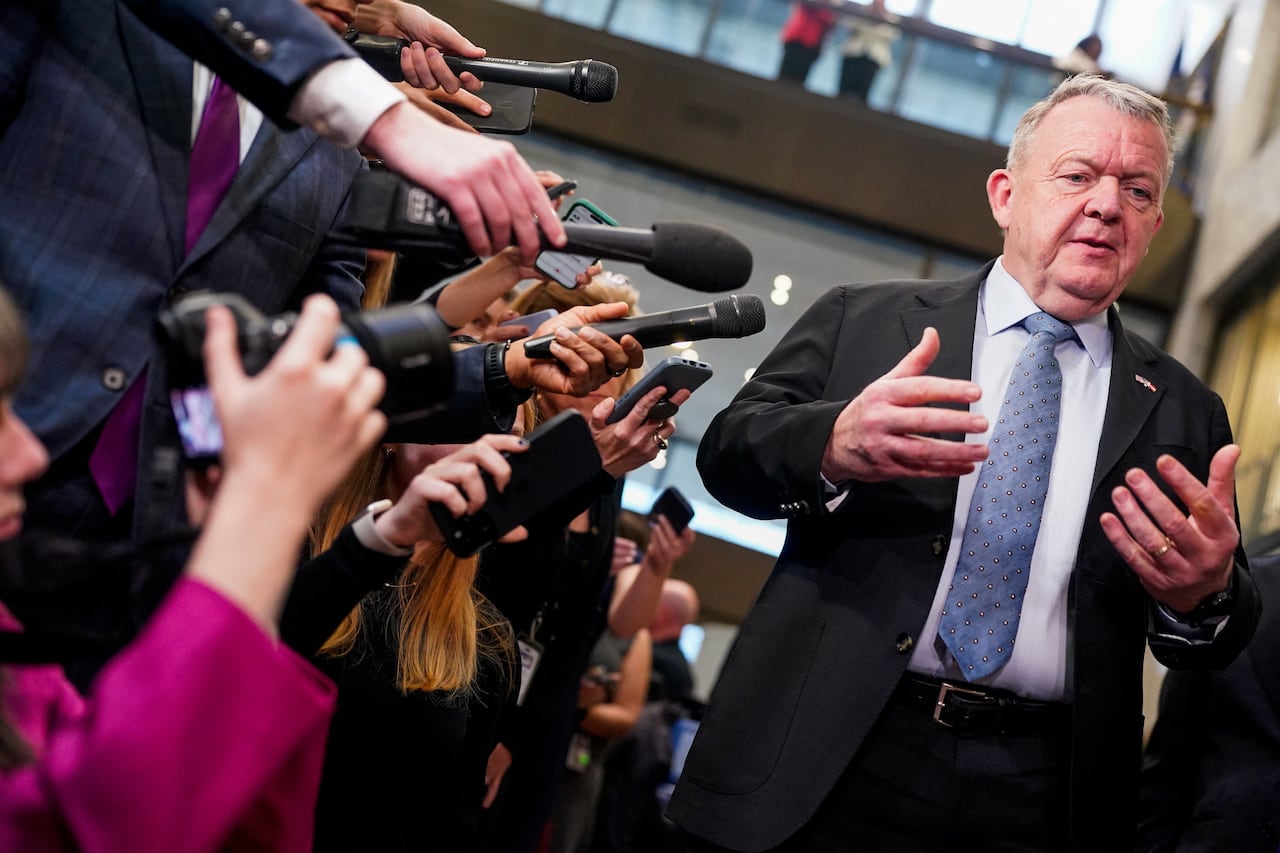 Denmark’s Foreign Minister Lars Loekke Rasmussen speaks with reporters after a meeting with U.S. senators in Washington on Wednesday. (Nathan Howard/Reuters)
He even refused to rule out using force to take Greenland.
The dispute has not only pitted formerly loyal NATO allies against each other, Trump’s incendiary statements have caused a crisis within the 76-year-old military alliance, prompting fears about its future.
‘Cool the temperature’
The Danes acknowledged they were unable to shift the Americans from their position during the meeting, but touted progress nonetheless by saying the U.S. has agreed to establish a working group to discuss common concerns.
“I hope it can cool the temperature,” said Rasmussen, noting that the upcoming meetings will take place in the coming weeks.
The second message Denmark sent Wednesday may have even deeper implications for NATO.
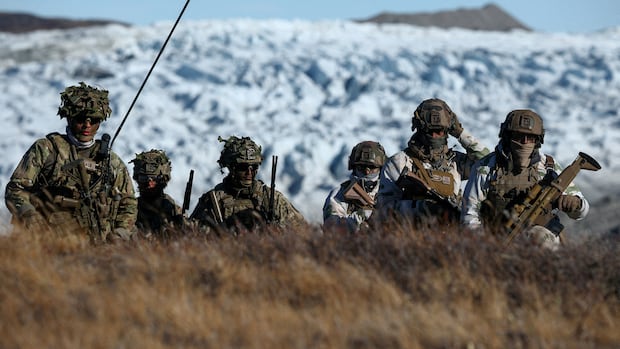
Denmark’s military announced it was sending more troops and equipment to Greenland, and that several other European nations — Germany, Norway and Sweden — will send military personnel as well.
WATCH | Trump threat to take Greenland could be test of NATO resilience but wouldn’t be first: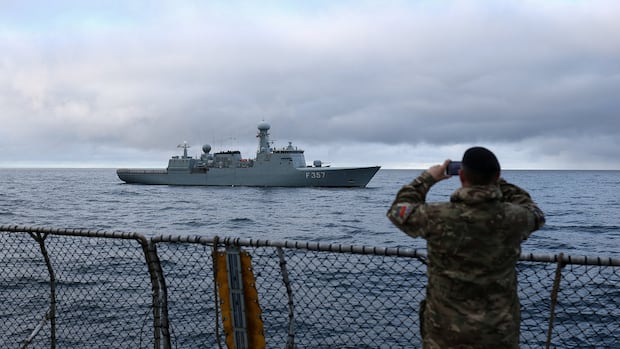
What happens to NATO if Trump grabs Greenland?
U.S. President Donald Trump’s threat to take Greenland could be a major test of NATO’s resilience, but it wouldn’t be the first. For The National, CBC’s Chris Brown explores what a hostile annexation of the semi-autonomous island could mean for the alliance.
The move could significantly raise the stakes for Trump should he even consider a military solution to bring Greenland under U.S. control.
“Geopolitical tensions have spread to the Arctic,” said a Danish government statement.
“From today, there will be an expanded military presence in and around Greenland — in close co-operation with NATO allies,” it continued, underscoring that the intention of the deployment is to “strengthen the alliance footprint in the Arctic.”
There was no mention that the deployment could also provide a form of deterrence against a U.S. military takeover, should Trump decide to go that route.
“The deployment of Danish and European forces shows us that we [Denmark] chip in concerning their [American] stated worries and it also raises the political cost for Trump invading,” Ulrik Pram Gad told CBC News in an email.
Gad is a researcher and political scientist at the Danish Institute for International Studies in Copenhagen, and was previously a government administrator in Nuuk, Greenland’s capital.
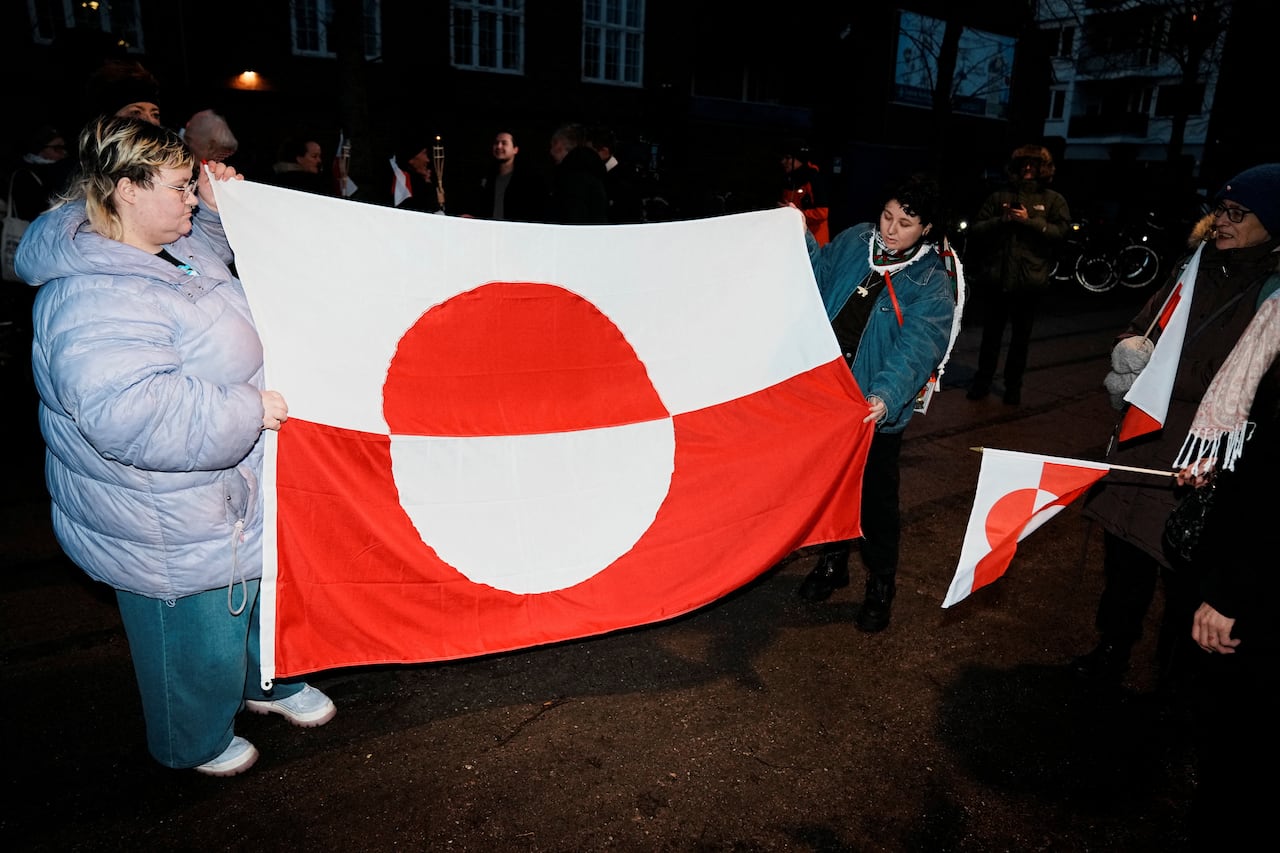 People hold up Greenland’s flag during a demonstration in front of the American Embassy in Copenhagen, on Wednesday. (Thomas Traasdahl/Ritzau Scanpix/Reuters)
In a news conference earlier Wednesday, Denmark’s defence minister dismissed the suggestion that the European troop deployment is intended to defend Greenland from the United States.
“I think that is a strong hypothetical question,” said Troels Lund Poulsen in Copenhagen. “I consider it unlikely that a NATO country should attack another NATO country.”
The U.S. forms the backbone of the alliance and provides the vast majority of its military, nuclear and logistical power.
Canada’s doorstep
While other observers also play down the likelihood of a real conflict, the fact that actual troop deployments are now taking place has significantly upped the stakes.
“This is happening off the coast of Canada — a third NATO ally, and Iceland, a fourth NATO ally — and in reality if we are taking the [NATO] treaty seriously, Canadian and Icelandic troops should be defending Nuuk if there was a hostile invasion,” said Anders Vistisen, a Danish member of the European Parliament who was speaking on CBC News Network.
“Just having the talk about doing this, we are jeopardizing the most important security structure that’s been put in place in our lifetime.”
WATCH | NATO’s secretary general pressed over Greenland question earlier this week:
NATO chief pressed on Trump’s push to control Greenland
NATO Secretary General Mark Rutte, speaking Tuesday at an event in Brussels, declined to comment on discussions between allies when asked to react to U.S. President Donald Trump’s repeated assertions that the U.S. needs to control Greenland, a semi-autonomous territory of Denmark.
Prior to the diplomatic meeting in Washington, Trump had been pushing tensions to the boiling point, releasing successive statements on social media claiming that U.S. ownership of the world’s largest island is imperative and non-negotiable.
“Anything less than that is unacceptable,” he wrote on Truth Social.
Later in an Oval Office news conference, Trump again made untrue statements that Denmark is only defending the world’s largest island with dog sled teams.
Denmark’s foreign minister said that he used the meeting with Rubio and Vance to push back against Trump’s false narratives.
“The Kingdom of Denmark has already stepped up our own contribution by committing additional funds for military capabilities,” said Rasmussen.
“Not dog sleds, but ships and drones and we are ready to do more.”
WATCH | No agreement on Greenland:
U.S., Denmark have ‘fundamental difference’ over Greenland: Danish foreign minister
Danish Foreign Minister Lars Løkke Rasmussen met with U.S. Vice-President JD Vance and Secretary of State Marco Rubio on Wednesday. Rasmussen said U.S. President Trump has a wish of ‘conquering’ the island.
Polymarket, an online prediction market where traders can make bets on real world events, put the chances of the U.S. acquiring portions of Greenland sometime in 2026 at 26 per cent, up from 15 per cent when the year began.
NATO boosters in Europe have reacted with dismay to Trump’s taunts and insults but believe the U.S. president can still be convinced to work with the alliance, rather than against it.
Denmark’s ‘red lines’
“We are preparing [contingency] plans for our adversaries, not our allies,” said retired Dutch admiral Rob Bauer, who was NATO’s most senior military officer until his retirement in 2025.
“I think NATO is too important for the United States, and therefore I cannot imagine that this will lead to an invasion of the United States in Greenland,” he said, noting that Europe’s military bases help the U.S. project its military might around the globe.
Bauer said he believes a strong show of NATO force in Greenland can help demonstrate to the Trump administration that the military alliance remains the most effective way of countering potential threats in the Arctic, including from adversaries such as China and Russia.
Bauer also noted that NATO has survived near-death experiences before, such as when France pulled out of the alliance’s military command in 1966, and that there was deep acrimony over the U.S. invasion of Iraq in 2003.
“This is the way President Trump, probably his whole life, has worked.
“It’s putting a lot of pressure on your opponent and then … slowly letting the pressure go and basically get what you want,” he said.
“So I think that’s still what we see here.”
Despite Trump’s threats and cajoling, the Danish delegation was measured in their comments as they left the U.S. capital, saying that the meeting “took place in a constructive atmosphere” and crucially, opened a forum to continue discussions in the days and weeks ahead.
Rasmussen, the foreign minister, said any outcome must respect his country’s “red lines” over Danish sovereignty of Greenland.
“Denmark and Greenland initially see this as a win, ” said Pram Gad, the Copenhagen analyst. “But let’s see if Trump wants to explode the situation with another tweet.”