
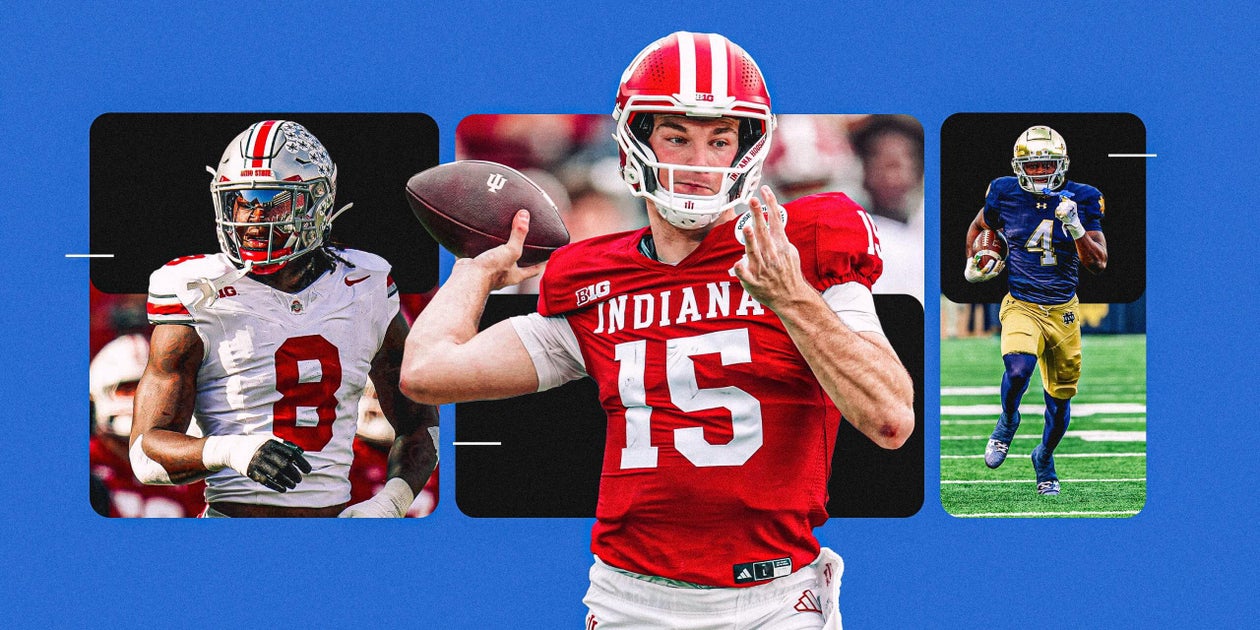
As happened last year with Cam Ward and the Titans, the No. 1 pick in the 2026 NFL Draft feels like it’s already locked up in January. But after that, things quickly become unclear.
Who will be the first non-quarterback drafted? How many QBs will end up in the top 32? Where is the potential for the first “whoa” moment in Round 1?
There are still several unknowns at this point, but we do have the draft order for the first 24 picks. We also know almost all the underclassmen who have officially jumped into the 2026 pool (Indiana and Miami prospects have until a few days after the College Football Playoff championship game to declare).
As always, this mock draft is based on early buzz from talking to people around the league, not my personal rankings or what I think teams should do.
1. Las Vegas Raiders: Fernando Mendoza, QB, Indiana
The Raiders have drafted a quarterback in the first round four times during the Super Bowl era. All four choices quickly backfired. JaMarcus Russell (2007) was out of the league after three years; Todd Marinovich (1991) lasted just two seasons with the organization; Marc Wilson (1980) won two Super Bowls with the Raiders, but he was a backup for both; Eldridge Dickey (1968) was moved to wide receiver.
That would be the history working against Fernando Mendoza. But, with his happy-go-lucky attitude, you know Mendoza would welcome the challenge. Though he might not be the physical freak some desire in a No. 1 pick, Mendoza is impressive in two key areas of playing the position: pre-snap recognition and accuracy. I don’t think there is much mystery with this pick.
2. New York Jets: Arvell Reese, edge, Ohio State
With Dante Moore returning to Oregon for the 2026 season, the No. 2 pick looks as wide open as I can remember.
Though it’s disappointing for the Jets that Moore isn’t on the board, it gives them an opportunity to select whomever they see as the best non-quarterback in the class — and Reese is a prime candidate. He played a hybrid role for the Buckeyes last season, mostly spying and setting the edge, but he was disruptive when allowed to use his speed and violence as a pass rusher.
3. Arizona Cardinals: Spencer Fano, OT, Utah
The Cardinals have a major question mark at quarterback, but the organization must also address a porous offensive line to protect whoever will be taking snaps. Paris Johnson Jr. is a building block at left tackle, but right tackle is a problem area as Arizona goes into the offseason.
Fano played right tackle throughout high school, moved to left tackle as a freshman for the Utes, then kicked back over to the right side and became a two-time All-American.
4. Tennessee Titans: Carnell Tate, WR, Ohio State
With their quarterback in place, the Titans can shift their focus this offseason to other needs, specifically pass catchers and pass rushers. I wouldn’t be surprised to see David Bailey taken in this spot, especially if Tennessee lands a veteran receiver such as Alec Pierce or Romeo Doubs in free agency.
But I love Tate’s potential fit with Cam Ward. He is productive in short-to-intermediate areas with his route precision and ball skills, and truly shines as a vertical ball-winner because of his pacing and tracking skills.
5. New York Giants: Jordyn Tyson, WR, Arizona State
The Giants will be drawn, understandably, to Caleb Downs’ potential impact on the back end of the defense, or to the chance to address their offensive line with Francis Mauigoa. But Tyson would add an immediate offensive playmaker who could help a young quarterback take the next step in his development.
Obviously, expected new head coach John Harbaugh will influence this selection.
6. Cleveland Browns: Francis Mauigoa, OT, Miami
The Browns need a complete makeover on the offensive line — and that is tough to do in a meaningful way without spending premium resources.
Some NFL teams have Mauigoa on their draft boards as a guard, but he has 33-inch arms and has been exceptionally consistent in pass protection all season for the Hurricanes. He has the highest floor of any offensive lineman in the 2026 draft class.
7. Washington Commanders: David Bailey, edge, Texas Tech
I understand the argument that the Commanders should lean offense with this pick to help their young quarterback. But their defense was atrocious this season, with a noticeable lack of juice, especially off the edges.
With his explosive twitch and raw power, Bailey is one of the most disruptive rush pieces that this draft has to offer.
8. New Orleans Saints: Jeremiyah Love, RB, Notre Dame
Three years ago, a different NFC South team (the Falcons) drafted running back (Bijan Robinson) at No. 8, and he quickly ascended to be one of the league’s top five players at his position.
We could see it happen again with the Saints and Love. With his pass-catching talent and home-run ability, Love would give Kellen Moore’s offense a shot of adrenaline.
9. Kansas City Chiefs: Caleb Downs, S, Ohio State
There certainly is a case to be made that a wide receiver (Tate, if he’s available) or tight end (Kenyon Sadiq) could be the weapon Kansas City has been desperately missing on offense. But Downs is a difference-maker, both with his impact on the field and within the culture of the team. One could argue that he is the best safety prospect since Eric Berry, a top-10 pick of the Chiefs 16 years ago.
10. Cincinnati Bengals: Rueben Bain Jr., edge, Miami
At this early juncture, defensive line is the overwhelming favorite to be the Bengals’ pick.
Because of his “tweener” skills and lack of length, Bain is one of the more polarizing prospects in this class. Even if he falls short in a few areas, however, he is a stout run defender with the relentless power as a pass rusher to kick down the door to the pocket.
11. Miami Dolphins: Jermod McCoy, CB, Tennessee
The Dolphins aren’t starting over from scratch, but with new general manager Jon-Eric Sullivan and a TBD head coach, it feels like anything is on the table in the draft. Considering that Sullivan came up through the Green Bay scouting system, Auburn’s Keldric Faulk fits the mold. An offensive weapon (Makai Lemon or Kenyon Sadiq) also makes sense. But cornerback has been a problem spot on this team for some time.
12. Dallas Cowboys: Sonny Styles, LB, Ohio State
The last time the Cowboys had multiple top-20 picks, in 2005, they went with two defenders (Demarcus Ware and Marcus Spears). That is the expected approach for Dallas in the upcoming draft, too.
At 6 feet 4 and 240 pounds with 4.5 speed, Styles is a freak of nature. He doesn’t miss tackles, and his read-react skills get better with every game.
13. Los Angeles Rams (from ATL): Mansoor Delane, CB, LSU
The Rams haven’t used premium draft picks to address cornerback in more than a decade — and it shows.
Delane lacks elite size and length, but he has the best tape among this cornerback class. In both man and zone, he plays sticky in coverage, with the route awareness that will make him an immediate contributor.
14. Baltimore Ravens: Vega Ioane, G, Penn State
Like last year when the Cowboys drafted Tyler Booker at No. 12, the Ravens selecting a guard wouldn’t get major headlines and might be unpopular with the fan base. But Ioane is a high-floor prospect and should be mentioned among the better players in this class.
The last time Baltimore held the 14th pick, in 2022, it drafted a “non-premium” position (safety Kyle Hamilton) — that has worked out just fine.
15. Tampa Bay Buccaneers: Keldric Faulk, edge, Auburn
Reminiscent of Mykell Williams from last year’s class, Faulk doesn’t have gaudy backfield production (five tackles for loss, two sacks in 2025), but he also wasn’t consistently asked to rush from a wide alignment in Auburn’s three-man front. At 6-6, 270 with long arms, Faulk creates movement with physical hands and detaches well in the run game. Teams will trust his traits.
16. New York Jets (from IND): Makai Lemon, WR, USC
The Jets have one legit starter (Garrett Wilson) on their wide receiver depth chart and desperately need to add another weapon who scares defenses.
Lemon won’t wow with his size or athletic profile, but he is a manipulative route runner and catches everything thrown his way. If the Jets think his impact can be anything close to what the Lions have gotten from Amon-Ra St. Brown, they should run the card to the podium.
17. Detroit Lions: Caleb Lomu, OT, Utah
It shouldn’t surprise anyone if the Lions address their offensive line early, although I am intrigued by which prospect Brad Holmes and Dan Campbell would see as the best fit.
I have questions about Lomu’s play strength, which might be an issue for this team in particular, but his above-average athleticism and processing will be strong selling points.
18. Minnesota Vikings: Kenyon Sadiq, TE, Oregon
If T.J. Hockenson is a cap casualty this offseason, tight end would move up the Vikings’ needs list.
Sadiq is a big, freaky athlete with the adjustment skills to make difficult catches look routine and the mentality to be an asset as a blocker. NFL teams believe he has the talent to be a top-10 pick.
19. Carolina Panthers: Peter Woods, DT, Clemson
To be serious contenders in the NFC, the Panthers need more impact players on the defensive line.
Woods didn’t have the 2025 season that evaluators expected, but he is a nimble big man with the agility to threaten gaps and chase the football. One would like to see more proof of concept on his tape, but the flashes show an ascending player.
20. Dallas Cowboys (from GB): Avieon Terrell, CB, Clemson
Terrell, the younger brother of Falcons cornerback A.J. Terrell, doesn’t have elite size — and it shows at times versus bigger targets. But he does have NFL-level athleticism and competes like a linebacker. Over the last two seasons, Terrell has combined for 25 passes defended and eight forced fumbles. He has a “Honey Badger” aura to him.
21. Pittsburgh Steelers: Ty Simpson, QB, Alabama
This is going to be a popular pairing in mock drafts over the next four months. The Steelers presumably will be looking for a starting quarterback this offseason, and Simpson is expected to land somewhere in the back half of the first round. Would this be the Kenny Pickett route all over again? Maybe. But Simpson processes his surroundings well, especially considering his meager starting experience.
22. Los Angeles Chargers: Brandon Cisse, CB, South Carolina
Cisse should be one of the “winners” at the combine, thanks to his explosive testing potential. The 6-foot, 190-pound corner shows an easy transition out of his pedal and has no trouble staying hip to hip with receivers, up and down the field.
The Chargers have a crowded cornerback room, but a lack of consistency could make the position an early target on draft weekend.
23. Philadelphia Eagles: Kadyn Proctor, OT/G, Alabama
At 6-7, 360, Proctor is a massive blocker with unique talent, which is exactly what the Eagles and offensive line coach Jeff Stoutland target up front. With Landon Dickerson’s future in doubt, and given Tyler Steen’s inconsistent play, Proctor would provide immediate competition at guard and a long-term option at tackle.
24. Cleveland Browns (from JAX): KC Concepcion, WR, Texas A&M
The Browns currently have a bottom-five wide receiver depth chart, so finding an upgrade should be a priority early in the draft.
Concepcion is a fluid, gliding athlete who specializes in getting open before the catch and creating after it. He would be an immediate starter (slot or Z).
25. Chicago Bears: Kayden McDonald, DT, Ohio State
General Manager Ryan Poles saw Ohio State in person multiple times in 2025, and it is fair to assume he came away impressed with McDonald (6-6, 330). The big nose tackle resets the line of scrimmage with explosive power and immediately finds the football to create congestion in the run game.
26. Buffalo Bills (12-5): Cashius Howell, edge, Texas A&M
We can all agree that the Bills must upgrade their defense in the draft. But the way in which they’ll do that is up for debate. One option would be to add an uber-athletic and competitive edge rusher, such as Howell, who might lack ideal size but can scream off the edge with bad intentions. Howell would be an immediate subpackage weapon while he pushes for an every-down role.
27. San Francisco 49ers: Monroe Freeling, OT, Georgia
Trent Williams is still playing at a Pro Bowl level but will be going into his age-38 season in 2026. At some point, the organization must plan for the future.
Freeling showed steady game-to-game improvement this season, turning himself into a top-50 NFL prospect. Given Freeling’s talent and upside, San Francisco would be an ideal landing spot for him to continue developing.
28. Houston Texans: Caleb Banks, DT, Florida
The Texans have one of the best defensive lines in the NFL, mostly because of their edge rushers. The defensive tackles have produced better than expected, but Houston would be strengthening a strength by investing more in its interior.
Banks missed most of the 2025 season with a foot injury, but at 6-6, 335, he is a disruptive presence who has yet to play his best football.
29. Los Angeles Rams: Emmanuel McNeil-Warren, S, Toledo
Doubling up at defensive back? We have seen the Rams do this before, like when they used top-40 picks on defensive linemen Jared Verse and Braden Fiske in 2024.
Delane (their earlier Round 1 pick here) would fill a hole at outside cornerback, and McNeil-Warren is the type of rangy presence who would upgrade the Rams’ safety room.
30. New England Patriots: Akheem Mesidor, edge, Miami
Yes, Mesidor is older (he’ll turn 25 in April), but he won’t need a ramp-up period as a rookie — Mike Vrabel could wind him up and cut him loose on Day 1. New England ranked in the bottom third of the league in sacks and QB hits and should continue to address its pass rush this offseason.
31. Denver Broncos: CJ Allen, LB, Georgia
Despite a defense that ranked among the best in the league (both stat-wise and according to eye test), the Broncos could look to upgrade at linebacker with a younger option in the middle of the field.
Allen is quick to key and diagnose with outstanding play speed, and he rarely misses tackles once he arrives at full-speed.
32. Seattle Seahawks (14-3): Colton Hood, CB, Tennessee
Keeping Washington wide receiver Denzel Boston in Seattle would make sense, but the Seahawks’ cornerback depth must be addressed this offseason.
The second Tennessee cornerback off the board in this mock, Hood is explosive and aggressive in his movements, and his route recognition continued to develop on his 2025 tape.
Teams without Round 1 picks47. Indianapolis Colts: R Mason Thomas, edge, Oklahoma
The Colts need more juice off the edge, which just happens to be Thomas’ specialty. Despite his lack of ideal size, his first-step burst and violent play style would be welcome additions as Indianapolis makes key changes on the defensive side of the ball.
48. Atlanta Falcons: Eli Stowers, TE, Vanderbilt
Considering that he’s on an expiring contract, Kyle Pitts picked the right time to have an All-Pro season. If the Falcons don’t re-sign or franchise tag him, they can take solace in knowing this draft is rich with tight end talent. Stowers will turn heads with his testing.
52. Green Bay Packers: Devin Moore, CB, Florida
The Packers don’t have a top-50 pick, so the pressure is on their scouting staff to nail both of its Day 2 selections. Moore is a verified 6-3, with 32-inch arms and the talent to cover receivers up and down the field.
56: Jacksonville Jaguars: Dillon Thieneman, S, Oregon
The Jaguars will be addressing the secondary this offseason in multiple ways, and Thieneman could be an option because of his man-coverage skills and run-stopping ability.