
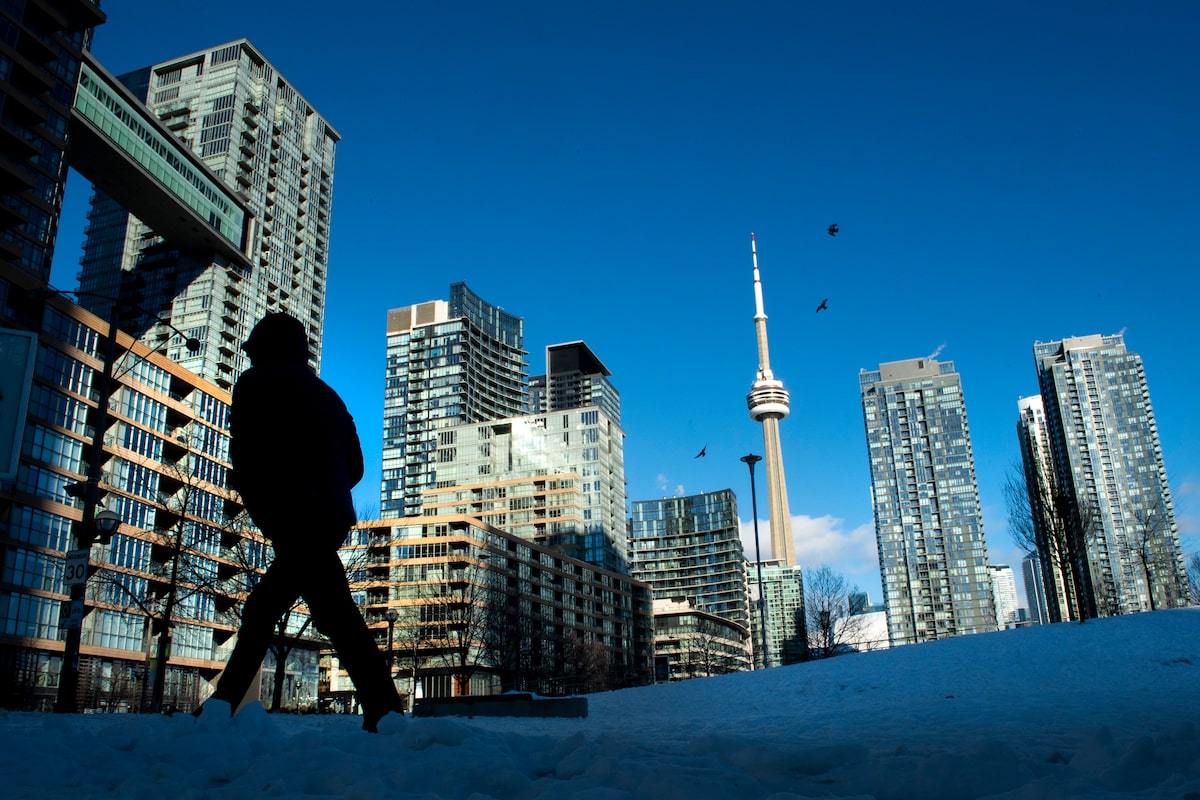
Condo sales in the Toronto area saw an uptick in December after November’s drop.Frank Gunn/The Canadian Press
Condos emerged as the surprising glimmer in a gloomy Toronto-area housing market in December, as the quietest year in residential real estate since 2000 wound down.
Daren King, senior economist at National Bank of Canada, notes that sales in the broader Greater Toronto Area market sagged in the final month of the year, but he attributes all of the decline to the non-condo segment.
Mr. King estimates that condo sales jumped 5.7 per cent on a seasonally adjusted basis in December from November.
That compares with a 2.5-per-cent dip in the single-family segment in the same period.
The uptick in condo sales followed a 7.4-per-cent drop in November from October.
Renovated downtown Toronto condo gets an offer in two weeks
Christopher Bibby, broker with Re/Max Hallmark Bibby Group Realty, says the condo segment appears more stable now after a turbulent three or four years.
“It’s a lot more predictable now than it was,” he says. “There’s a lot of data.”
Mr. Bibby, who concentrates his business in hard lofts and the upper tiers of the condo segment, noted his team’s condo listings shrank to 27 from 36 in the final weeks of 2025.
He also senses that negotiations have become more civil in recent months as the downturn lingers on.
“We all need each other,” he says. “My objective every time is to keep everyone at the table. We don’t have to walk away and play all these games.”
This penthouse near St. Lawrence Market sold for $1.050-million.Re/Max Hallmark Bibby Group Realty
In the Entertainment District, for example, Mr. Bibby sold a two-bedroom penthouse at 438 King St. W for $1.275-million after listing the unit with an asking price of $1.375-million.
Another penthouse in the St. Lawrence Market area sold for $1.050-million after Mr. Bibby listed the two-bedroom unit at 230 King St. E with an asking price of $1.125-million.
Looking at the end of 2025, Mr. Bibby says baby boomers and empty nesters were less active in buying condos. Many failed to sell their large homes and had to pull them from the market.
“I think these downsizers are in a jam,” he says, noting that prices have dropped significantly in the segment for detached houses.
As a result, more clients are selling an existing property before they look for a new one.
“People sell first so they’re not in any financial difficulty, then take the proceeds and shop.”
Among sellers, it’s common knowledge that the market is going through a correction but some remain mired in the past.
“The numbers need to reflect what the buyers are willing to pay.”
In one case, Mr. Bibby listed a condo unit with an asking price of $2.795-million. The seller rejected an offer for $2.6-million.
The unit languished and eventually the seller listed with another agent. Mr. Bibby later saw that the unit sold for $2.25-million.
BMO economist says real estate has entered a ‘slow grind’ toward affordability
Looking at the broader market in 2025, sales in the GTA dropped 11.2 per cent from a sluggish 2024, according to the Toronto Regional Real Estate Board.
Mr. King at National Bank points out that 2025 began on a note of optimism among industry players, who expected buyers to return to the market after the Bank of Canada began a series of interest rate cuts in June, 2024.
As it turns out, active listings swelled by 10.5 per cent in 2025 from the previous year.
In Mr. King’s view, lower borrowing costs have been offset by unaffordable homes, trade tensions with the United States and a significant drop in population growth.
Frances Donald, chief economist at Royal Bank of Canada, cautions that the country’s affordability pressures aren’t going away.
Prices for essentials – including food and housing – have far outpaced wage growth, she notes.
She is forecasting that the rate of inflation will moderate to just above two per cent, the unemployment rate will likely improve and house price growth will ebb.
Against that backdrop, broker Patrick Rocca of Bosley Real Estate is surprised at how pragmatic some sellers have become.
In one case, a homeowner suggested an asking price below the amount Mr. Rocca recommended.
“I told him the number, and he actually wanted to go a little lower.”
Patience pays off for seller of North York home
While many sellers are reasonable when it comes to current prices, others argue that their property is an exception.
Mr. Rocca met with one homeowner in late November and advised him that his semi-detached house in midtown would fetch approximately $2-million. He suggested listing in the early spring.
Instead, the homeowner listed in mid-December with an agent from outside the area and an asking price just under $2.3-million.
The house was still on the market in the second week of January.
The risk of setting the price too high is that the tactic “burns” the listing and house hunters won’t book showings, he warns.
“When I have those conversations, they’re not getting it – and they’re going to lose more.”
The condo segment appears more stable now, said Christopher Bibby, broker with Re/Max Hallmark Bibby Group Realty.Re/Max Hallmark Bibby Group Realty
In some cases, Mr. Rocca says, it is the buyers who have unrealistic expectations.
Mr. Rocca listed one property with an asking price slightly above $1.4-million, which was well below the price comparable properties had sold for in the past.
“A buyer came in with a ridiculously stupid offer,” he says of the bid about $200,000 below asking.
The seller signed back a counter-offer, but the buyer refused to come up by more than $25,000.
The chasm was too wide and the two sides were not able to reach an agreement.
Mr. Rocca pulled the listing for the holidays. He plans to bring the property back to the market later in January.
Could this Toronto couple find a detached home with transit access on a $1-million budget?
Some buyers are offering far below asking as a buffer against the risk that prices will fall farther, he explains, but they are walking away from deals with realistic sellers.
Buyer confidence remains low, he adds.
“I think it’s going to be a really dicey year.”
Some homeowners wonder if they should list this year or wait for stronger prices in the future.
“Sell when it’s right for you and be realistic,” Mr. Rocca recommends. “If you’re hanging on, hoping for a rebound, that could be a couple of years. If you think 2022 is coming back – we may never see that again,” he says of the peak set that year.
As for whether the recent sales spurt in the condo segment will continue, Mr. Bibby says the outlook remains unpredictable.
In the recent past, any positive news has brought sellers – not buyers – out of the woodwork, he notes.
“If you’re going to wait until things are better, everyone else is going to do that too.”