
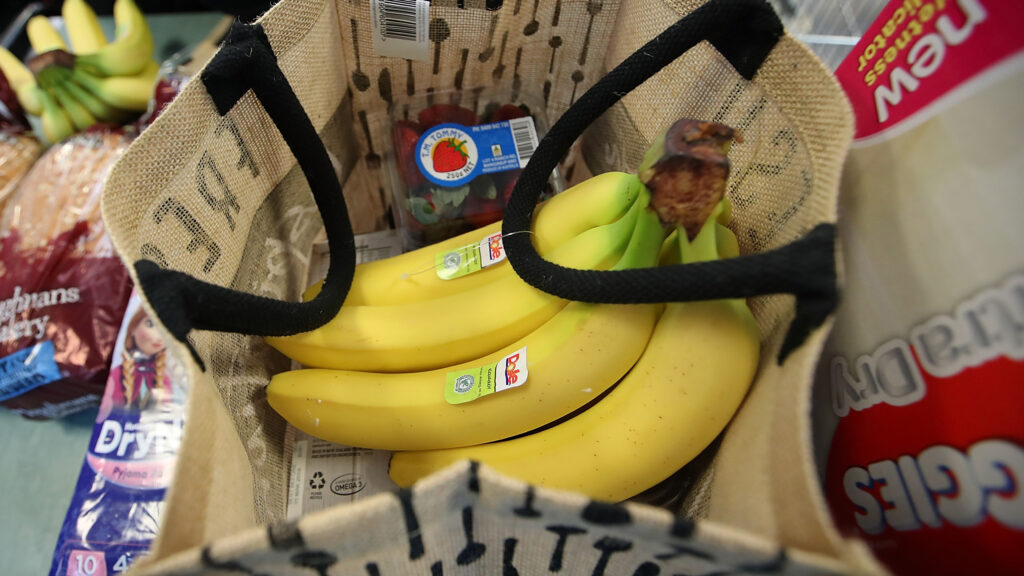
How easy is it to make a healthy dinner for $3?
When the new U.S. dietary guidelines came out last week, food economist William Masters emailed a few colleagues with a fun exercise — or at least what passes for fun among economists. (It was, after all, a spreadsheet.) The challenge: Design your own diet to figure out how affordable, and healthy, following the new guidelines would actually be.
The question of affordability, now a major political buzzword, is top of mind for Make America Healthy Again leaders and critics alike as President Trump and Democrats debate higher costs of living and who’s to blame for them. Trump administration officials have been promoting the new guidelines, which emphasize protein more than previous versions and for the first time urge Americans to limit or avoid ultra-processed foods, as healthier than previous versions as well as budget-friendly.
For three dollars, Americans could create a meal using “pork, or eggs, or whole milk, or cheese, tomatoes, other fresh and frozen fruits and vegetables, whole grain bread, corn tortilla,” agriculture secretary Brooke Rollins said at a news briefing after the guidelines’ debut. Calley Means, special adviser to health secretary Robert F. Kennedy Jr., shared a post on X comparing the cost of two Walmart grocery hauls — with a guidelines-approved basket featuring ground beef and full-fat yogurt coming out cheaper than one stocked with ultra-processed foods the guidelines discourage.

How saturated fats lost, and won, on new food pyramid
At the same time, some nutrition experts have criticized the prominent placement given in the guidelines to beef and beef tallow — foods that are not only higher in saturated fat, but also more expensive than chicken and plant-based sources of protein like beans and tofu.
Both camps have valid points, according to food economists and nutrition experts who spoke with STAT. Overall, the MAHA agenda of eschewing ultra-processed foods is an affordable one, said Masters, a professor at Tufts University. “When you choose the least expensive options in food groups to meet dietary needs, you go with whole foods,” he said. Plain dairy products, canned beans, and tinned fish, all items featured on the new food pyramid, pack a lot of nutrients at a relatively low cost.
On the other hand, Masters noted, the pyramid also features pricey shrimp and ribeye steak at a time when beef prices are at an all-time high, up 16% from a year ago. And the guidelines’ recommendations that people more than double their protein intake compared to previous standards would likely increase spending, said Joelle Johnson, deputy director for healthy food access at the Center for Science in the Public Interest.
“That recommendation, along with choosing higher-fat dairy, would likely have the biggest impact on a person’s food expenses if they were to follow it,” Johnson said via email. “Doubling your intake of beans and lentils might not be felt in the budget the same way that doubling meat or seafood would be, but the 2025 DGA fails to message this point effectively, and does not address how consumers should consider affordability or the relative price of foods in choosing which protein foods to eat more of.”
Ultimately, the costs and nutritional impact of the new guidelines vary based not just on where Americans live and shop, but how each individual might interpret the new guidelines. Still, as a thought exercise, STAT found a food economist and registered dietician who used Masters’ spreadsheet to calculate the costs of a couple versions of a MAHA diet — both financially and nutritionally. To understand the results, it’s helpful to take a step back to explain what nutrition experts mean when they talk about affordability, and why it matters for Americans’ health.
What affordable food really means in the U.S.
Food prices are up 27% compared to five years ago, said Michigan State University food economist David Ortega — putting many Americans strolling the aisles of their local grocery stores into a permanent state of sticker shock. Forces including the Covid-19 pandemic, bird flu, droughts, tariffs, Russia’s invasion of Ukraine, and flesh-eating screwworms, among others, have all combined to increase the cost of beef, eggs, and other sundries.
Prices today aren’t rising as much as they were. But economists don’t expect grocery bills to go back to pre-pandemic levels, since generally, the prices consumers pay aren’t out of line with the costs of production. “They’re expensive because labor, rent, and [other costs] are expensive,” said Masters.
What a person considers affordable will depend on their income. In the U.S. in 2023, the lowest-income households spent about $14 a day on food, while middle-class households spent $25 and the highest-income households spent $47, according to government data. People on food benefits, meanwhile, receive an average $6 a day to spend on food per person.
Affordability is also about more than how much you pay at the grocery store, say nutrition experts.
“When you’re trying to assess the cost of whether people can afford food, the most important is the time cost” — how much time people spend planning meals, acquiring ingredients, and preparing them, said Jerold Mande, who worked as a policymaker under three presidential administrations and currently heads the nonprofit Nourish Science.


STAT Plus: Panel behind new dietary guidelines had financial ties to beef, dairy industries
A one-pound bag of dried chickpeas, for example, is both nutritious and cheap — less than $1.50 at Walmart. But before they’re ready to eat, they have to be soaked for at least an hour (some prefer overnight), then cooked a couple hours on the stove over low heat, then combined with other ingredients — presumably ones that require some preparation of their own — into a complete dish.
That’s a lot of time and effort, plus even more time getting the chickpeas in the first place — particularly if, like 6% of Americans, you happen to live in a food desert.
It’s true that there are plenty of nutritious meals with protein, whole grains, and produce that can be prepared relatively cheaply and quickly. But it’s also easy to see why a busy family juggling work, school, and childcare might grab some frozen pizza instead. “Maybe a meal can cost three dollars, that’s not inherently a wrong statement,” said Ortega. “But those types of calculations often rely on best-case scenarios that don’t reflect how many households actually eat.”


Sign up for Morning Rounds
Understand how science, health policy, and medicine shape the world every day
That’s why affordability is such an important issue when it comes to Americans’ health, he said. “When budgets are tight, households substitute toward foods that minimize both money and time costs,” he said. “That often means more ready‑to‑eat and ultra‑processed options, which can be higher in sodium, added sugars, and saturated fats.”
Amelia Finaret, a clinical dietician and food economist at Allegheny College, notes that there’s another, less direct concern when it comes to affordability: “Sometimes, more affordable items don’t taste as good to us, such as the difference between fresh and canned vegetables, which could make it less enticing to include our vegetables if we need to go with the more affordable option.”
All this means that in the fight against chronic disease, diets that are affordable as well as nutritious are a key part of the equation.
The cost of MAHA’s new protein recommendations
Many experts cheered the guidelines’ strong stance against ultra-processed foods from both an affordability and nutrition perspective, with Masters praising the administration’s apparent willingness to stand up to major food manufacturers “who had prevented any kind of full-throated recognition that some of these heavily marketed, highly-processed foods are really harmful.”
There are other bright spots, too. The new food pyramid features a bag of frozen peas. Frozen vegetables are often cheaper than their fresh counterparts, and “avoid the high sodium in many canned products and have the virtues of nutrient density and freshness as well as convenience,” Masters said.
The guidelines also directly influence the food served in U.S. schools, and Mande is optimistic about how that may play out. “They kept the 10% saturated fat cap, and they’re saying you need to eat less refined grains and more protein,” he said. If schools have to increase protein and reduce refined carbohydrates while taking costs into account and abiding by the limit that saturated fat make up no more than 10% of daily calories, he said, the only path is to use more plant protein.
I’m a designer. The new food pyramid is outdated and confusing
On the other hand, Finaret of Allegheny College worries about people spending money on protein they don’t need. “Most adults who are not critically ill and who are not elderly and losing muscle mass don’t need more than about 0.8-1 gram per kilogram of body weight,” she said. The new guidelines recommend 1.2-1.6 grams of protein per day per kilogram of body weight. (For a 150-pound person, that would be 109 grams of protein at the high end of the range, equivalent to about 18 eggs or four chicken breasts.) But unlike fats or carbohydrates, “we can’t really store protein in our bodies,” Finaret said. “I don’t know where all this protein is going to go or why you would buy it, because it seems pretty wasteful.”
Another concern, she said, is that the new dietary guidelines lower the recommended amount of carbohydrates, which means people may miss out on affordable, high-fiber whole grains like whole wheat, quinoa, brown rice, and buckwheat. If people don’t get enough fiber, she said, “we’re all going to be constipated and sad.”
Eating by the new food pyramid
Finaret was game to test out the new MAHA guidelines using Masters’ spreadsheet, which tallies up the cost per day of a diet that aims to meet daily recommendations for nutrients like protein, fat, fiber, and calcium. It’s based on online grocery prices at Stop & Shop in Boston, which he often used as a classroom exercise for helping his students at Tufts University understand the costs of adequate nutrition.
In designing two versions of a daily diet for a 30-year-old woman, Finaret explained, “I tried to meet the new protein guidelines and have two servings of fruit, three servings [of] veggie, and three servings [of] whole grains, just like the new pyramid advises.”
For her first version, she said, she wasn’t trying to keep costs as low as possible — just choosing foods she thought she’d like to eat. She included servings of beef and blueberries, and aimed for about 90 grams of protein based on the new recommendations. (“Far more than I need,” she said; she needs about 50 grams.) She also chose chicken breasts over the cheaper chicken thighs. Her total cost per day: $8.59.
The second time, she tried to keep costs down as much as she could while staying within the guidelines’ recommendations. She chose canned tuna and chicken thighs, apples and bananas, frozen peas, cabbage, and canned green beans. Total cost: $5.08.
Nutritionally, Finaret said, there was at least one big problem. She wasn’t getting enough energy (she’d need around 2,300 calories) to maintain her body weight. “Two to four servings of grain is insufficient,” she said. “I don’t think people know how small a serving of grains is” — equivalent to one slice of bread, or six Triscuits. She also wasn’t getting enough fat with her sample diets, though that’s likely more about the selection of lower-fat meats on the spreadsheet than the new guidelines themselves.
The more expensive diet did a better job of meeting her micronutrient needs, though vitamin E and calcium were still pretty low.
Overall, Finaret wouldn’t recommend that her patients adhere strictly to the new guidelines, especially because of their emphasis on animal proteins and her concerns about relying too much on produce rather than whole grains for fiber. Also, she said, “I wouldn’t be able to ask my patients to spend that much money.” If one person is spending $8.58 on food each day, she said, for a family of five, that’s $300 a week. That’s a lot for people on a budget.
Finaret sees patients in rural Pennsylvania, in an area with a 22% poverty rate. They’re often worried that they need to be spending more money to eat meat with every meal, and are relieved when they learn that’s not necessary, she said. Now she worries they’ll feel pressured to seek out protein from animal sources rather than plants, which are “really under-emphasized in the new guidelines,” she said.
The good news, she said, is that most people can spend less food and have healthier diets in the process, particularly if they focus on plant-based proteins like beans. That’s especially true if people stop spending so much money on unnecessary supplements and alcohol. Notably, the new guidelines actually feature weaker language about limiting alcohol consumption.
The upshot, according to Masters, is that some parts of MAHA’s new guidelines are both affordable and nutritious, and some aren’t.
“That’s a characteristic feature of the movement, “ he said, “where it’s rebelling and declining to follow consensus. Sometimes that provides a breakthrough that’s really helpful, and sometimes it’s just incorrect.”
STAT’s coverage of chronic health issues is supported by a grant from Bloomberg Philanthropies. Our financial supporters are not involved in any decisions about our journalism.