
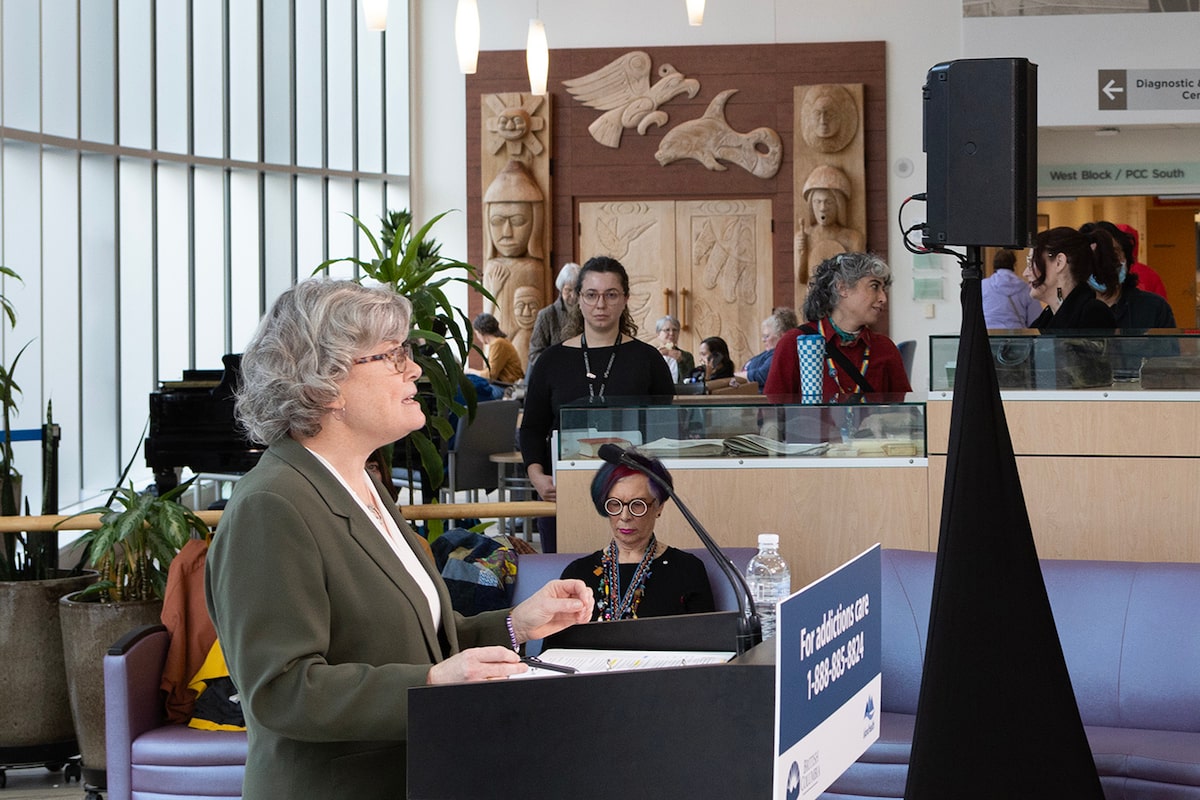
B.C. Health Minister Josie Osborne provides an update about addictions care and the end of the decriminalization pilot project at the Royal Jubilee Hospital in Victoria on Wednesday.CHAD HIPOLITO/The Canadian Press
B.C. First Nations groups say they were excluded from the provincial government’s decision to end its drug decriminalization pilot program, despite the policy’s disproportionate impact on Indigenous people.
The First Nations Health Authority (FNHA), which was an active partner on B.C.’s decriminalization core planning table, said it respects the need for evidence-based policy adjustments when addressing the province’s toxic-drug public health emergency.
But “as a health system partner to the provincial government, we are disappointed that FNHA was not engaged in a decision that will disproportionately impact First Nations people, communities and families,” the health authority said in a statement.
The BC First Nations Justice Council, which also contributed to the core planning table, was likewise not engaged in the decision-making process.
Decriminalization supporters question B.C. drug study that links policy to overdoses
Judith Sayers, a BCFNJC board member and the council’s lead on policing, oversight and accountability, said it was disappointing for the province to make such a decision unilaterally.
“We try really hard to build our relationship with the province,” said Dr. Sayers, who is also president of the Nuu-chah-nulth Tribal Council.
“We meet bi-monthly with the Attorney-General, we try to be upfront and honest about the things that we’re working on, and they know this is one of our priorities: over-incarceration. So I really wonder about the strength of our relationship, if we can’t be told this.”
Dr. Sayers said she would have liked to see drug decriminalization made permanent, with evaluations and amendments to the policy as necessary.
Meanwhile, the Union of BC Indian Chiefs said it is “extremely concerned” with the decision to end the pilot. Instead of fully resourcing the initiative, “the province weakened it through policy rollbacks in 2023, and again in May 2024, including recriminalizing possession in public spaces,” and failed to implement the comprehensive supports required for success, the group said in a statement.
UBCIC President Grand Chief Stewart Phillip said that, by ending decriminalization, the province is failing to treat addiction as a public-health issue.
“Arresting and criminalizing individuals who need care and support will not save lives, it will only deepen trauma, reinforce systemic racism in policing, and widen the disproportionate gaps in health and justice outcomes for First Nations,” he said in a statement.
B.C. Health Minister Josie Osborne announced Wednesday that the province would not seek to renew its exemption from the federal Controlled Drugs and Substances Act, which allowed the province to run a three-year trial decriminalizing possession of up to a total of 2.5 grams of opioids, cocaine, methamphetamine and MDMA for people 18 years and older. The exemption came into effect on Jan. 31, 2023, and expires at the end of this month.
Ms. Osborne said the pilot “hasn’t delivered the results that we hoped for,” and that complaints about public drug use, and feelings about public safety, also factored into her government’s decision.
A Ministry of Health statement provided to The Globe and Mail on Thursday said that Indigenous partners and communities have been key stakeholders over the past three years as the province gathered information on the pilot.
“The Ministry of Health has started the process of notifying stakeholders including municipalities, Indigenous partners and communities, health authorities, substance use service providers, housing sites, people who use drugs and others of the decision not to renew the exemption,” the statement said.
André Picard: What has three years of decriminalization of drug possession yielded in B.C.?
On the same day as Ms. Osborne’s announcement, Statistics Canada released a report saying that Indigenous adults were incarcerated at a rate 10 times higher than non-Indigenous adults – a finding that BCFNJC Chair Kory Wilson called “staggering, but not surprising.”
The report used data from six reporting provinces (B.C., Alberta, Saskatchewan, Ontario, Prince Edward Island and Nova Scotia) and found that the overrepresentation of Indigenous adults in custody increased each year from 2019/2020 to 2023/2024.
Indigenous adults accounted for one-third of the custodial population in federal and provincial facilities in 2023/2024 despite representing just 4.3 per cent of the adult population.
“The causes of overrepresentation are complex and interconnected, though indisputably linked to colonialism, displacement, socioeconomic marginalization, intergenerational trauma and systemic discrimination,” the report said.
Meanwhile, FNHA data from January to June, 2025, found that First Nations people died from illicit drugs at 5.4 times the rate of other British Columbians.
Ms. Wilson said incarceration is a costly response to nonviolent offences that offers little rehabilitative benefit. With the end of drug decriminalization, the province should explore other alternatives to the justice system, she said.
In Prince George, the justice council is piloting an Indigenous Diversion Centre, which offers pre-charge diversion for Indigenous adults accused of certain minor, nonviolent offences, such as drug possession, theft or mischief. Voluntary participants complete a 90-day program focused on addressing the root causes of their offending, with supports such as ceremony, clinical counselling and social workers; upon completion, no charges are laid.
Ms. Wilson said something similar could be trialled in Vancouver or Surrey.
“We have the opportunity to make authentic, systemic change,” she said.