
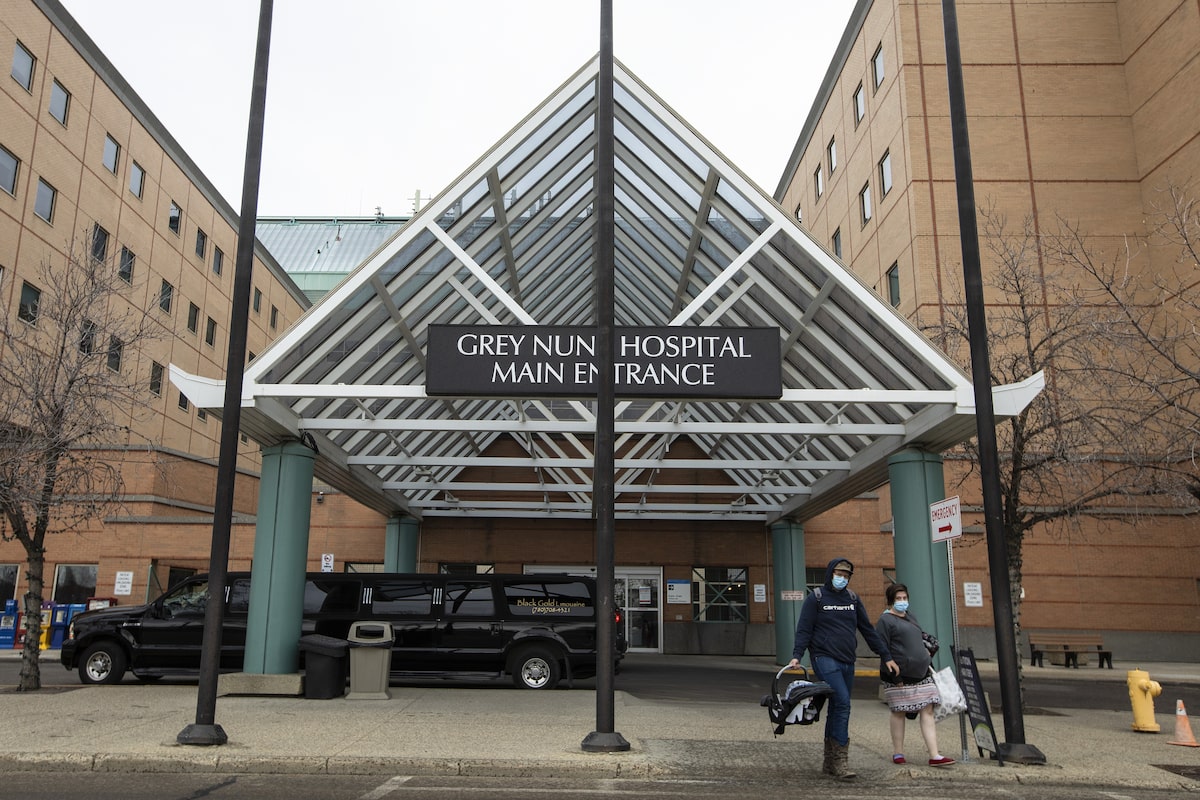
Grey Nuns Hospital in Edmonton in May, 2021. Prashant Sreekumar died after eight hours in the hospital’s emergency department in December, 2025.JASON FRANSON/The Globe and Mail
At least six preventable deaths and more than 30 “near-misses” occurred in Alberta emergency departments since the beginning of the year because of overcrowding, according to documents obtained by The Globe and Mail.
Concerns about patient safety in provincial EDs have been front and centre for weeks in the wake of the highly-publicized case of Prashant Sreekumar, who died on Dec. 22 after eight hours in Edmonton’s Grey Nuns Community Hospital ED. The documents further highlight how overcrowding has hindered patient care.
“Our provincial hospitals and EDs have never been this overcrowded or unsafe,” wrote Paul Parks, president-elect of the emergency physicians section of the Alberta Medical Association, in an e-mail to government officials on Jan. 12, which included the list of “suboptimal cases” in an attachment.
“These examples originate from major EDs across the province and represent only the tip of the iceberg regarding the severe overcrowding our hospitals face daily.”
Dr. Parks sent the e-mail to Matt Jones, Alberta Minister of Hospital and Surgical Health Services, and leaders of Acute Care Alberta, including chief executive David Diamond and chief medical officer Aaron Low. He copied colleagues at the AMA.
Alberta to order inquiry into case of man who died after eight hours in emergency room
Senior with influenza waited 90 hours in Edmonton emergency department, family says
Among the anonymized cases, which were collected by the AMA section of emergency medicine, was a man in his 50s who appeared weak and was short of breath, but left an ED without being seen after about eight hours. He arrived at the hospital the next day by ambulance, suffered cardiac arrest and was admitted to intensive care with a serious bloodstream infection. He eventually died owing to multiorgan failure.
“This is a tragic case where the patient would likely still be alive had he been seen more urgently at his first presentation,” according to the document.
Physicians working in Edmonton’s major hospitals recently called on the province to declare a formal emergency because there is no more space to safely accept patients. On Thursday, Mr. Jones acknowledged hospitals are under “extreme pressure” and announced a new physician role to help triage and care for patients in Calgary and Edmonton EDs, beginning in February.
Other preventable deaths detailed in the document included a female patient who had a delayed diagnosis of bowel obstruction and became septic; a patient who suffered cardiac arrest in a hallway and had not been assigned to a nurse; and another person with kidney failure who remained in an ED for nearly 24 hours but died waiting for a general medicine assessment.
“We wonder how many ‘ticking time bombs’ will drop dead when they should be receiving life-saving care in a functional emergency space,” the document stated.
Dr. Parks, in his e-mail, said he shared the list of recent deaths and close calls in EDs to spur clarity on the provincewide crisis. He also pushed the government to clearly identify who is in charge of the provincial response and for additional mitigation strategies to be employed.
Reached by The Globe on Friday morning, Dr. Parks confirmed that he sent the document to government officials, adding that he has yet to receive a response. He said the document has additionally been sent to Premier Danielle Smith and Adriana LaGrange, Minister of Primary and Preventative Health Services.
Kyle Warner, press secretary to Mr. Jones, said in a Friday statement that the minister has reached out to the AMA for a meeting with Acute Care Alberta.
“He wants to ensure a shared understanding that the system is under exceptional strain, is responding as it has in past years, and requires additional resources beyond flu season,” said Mr. Warner.
The province has previously pointed to influenza season as the major contributor to hospitals being overrun. But physicians have said the problem is not new and is related to other issues, such as rapid population growth and underfunding of the health system.
Another portion of the document lists high-stakes diagnoses that were delayed in waiting rooms, increasing those patients’ chances of death. More than 30 cases of patients with a range of conditions such as septic shock, pneumonia, delirium and a ruptured spleen, were referred to as “near-misses.”
Among them was a young individual who was not considered high-priority and waited six hours to be examined. It was later revealed that the patient had an aortic dissection, which is a tear in the inner layer of the aorta, and could have “easily coded and died” in the waiting room.