
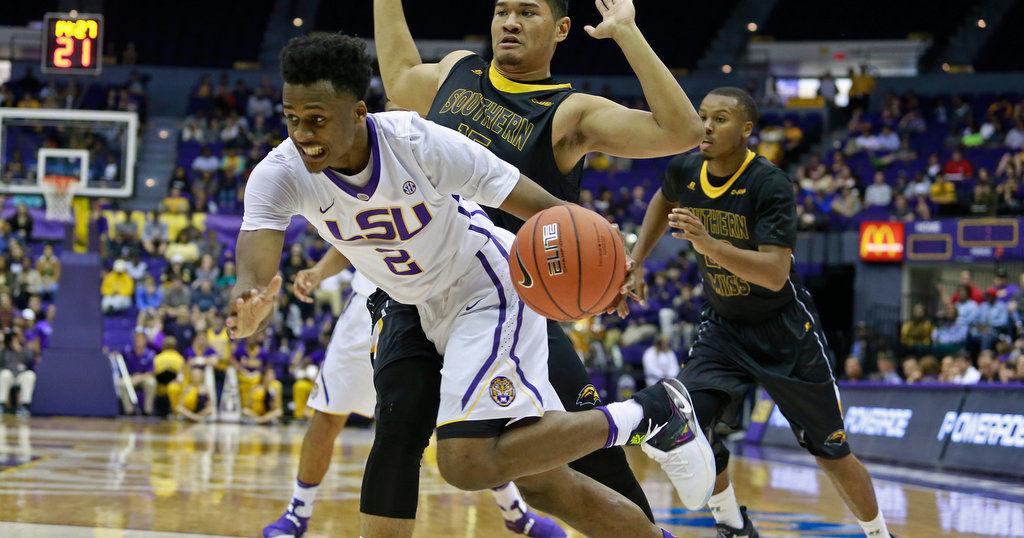
In early 2023, former LSU guard Antonio Blakeney — then playing in the Chinese Basketball Association — went on a five-game tear.
He averaged 28 points on about 22 shot attempts a game, capped by a 44 point, 10 rebound performance. His prolific scoring abilities had helped him get named a McDonald’s All American in high school, and he later was named a member of the All-SEC Freshman Team. After his sophomore year at LSU, he declared for the NBA draft.
But after his flash of scoring prowess in China, his next game there on March 6, 2023 was different.
Blakeney scored just 11 points in 31 minutes and took only 11 shots. His Jiangsu Dragons lost by 31 points.
Federal prosecutors now say Blakeney’s performance was no fluke. In an indictment handed up this week in the Eastern District of Pennsylvania, Blakeney was named as a central figure in an 11-state scheme to fix the outcomes of basketball games in the U.S. and China, mostly at the college level.
Blakeney and more than a dozen other players, including eight men who played basketball for Louisiana colleges, are accused of attempting to influence the final scores of at least eight games involving Louisiana teams in 2024 and 2025.
Blakeney is accused of point shaving in two games in China, before using his influence as a former LSU star to recruit other college athletes in Louisiana into the scheme.
Ultimately, two former forwards from Nicholls State, three former guards from the University of New Orleans and a former Tulane University forward were charged with bribery, fraud and aiding and abetting.
That a significant share of the compromised games involved Louisiana teams appeared to mostly be the result of Blakeney’s connections here. Louisiana legalized sports gambling in 2021, however, most of the bets on the fixed games were placed by actors in other states, according to the indictment.
“It is fair to say that (Blakeney’s) closer to the center than he is the periphery,” said David Foster, a New York attorney and former deputy general counsel for the National Basketball Players Association. He added that Blakeney’s reputation from his time at LSU likely garnered him “instant credibility” with other college players.
Federal prosecutors have focused on Blakeney’s time playing in China and have not charged him with rigging games while he played for LSU. But they say that for his role in the scheme involving Louisiana players, Blakeney was well compensated in bribes, plus his share of winning bets placed on games that players helped rig.
At one point, according to the indictment, a co-conspirator placed a package inside a storage unit owned by Blakeney in Florida. Its contents? Nearly $200,000 in cash.
Reached by The Times-Picayune on Friday, a lawyer for Blakeney said his client had no comment on the allegations.
The case is another turn in the once-promising career for Blakeney, an Orlando, Florida native who ESPN ranked as the No. 3 shooting guard in the nation when he committed to LSU in 2015.
After two standout years with the Tigers, Blakeney tried moving on to the NBA, but didn’t get drafted. He signed a minor-league contract with the Chicago Bulls, winning the NBA G League Rookie of the Year award, but was released by the team in 2019.
In 2021, when Blakeney was 24 years old, he was arrested at his home in Kissimmee, Florida and accused of arranging an armed robbery of two men who Blakeney invited to play cards at his house. It’s unclear how the case was resolved: A lawyer for Blakeney at the time didn’t return messages.
‘Open to other criminal activity’
As the scheme’s ringleaders, federal prosecutors identified Marves Fairley, of Mississippi, and Shane Hennen, of Philadelphia. Both were professional gamblers and social media influencers who sold betting advice to their followers.
Prosecutors haven’t said exactly why, but at some point during Blakeney’s 2022-2023 season in China, the pair offered Blakeney bribes in exchange for his participation in the scheme, according to the indictment. There’s no indication that Blakeney had a prior relationship with Fairley or Hennen.
Harry Rosenberg, a former U.S. Attorney in New Orleans, said the pair may have learned of Blakeney’s prior arrest, which was reported on by news outlets.
“If he was caught structuring a card game for other individuals to use as a stickup point, it would seem to me that it tends to indicate that he would be open to other criminal activity,” Rosenberg said. “If somebody’s willing to put their foot in the pool, they’re likely to jump into the pool.”
Either way, the scheme began with the March 2023 game in China. Bettors made at least $198,000 in illegal wagers on it, according to the indictment. The group placed another $100,000 in winning bets on a game that Blakeney sat out nine days later, prosecutors allege.
There’s nothing guaranteed in this world, one co-conspirator later texted, but “death, taxes, and Chinese basketball.”
Offering bribes
The group soon recruited more than a dozen other athletes into the fold, this time targeting college basketball games in the U.S. beginning in 2024.
According to the indictment, Blakeney and four others, “in person and through social media, text message communications, and cellular telephone calls,” contacted college athletes and offered them bribes ranging from $10,000 to $30,000.
Other defendants accused of helping rig outcomes of games involving Louisiana teams include: Kevin Cross, former Tulane University forward from 2020-2024; Carlos Hart, former University of New Orleans guard from 2023-2024; Cedouavious “Dae Dae” Hunter, former UNO guard from 2024-2025; Oumar Koureissi, former Nicholls State forward from 2023-2024; Dyouavion “Jah” Short, former UNO guard from 2023-2025; Diante Smith, former Nicholls forward from 2023-2024.
None have entered pleas yet.
Why target college basketball?
For bettors looking to illegally fix the outcome of sports contests, college basketball games, particularly involving teams without a large following, make for sensible targets, Foster said.
“It’s a lot easier for a basketball player to have a bigger impact on a game consistently than other sports,” Foster said, because the game involves a relatively small number of players who receive consistent playing time, among other factors.
The scheme also targeted small schools in games that weren’t nationally televised and unlikely to garner much attention, Foster added.
“If something strange is happening in a Duke/North Carolina game, there’s just more people watching,” Foster said.
And even in the era where college athletes can earn money through endorsements, or through direct payments from their universities, the athletes targeted in the scheme likely weren’t making much, said Noah Henderson, Director of the Sport Management Program at Loyola University Chicago.
They also played for low-performing teams that weren’t competing for a championship, meaning the outcomes of a regular season game weren’t as critical, Henderson said.
“They were targeting teams that don’t have a whole lot of high hopes for their season and they were targeting role players who were more than likely earning pretty nominal sums of (endorsement) and other athletic compensation,” Henderson said.
“The bribes go longer and it’s not putting the season in jeopardy.”