
France’s Emmanuel Macron has called for the EU to activate its most potent trade weapon against the US after President Donald Trump threatened to hit several European countries with extra tariffs in response to the dispute over Greenland.
Trump on Saturday said the US would apply an additional 10 per cent levy on goods from France, Germany, the UK, the Netherlands, Denmark, Norway, Sweden and Finland from February 1, marking an abrupt escalation in tensions between the US and its allies over Trump’s ambitions to own Greenland. The tariffs would rise to 25 per cent in June if no resolution was found, Trump said in a Truth Social post.
His outburst is the deepest rift among Nato allies since the alliance’s foundation and has prompted angry reactions from European leaders and business executives who have previously been more measured for fear of losing US support for Ukraine.
An Élysée official said on Sunday that the French president would request that the EU activates its so-called anti-coercion instrument that can restrict access to the single market for American companies.
“He will be in contact throughout the day with his European counterparts and will request, on France’s behalf, the activation of the anti-coercion instrument,” said an Élysée official.
 Emmanuel Macron meets Donald Trump at the White House in February 2025 © Jim Watson/AFP/Getty Images
First adopted in 2023, the tool has never been used but allows the EU to respond to instances of “economic coercion” by other countries — such as punitive tariffs — with its own retaliatory measures.
Several other leaders and business executives echoed Macron’s sentiments, although a senior EU diplomat said that many were still hesitant to activate the instrument.
EU ambassadors are set to meet on Sunday afternoon in Brussels to discuss next steps.
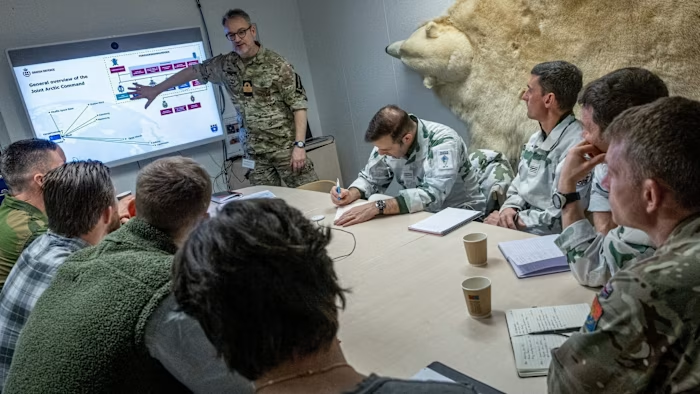
Trump’s remarks came after European nations sent small numbers of troops to Greenland for a military exercise. Danish Arctic Command said there were more than 200 extra Nato troops in Greenland on Sunday.
In a joint statement Denmark, Finland, France, Germany, the Netherlands, Norway, Sweden and the UK said the military exercise “poses no threat to anyone” and “we stand in full solidarity with the Kingdom of Denmark and the people of Greenland”.
“Tariff threats undermine transatlantic relations and risk a dangerous downward spiral,” they said. “We will continue to stand united and co-ordinated in our response. We are committed to upholding our sovereignty.”
The EU has yet to ratify a trade deal it agreed with the US last summer that would hold tariffs at 15 per cent. Lawmakers in the European parliament said they would delay approval because of the Greenland threat.
One option being discussed in Brussels is hitting the US with levies on €93bn of its exports, according to two people familiar with the situation.
The retaliatory package was put on hold in August after the two sides signed the trade deal. But its six-month suspension is due to expire on February 7 unless the European Commission extends it. These tariffs include US cigarettes, clothing and food.
Germany’s vice-chancellor and finance minister Lars Klingbeil said that “a line had been crossed”, adding that the affected nations “must not allow ourselves to be blackmailed”.
“There will be a European response to this threat,” he said.
“It is unacceptable to hit countries that are now taking more responsibility for our common security in Nato,” said Troels Lund Poulsen, Denmark’s defence minister, who will meet Nato secretary-general Mark Rutte on Monday.
Lars Løkke Rasmussen, Denmark’s foreign minister, said that the tariff move was “surprising” because he had a “constructive dialogue” with vice-president JD Vance on Wednesday. He added: “It is paradoxical because what makes the president react is that we are doing what we are criticised for not doing: namely taking care of the Arctic.”
Alexander Stubb, president of Finland, who is known to have a good personal relationship with Trump, said that “tariffs would undermine the transatlantic relationship”. The Swedish and Norwegian premiers Ulf Kristersson and Jonas Gahr Støre also warned that Europe “will not allow ourselves to be blackmailed”.
EU trade commissioner Maroš Šefčovič told the German news outlet DW on Sunday that the implementation of the US-EU trade deal would be “very complicated” in light of Trump’s threats.
Bertram Kawlath, president of the German machine makers’ association the VDMA, said the European parliament “cannot possibly” go ahead with ratifying the US-EU trade deal. He also called for Brussels to consider use of the anti-coercion mechanism, despite the machine-parts industry suffering from tariffs already in place.
Hildegard Müller, president of the German carmakers lobby the VDA, said that the cost of the additional tariffs would be “enormous for German and European industry — in already challenging times”, adding: “Hasty decisions lead to escalation and a potential spiral that only produces losers.”
 People hold Greenland flags during a march in Nuuk to protest against Trump’s threats © Sean Gallup/Getty Images
The increasing strains in the transatlantic relationship have heaped pressure on Italian premier Giorgia Meloni, who has forged a close bond with Trump and acted as a conduit with the White House.
Speaking to reporters in Seoul, Meloni said she had spoken to Trump and Rutte on Sunday morning to try to defuse tensions.
Trump’s announcement was “according to me, a mistake”, she said. “It’s very important at this stage to talk to each other and avoid an escalation.”
Italy will not be hit directly by the tariffs as it did not join the military mission. But the Italian economy will suffer from tariffs on Germany, one of its largest trading partners, to which it sends many intermediate goods used in German exports.
Recommended

Meloni said the White House may have misunderstood the military exercise and not realised that it was directed against powers such as Russia and China.
“This could have been a problem of comprehension and communication, which is why I continue to insist on the role of Nato as the forum in which we should try to look to organise instruments of deterrence,” Meloni said.
Only one country that sent military personnel was not included in Trump’s threats. Belgium was not targeted although it will send one military officer to Greenland.
“If Nato members decided on an operation in Greenland, it is precisely to demonstrate that we are all preoccupied about Arctic security,” Belgian foreign minister Maxime Prévot wrote on X.
Additional reporting by Laura Pitel in Berlin and Henry Foy, Andrew Bounds and Laura Dubois in Brussels