
VANCOUVER – The only way the Vancouver Canucks’ last road trip could have been worse was if it was at home.
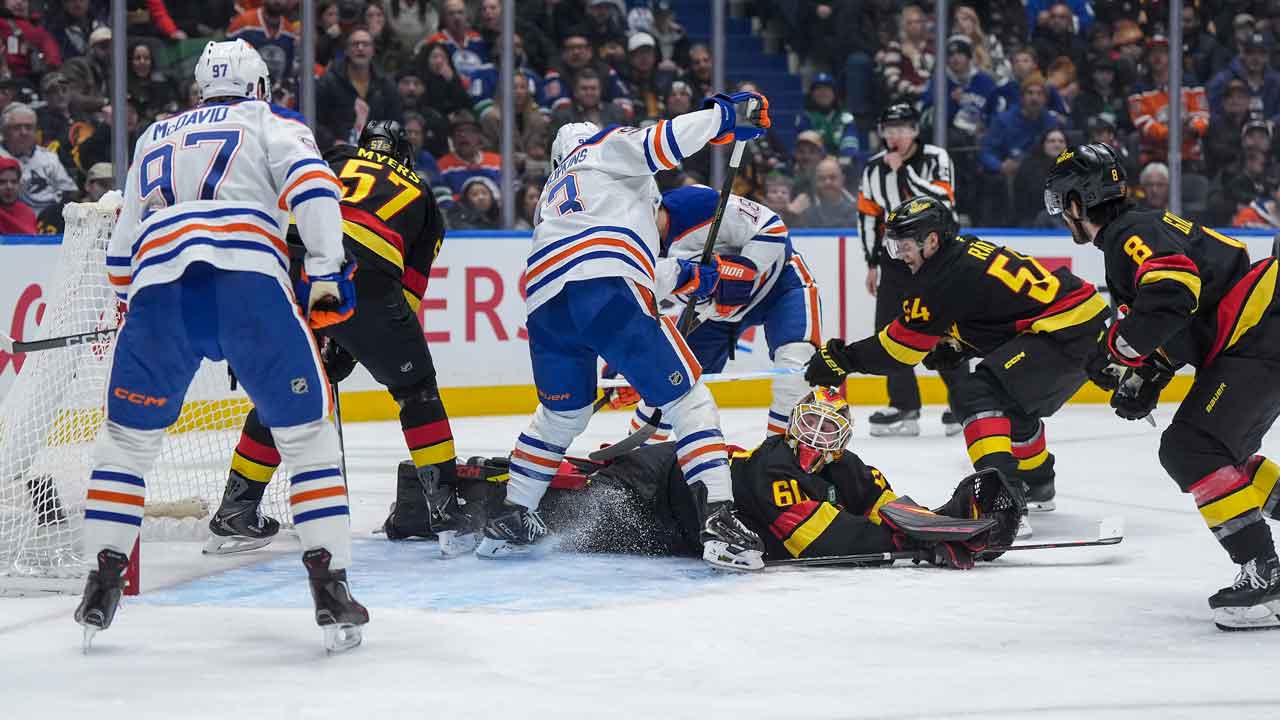
On Saturday, on Hockey Night in Canada, the Canucks brought their horror show home and were humiliated 6-0 at Rogers Arena by the Edmonton Oilers.
All six goals were surrendered in the second period, five of them in a span of 10 minutes and the final three over about two minutes. It wasn’t so much a collapse by the Canucks as a disintegration.
The Oilers didn’t even need Connor McDavid, who had one second assist, although, to his credit, the second-best player in the world was still wheeling around with the puck on Edmonton’s first-unit power play in the final half of the third period, trying to poach points in the blowout while finishing with 21:27 of ice time.
There are bad spells, and then there is just plain awful. People will remember this return home by the Canucks after a historic 0-6-0 road trip.
The team has lost 10 straight games (0-8-2) for the first time since 1998, the last seven of them in regulation while being outscored 33-9. Vancouver’s last victory was last year— on the fifth day of Christmas.
With 34 games to go, the Canucks have just about guaranteed themselves the top seed in the draft lottery as the National Hockey League’s worst team, something they have never been despite the organization’s mostly dark history.
At 16-27-5, and with only four home wins in the four calendar months of the NHL season so far, the Canucks have amassed a goal-differential of minus-50, which may only be seven worse than the St. Louis Blues but is at least 27 worse – more than double bad — the other 30 teams.
All these ghastly numbers provide context for what we are witnessing as the Canucks dive into a rebuild, a direction that chose them as much as they selected it.
And if you just can’t believe a team can look this bad, less than two years removed from a 109-point season, currently in a campaign in which they expected to challenge for a playoff spot, we remind you of 1997-98 – the freak show to which the results from this one closely resemble.
That season, 28 years ago, was the one in which majority owner John McCaw fired general manager Pat Quinn, then coach Tom Renney, tried to hire Quinn back to coach but settled for Mike Keenan, and eventually bestowed GM authority on a committee that included a former executive from B.C. Gas but was quickly bullied by Keenan.
That team managed not one but two 10-game losing streaks and finished at 25-43-14 for 64 points and the third-worst record in the NHL.
That team also boasted a roster that included Pavel Bure and Alex Mogilny, Mark Messier, Markus Naslund, Jyrki Lumme and Mattias Ohlund and, for the first half of the season, Trevor Linden and Kirk McLean.
After a while, talent is secondary, not that we’re suggesting there is enough talent on the Canucks right now to do considerably better.
But their relative lack of talent, the injuries at centre that have hollowed the Canucks and turned their forwards group into a donut, the enigma that is Pettersson (minus-four and zero shot attempts against the Oilers), the exit of Quinn Hughes, the arrival of three rookies on defence, and Demko’s health still do not fully explain the gulf between the team and basic competitiveness over most of their games since the New Year.
On Saturday, after a scoreless first period in which the Canucks gave as good as they absorbed, the team vanished under duress.
Jack Roslovic’s sketchy first goal, an accidental backhand through Vancouver goalie Nikita Tolopilo’s pads amid a pileup in the crease, withstood coach Adam Foote’s challenge at 3:11.
The Canucks killed that penalty, but couldn’t kill their next one, as Zach Hyman’s backhand banked off defenceman Filip Hronek from Tolopilo at 6:49.
The really bad stuff was still to come, four goals in less than five minutes, starting with Kasperi Kapanen’s breakaway at 11:42 after Canuck callup Victor Mancini was caught up ice and Pettersson couldn’t make it back in time to fill in for him.
After Roslovic made it 4-0 at 14:31 on a four-on-two that was unhampered by any kind of Canucks backcheck, Foote tried to stop the onslaught by starting his best three forwards: Pettersson, Boeser and Garland, backed by senior defenceman Tyler Myers with elite prospect Zeev Buium.
The Oilers immediately scored again, Ryan Nugent-Hopkins badly beating Pettersson off the end boards and centring to Kapanen, who got open behind Buium.
The Canucks couldn’t escape, couldn’t get a stop. Instead of finding a way to build one good shift, to find some resolve, they seemed to get weaker by the goal.
“They got a goal, and it just felt like everything collapsed,” Pettersson said.
Foote told reporters, “I don’t think Edmonton did a lot to us; there were some big mistakes there. That’s when we’ve got to learn not to lose our heads and stay within what we know.
“You know, there’s not a lot of room for error. But we’re going to keep building on it, keep working on it, keep teaching the details and, you know, keep supporting these guys. We’ve got to build their confidence and teach them how to survive these situations when they happen.”
 The Fan Hockey Show
Sportsnet’s Matt Marchese and former Los Angeles Kings executive Mike Futa take you around the league on Sportsnet 590 The FAN’s national hockey show, airing live across the country daily from noon-2 p.m. ET.
There is no surviving this season, though. The Canucks are too far gone, which is good at least for the draft-portion of the rebuild.
“The moment you start feeling sorry for yourselves. . . (and) hang your head about losing because it doesn’t feel good, it’s the moment you know you’re never going to get out of it that way,” Myers said. “It’s just wasted energy. Come in the next day, put in the work. It’s as simple as that.”
Still trying to find bottom, the Canucks have seven games left in their eight-game homestand, starting Monday against the New York Islanders.