
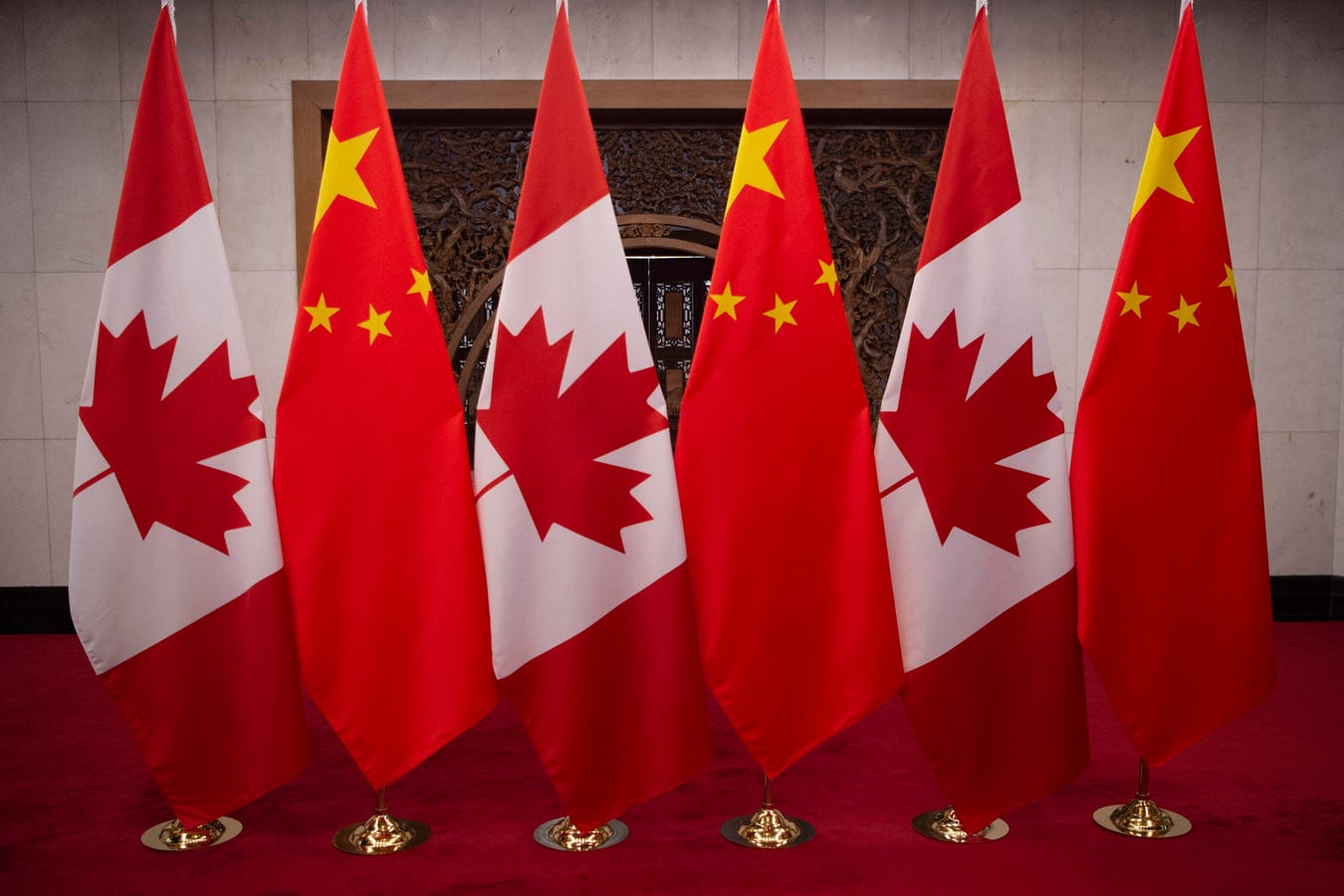
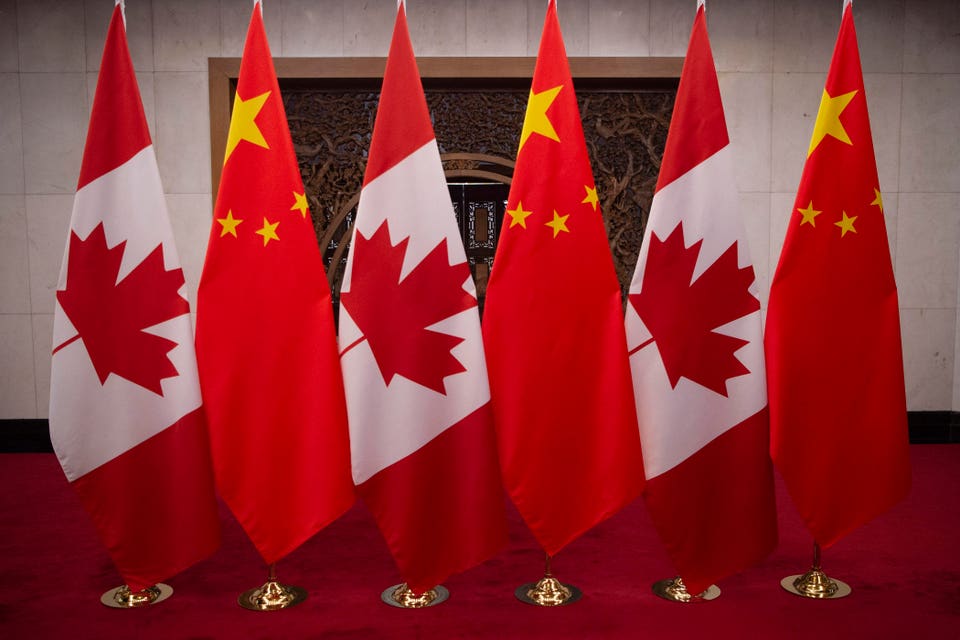
Canadian and Chinese flags.
POOL/AFP via Getty Images
Canada and China just struck a deal turning away from tariffs to improve the lives of citizens from both countries. China agreed to reduce its tariffs on agricultural products from Canada, and in return Canada will reduce the tariff on electric vehicles (EVs). Thus, Chinese will see food prices drop for high-quality nutritious food from Canada and Canadians will have an opportunity to buy state-of-the-art EVs for less money. The tariffs are essentially taxes on their own citizens that will be reduced, but not eliminated.
Tariffs On EVs From China
The tariffs on EVs that were at 100% will drop down to 6.1%. The initial deal will only allow in up to 49,000 Chinese EVs on most-favored-nation terms.
EV sales in Canada have been following something of a roller coaster – with 2025 seeing both the tariff block of Chinese EVs and Tesla EV sales in Canada fell by more than 60% in 2025.
Before the latest tariff exchange in 2023, China exported 41,678 EVs to Canada. To put that number in perspective in 2023 Canadian’s purchased 324,433 EVs – China had about 12% of the market. Carney told reporters that the quota would gradually increase, reaching about 70,000 vehicles in five years. Although this is not free trade, it is more free than it was. In return, the deals will unlock ~ $3 billion in export orders for Canadian farmers and fishermen.
EV Innovation in China
Visitors are visiting BYD new energy vehicles on display.
NurPhoto via Getty Images
Perhaps most interestingly Carney said “For Canada to build its own competitive EV sector, we will need to learn from innovative partners, access their supply chains, and increase local demand.” China has leaned into innovation.
This is the exact opposite message Canadians are accustomed to hearing about China from other countries.
In a recent EV review from the UK, the reviewer almost seemed shocked at how good Chinese EVs turned out to be when comparing the quality of the interiors. It may not be just looks. Consider the tech specs the reviewer summarized for the two high-end EVs from China’s BYD and America’s Tesla: The BYD Sealion 7 has 530 hp and 690 Nm of torque, and it weighs in at 2,420 kg. This beefy EV goes from 0-60 mph in 4.5 seconds. On the other hand, the Tesla Model Y has a lower 507 hp and much lower 494 Nm of torque. Although the Tesla is comparatively less powerful it is lighter weighing less than 2 tons. The Model Y can do 0-60 mph in a slightly slower 4.6 seconds.
Powering EVs China without Emissions
Electric car is charged from a charging station that takes energy from solar panels.
getty
It is pretty clear that Canada believes the market for Chinese EVs will be greater than the caps they put on them. If Canada is not careful, however, an increase of EVs could result in increases in emissions if dirty forms of electrical production are used.
Luckily, solar photovoltaic technology, which converts sunlight directly into electricity, has already been shown to be the cheapest energy in history, so cheap as to allow it to subsidize other systems like home heating. Solar can also subsidize EV charging beating gas costs.
To power all of these new EVs Canada has two approaches it could use to keep them charged while still making their climate commitments with solar energy. The first, is to use large-scale solar energy as in the form of agrivoltaics that couples large scale solar farms with an increase in agricultural products. The increased food production could be used in the deal and marketed to China. As the power available with agrivoltaics is orders of magnitude more than needed on the typical farm, the excess low-cost solar electricity could be used for car charging. This approach has a ton of benefits that go beyond simply saving money.
The second way is to follow the Europeans and make your own solar power on your home. It is perhaps interesting to note that the average parking space has enough area that if a solar-power carport is built over it, it will convert enough sunlight into electricity over the year to handle the EV charging for the average Canadian commuter. Covering parking with solar panels makes winners all around.
It will be interesting to see if solar carports start to sprout up around Canada at similar rates to EV sales and if agrivoltaics sprout up in Canadian fields to help feed more people in China.