
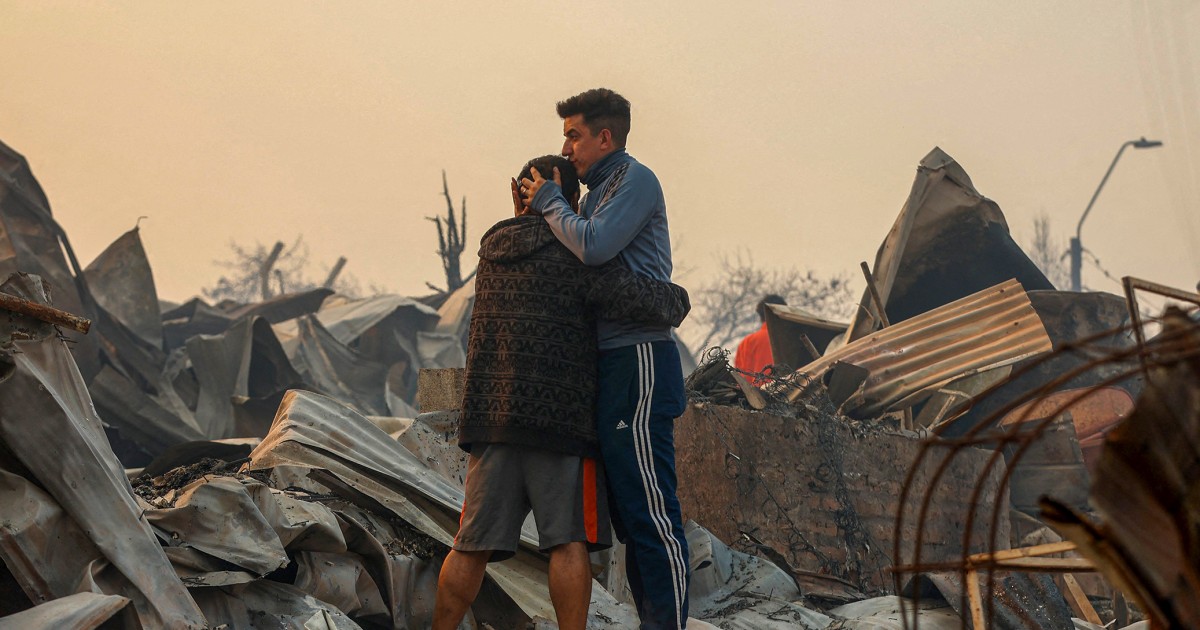
PENCO, Chile — Wildfires raging across central and southern Chile on Sunday killed at least 18 people, scorched thousands of acres of forest and destroyed scores of homes, authorities said, as the South American country swelters in a heat wave.
Chilean President Gabriel Boric said Sunday evening the death toll is expected to rise.
Boric announced the deaths at a news conference in the Biobío region, where he declared a state of catastrophe earlier Sunday, as well as in neighboring Ñuble region, around 300 miles south of Santiago, the capital.
The emergency designation allows greater coordination with the military to rein in two dozen wildfires that have so far blazed through 21,000 acres and prompted 50,000 people to evacuate, according to Chilean Security Minister Luis Cordero.
“All resources are available,” Boric wrote on X.
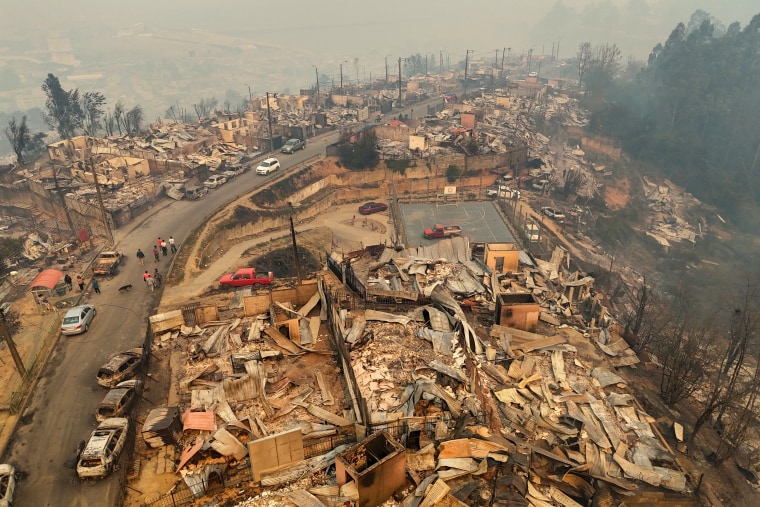 The charred remains of destroyed homes after a wildfire in Concepción on Sunday.Raul Bravo / AFP – Getty Images
Local officials reported that for hours Sunday, destruction was everywhere and help from the federal government was nowhere.
“Dear President Boric, from the bottom of my heart, I have been here for four hours, a community is burning and there is no [government] presence,” said Rodrigo Vera, the mayor of the small coastal town of Penco in the Biobío region. “How can a minister do nothing but call me to tell me that the military is going to arrive at some point?”
Vera said at Sunday’s news conference that Boric “responded and instructed the minister of health and the undersecretary of the interior to fulfill the points we requested.”
Boric also announced the imposition of curfews and the establishment of emergency shelters.
“Here, the government and the state of Chile must act without hesitation,” he said. “If it is necessary to restrict freedoms for a certain period of time to address both the fire and its consequences and the most at-risk areas, we will do so.”
Firefighters were struggling to extinguish the flames, but strong winds and scorching weather hampered their efforts Sunday with temperatures topping 100° F.
Residents said the fires took them by surprise after midnight, trapping them in their homes.
“Many people didn’t evacuate. They stayed in their houses because they thought the fire would stop at the edge of the forest,” said John Guzmán, 55, surveying the scene in Penco, where smoke blanketed the sky in an orange haze. “It was completely out of control. No one expected it.”
Although the total number of homes burned nationwide remained unclear, one municipality of Concepción in Biobío reported 253 homes destroyed.
Boric said that the preliminary count of destroyed homes is a “significant underestimate” and that he is certain the total will exceed 1,000 homes.
“We fled running, with the kids, in the dark,” said Juan Lagos, 52, also in Penco. The fire engulfed most of the city, burning cars, a school and a church.
Charred bodies were found across fields, in homes, along roads and in cars.
“From what we can see, there are people who died … and we knew them well,” said Víctor Burboa, 54. “Everyone here knew them.”
In February 2024, forest fires that triggered evacuations in several regions of central Chile killed more than 100 people.