
At 9 AM I fall in love with Amy. We’re in my friend’s old Corolla, following an Immigration and Customs Enforcement vehicle in our neighborhood. We only know “Amy” through the Signal voice call we’re on together, alongside more than eight hundred others, all trying to coordinate sightings throughout South Minneapolis. Amy drives a silver Subaru and is directly in front of us, expertly tailing a black Wagoneer with two masked agents in front. The Wagoneer skips a red light to try and lose us, but Amy’s fast. She bolts across the intersection, Bullitt-style, and we follow just behind, shouting inside the car, GO AMY! WE LOVE YOU! “I’m gonna fucking marry Amy,” my friend says. “You think it’s chill to propose over this call?”
You can’t walk for ten minutes in my neighborhood without seeing them: boxy SUVs, mostly domestic-made, with tinted windows and out-of-state plates. Two men riding in front, dressed in tactical gear. Following behind is a train of three or four cars, honking. Sometimes there are bikers, too, blowing on neon-colored plastic whistles that local businesses give out for free. Every street corner has patrollers on foot, yelling and filming when a convoy rolls by.
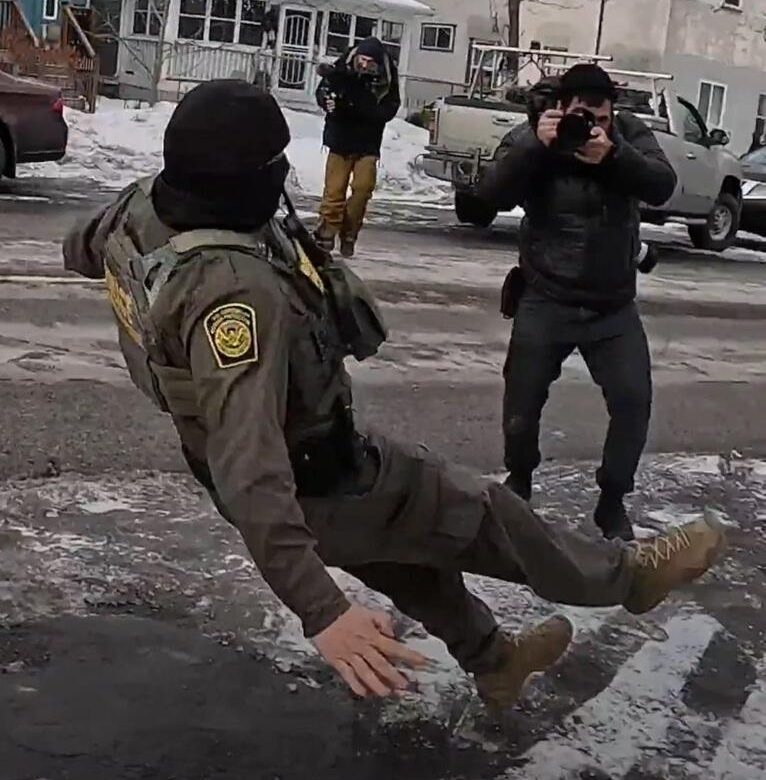
If the ICE vehicles pull over, people flood the street. Crowds materialize seemingly out of nowhere. The honking and whistling amps up, becoming an unignorable wail, and more people stream out of their houses and businesses. When agents leave their cars they’re met with jeers, mostly variations on “Fuck you.” Usually someone starts throwing snowballs. Agents pull out pepper spray guns, threatening protesters who get too close. If there’s enough of a crowd, they use tear gas. Meanwhile they go about their barbaric business: they’ve pulled someone out of their car or home and are shoving them into a vehicle, handcuffed. Over the noise, an observer tries to ask the person being detained for their name and who they want contacted. Sometimes a detainee’s phone, keys, or a bag make it into an observer’s hands. Everyone is filming. The press is taking photos.
Soon the agents are back in their vehicles. They pull risky maneuvers to move through the crowd and speed off. No more than six or seven minutes have elapsed, and another neighbor has been kidnapped. Observers are left to deal with the wreckage: tow an abandoned car, contact family, sometimes collect children. There are lawyers on call, local tow companies offering free services, mutual aid groups to support families after an abduction. Some observers stay behind to do this kind of coordination, and some get back in their cars or on their bikes and speed off again. If enough people get there fast enough, ICE might back off next time. At a minimum, their cruelty can’t go unchallenged.
I’m in my kitchen typing out “do swim goggles protect you from tear gas.” The AI search response that I’ve failed to disable tells me they can “help significantly.” I laugh at this ridiculous tableau. The local ACE Hardware store posted on Facebook that they’ve stocked up on respirators and safety goggles. What I once considered hardcore riot gear is now essential for leaving the house.
I live near the intersection of Chicago Avenue and Lake Street, two major South Minneapolis thoroughfares that mark the northwest corner of the Powderhorn Park neighborhood. My house is a mile north of where George Floyd was murdered by Minneapolis Police officer Derek Chauvin in 2020 and even closer to where Renee Good was murdered by ICE agent Jonathan Ross this month. Since the Department of Homeland Security initiated “Operation Metro Surge” in December, there have been at least half a dozen abductions that I know of on or around my block. A nearby house of recently arrived Ecuadorians used to be home to sixteen adults and six children. Six weeks into the federal invasion, only eight adults remain.
Citywide, hundreds of people are being abducted from their homes and separated from their families. Citizens are racially profiled and asked for papers. Exact numbers on detainees are unreliable, but the number of federal agents is roughly three thousand. These numbers are similar in scale to ICE operations in other cities across the US, including LA and Chicago, but what’s new in Minneapolis are the extreme tactics that federal agents are using to repress organized resistance. The stories circulating online and by word of mouth are harrowing: federal agents surrounding observer cars to trap them, then smashing car windows and dragging observers out; agents spraying mace six inches from someone’s face or spraying mace into intake vents so that the inside of cars are immediately flooded; agents suddenly braking at seventy miles per hour on the freeway and forcing tailing vehicles to swerve; agents throwing observers on the ground, punching observers in the face, agents taking observers on aimless rides around the city while taunting them with racial or sexual epithets; agents holding observers at the federal detention building for hours without access to phone calls or lawyers. (This is merely how ICE terrorizes US citizens.)
What also feels new is the frequent candor with which ICE agents are displaying hateful ideology. Two days after Good was murdered, DHS overtly referenced a Neo-Nazi anthem in a nationwide recruitment post. Agents seem to feel empowered to say new kinds of chilling things out loud. One told an observer: “Stop following us, that’s why that lesbian bitch is dead.” (He was referring to Good.) A friend of mine was sexually harassed by an ICE agent, who called them “too pretty” to stay locked up while in detention. Another was shoved to the ground and asked, “Do you like the dirt, queer?” Sometimes the behavior is simply bizarre. After an attempted abduction left a couple dozen observers standing on a neighborhood street, one ICE vehicle circled the block, broadcasting a looped audio recording of a woman screaming.
In these moments the whole situation can seem ridiculous. The professional kidnappers step out of their flashy American cars with their special outfits on. They wave their little mace guns at us, but we’re not scared—we have oversized ski goggles! A particularly comic element at play is that we’re in the middle of another winter with wild variations in temperature, meaning that Minneapolis streets are covered in thick sheets of ice. There are some heartwarming videos of agents falling down (“ICE on ice!”) but we slip too, running towards or away from them. It can feel kind of slapstick, until you remember that they will destroy someone’s life today, and that they can kill you.
A black gloved hand reaches out of the Wagoneer window and begins to give a princess wave to us, then the peace sign, then a thumbs up. They’re mocking us. The agents stop their vehicle suddenly but Amy brakes in time. Luckily, so do we. ICE has been using “brake-checks” as pretense for detaining observers. Another observer car pulls up and my city council member steps out. He strides up to the Wagoneer, blowing his whistle. (Absolutely everyone is confronting ICE—I’ve encountered my old boss from the local cafe scuffling with agents, too.) Someone on the street starts filming and the bicyclist we know in the chat as “small fry” shouts at the agents to get out of Minneapolis. We’re honking. The Wagoneer idles for a few minutes and then takes off towards the freeway. We follow until they’re on the exit ramp. It feels good to watch them leave the neighborhood, but I worry about where they’re headed next. We drive towards home and come across another two vehicles with observers tailing behind. Lake Street, a major corridor of immigrant businesses in the neighborhood, has been crawling with ICE vehicles every morning this week.
Powderhorn Park is a middle-class neighborhood known for its May Day parade, replete with larger-than-life puppets and steampunk Mad Max vehicles. Artists and families live here, and young queer people, and many immigrants, most arriving from Ecuador in recent years. The past few summers, the block south of me has become impassable every evening as hundreds of my Spanish-speaking neighbors use the park for massive volleyball tournaments. Food vendors set up tables and families bring lawn chairs to watch the games. Last year, two women sold grilled chicken on the corner closest to me. My neighbor’s lawn became a kind of informal restaurant, where customers would sit at the warping picnic table and eat. I bought their chicken a few times, and it was awesome.
A week into the invasion my neighbor with the picnic table called to ask if I was available to come with one of the two vendors to an immigration appointment. The woman had been contacted by USCIS that morning and was told to come in at 3 o’clock that same afternoon. She was worried she could be detained on the spot and had a newborn with her. Several neighbors gathered to arrange a ride, but in the end she only wanted a lawyer and translator to attend with her. I heard later that at the appointment she announced she wanted to self-deport, trading a planned exit for the fear of being taken at random. Her sister, the other vendor, is still here. The Saturday after Good’s murder, she and I sit with a small group of volunteers gathered to talk about how to improve rideshare coordination over WhatsApp. She tells us in Spanish that migrants can’t use corporate rideshare services because there have been reports of Uber drivers taking people directly to ICE. Of the more than two hundred people in the rideshare text thread, half are citizens offering rides and half are requesting. “I like being in this group because I’m meeting so many neighbors I would not have met otherwise,” someone says at the meeting. “I hope we stay connected after this is all over.”
Powderhorn is the same park where, in June 2020, a majority of Minneapolis City Council members stood on stage and announced their support for defunding the Minneapolis Police Department. It’s also where more than 10,000 people gathered to protest ICE the weekend after Renee Good was shot. Minneapolis learned a lot from the George Floyd protests and it shows. Well before Kristi Noem announced DHS operations in Minnesota, the neighborhood got ready. It started with rapid response preparation in the park’s recreation center and legal observer trainings at a church. Then it was block-by-block meetings. Small networks that formed in 2020 were reactivated to distribute 3D-printed whistles and practice scenarios for confronting agents. When ICE deployed in December, Signal threads for local alerts quickly surpassed the thousand-user limit, and an extensive mutual aid ecosystem of grocery runs and rideshares emerged overnight. After Good’s murder and Noem’s announcement that the number of ICE agents in Minnesota would triple, everyone I know cancelled their social plans. Lots of people called off work.
What we’re doing now is this: The trainings have evolved into street medic workshops on protecting yourself from chemical weapons and lessons on digital security; there’s a meet-up to sew reinforced umbrellas as shields from mace and a collection spot for barricade materials. And this is what it’s like: Sometimes you’re chasing ICE off your street, maybe you’re buying groceries for a family, but a lot of the time you’re on your phone. Behind every actionable piece of organizing are hours spent coordinating in Signal threads, calling to check up on someone, scrolling live feeds. At night, over dinner, it’s all anyone can talk about. Did you hear? Did you see that post? Did you read in the thread?
I moved to Minneapolis in 2019 because I was looking for a mid-sized city where rents were still relatively cheap. I knew it was a place where people could afford to be punks and experimental artists and career anarchists. I also knew it was a city with “good politics,” whatever that meant to me at the time. The first summer I lived here, my new friends were going to northern Minnesota on the weekends to support Indigenous resistance camps opposing construction of the Line 3 tar sands pipeline. During Covid, they were standing in parking lots, distributing food and diapers, or defending homeless encampments from police. The uprising following George Floyd’s murder brought everyone out to the streets each night for a week. It’s simply true, I learned, that when you only work part-time, when your main expense is a $400-a-month room in your punk house, you have time to organize. From anarchist info shops to nonprofit worker centers, from the founding of the American Indian Movement in 1968 to the first formations of Anti-Racist Action in the 1980s, grassroots organizing undergirds the culture of the city in a unique way.
Trump officials have made it clear that Operation Metro Surge is as much about seizing migrants from their homes as it is about repression of dissent to fascism. But they seem confused about how exactly the dissent works, and about where it’s coming from. Tricia McLaughlin, Assistant Secretary of DHS, lambasted Minneapolis mayor Jacob Frey, governor Tim Walz, and Minnesota Attorney General Keith Ellison—all varyingly pro-cop centrist liberals—for their non-compliance with federal operations on X. “Sanctuary politicians like Ellison are the EXACT reason that DHS surged to Minnesota in the first place,” she wrote. Did she think the attorney general was out in the streets, throwing snowballs with his constituents?
One tactic of fascism is to shift the scales of political alignment: centrists become stalwarts of the radical left; moms become “domestic terrorists.” Everyone with a whistle becomes antifa. And actually, that last part is correct—or at least it should be. A general strike has been called for Friday, January 23. With luck, thousands of Minnesotans will join in on what many further left are already doing: stopping business as usual and withdrawing their consent from fascism. Among many things I hope for, I want to see volleyball games in the park again this summer.
If you like this article, please subscribe or leave a tax-deductible tip below to support n+1.