
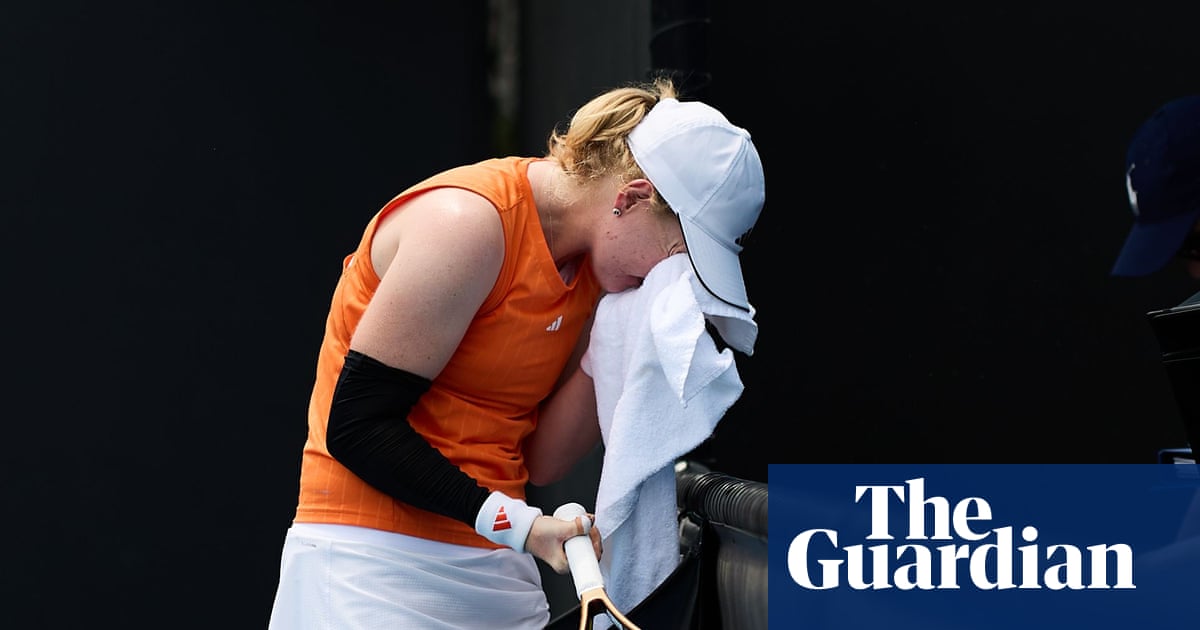
“I’ve honestly got no bloody clue what happened after that point in the match,” said Francesca Jones as she fought back tears. Jones had been battling hard on court 15 at Melbourne Park, chasing her first grand slam main-draw win at the fifth attempt, when she slipped and fell. She instantly felt a tear in her glute muscle. Jones soon had no choice but to retire from her Australian Open first-round match while trailing 6-2, 3-2 to Linda Klimovicova, a 21-year-old Polish qualifier.
“I’m at a career high,” Jones said. “I’m probably in the main draws of the Masters, and then you are thinking: ‘Should I continue, do I fight because it’s a slam?’ There’s money, there’s points on the line. Equally with my history, it’s probably not the smartest thing to keep pushing. I’m just having that internal debate.”
A dramatic second day in Melbourne underlined the physical challenges of competing at the highest level as numerous players retired from their first-round matches due to injuries. Félix Auger-Aliassime, the men’s seventh seed and one of the most in-form players in the world, bowed out meekly in his opening match against Nuno Borges of Portugal suffering from cramp, retiring on John Cain Arena while trailing 3-6, 6-4, 6-4.
It was a similarly miserable day for Auger-Aliassime’s compatriot Marina Stakusic, a talented 21-year-old from Canada. Stakusic began to suffer severe cramps in both legs in her match against local wildcard Priscilla Hon and while trailing 1-6, 6-4, 5-3, she collapsed to the ground. Aided by Hon, Stakusic left the court in a wheelchair. Conditions were hardly extreme, with the forecast reading 29C (84.2F) with 29% humidity. The Australian Open heat stress scale peaked at 1.9 out of 5, signalling temperate playing conditions.
Auger-Aliassime had arrived playing some of the best tennis of his career, rising into the top five. A quarter-finalist in 2022, he had hopes of following up his US Open semi-final appearance with another deep run before his tournament quickly unravelled. “I just knew it wasn’t heading in the right direction,” he said. “I don’t like to be on the court that way. I want to be on the court winning. I want to be on the court competing with my opponent. I don’t want to be just standing there like a punching bag.”
Félix Auger-Aliassime was at a loss to find a reason for his body letting him down after the first set in Melbourne. Photograph: Fred Lee/Getty Images
This defeat was particularly painful for Auger-Aliassime because he felt he had prepared well and everything was in place before the first grand slam of the year. Now he has to figure out why his body let him down. “I don’t have all the answers now,” he said. “I’m trying to be very professional at everything I do, prepare well. I love this sport, and I love to play. So I try to do everything I can in my control to get ready.
“It hurts even more, because if I was self-aware and I was, like, ‘Well, I wasn’t really ready or I wasn’t doing everything,’ then you have to be honest with yourself. But even with being honest with myself, I’m not totally finding the reasons why this is happening. It wasn’t happening in the past, so I’ll have to figure it out.”
Jones’s circumstances, meanwhile, are unique. She has ectrodactyly ectodermal dysplasia, a rare genetic syndrome that has resulted in her having three fingers and a thumb on each hand along with several other physical issues. Jones has struggled badly with injuries throughout her career but she insists they are not a direct consequence of her condition.
“I don’t relate to any of the retirements directly to what could be referred to as ‘kid with a syndrome’. I don’t relate to any of that. I think what I relate it to … is that I don’t think I had a team in place and the expertise that I needed from a younger age. So my age might say 25, but my physical journey, I’m still quite early in. I think that’s where my tennis level is so much higher than my physical journey, and I’m trying to match those up every year and every time.”
Jones, who sits at a career high ranking of No 69 after the best season of her life, has now retired in three of her five main draw and qualifying matches at the Australian Open. Through frustration and tears she was resolute: “It hurts a lot. But if I was someone that didn’t know how to pick myself up quickly, [I] would be effed. I don’t know what the better way to say that is; I’d have no capacity to be where I am right now.”