

Partner Rick Lamanna explains how Canada’s immigration system and strategy for international students has come with a lot of ‘mixed messaging.’
The quality of Canada’s immigration system has taken a critical hit, one group of lawyers say.
According to numbers from the Immigration, Refugees and Citizenship Canada (IRCC), as of Oct. 31, 2025, there are more than one million applications in backlog. Those do not include the additional one million that are still within service standards, bringing the total number of applications to over two million.
Rick Lamanna, a board director for the Canadian Immigration Lawyers Association (CILA) and partner at Fragomen Canada, told CTV Your Morning on Monday that one of the major issues is the downsizing of IRCC staff to pre-COVID-19 levels.
According to Lamanna, that strategy is not working because the number of applications is a lot higher than pre-COVID-19 levels.
“There’s only so much you can do with so many people,” Lamanna said.
The IRCC said technology that focuses on advanced analytics, automation and AI is being used to help process applications faster and reduce the wait times for applications. But Lamanna said they are “not there yet.”
“AI technologies, at this point, are not solving the problem of anything,” he added. “It’s resulting in some very wonky decision making at best, (and) suspicious at worst.”
 McGill University campus in Montreal People play frisbee on the McGill University campus in Montreal on Wednesday, August 6, 2025. THE CANADIAN PRESS/Christopher Katsarov (Christopher Katsarov/The Canadian Press) Slashing study permits for international students
The federal government announced last November that a total of 408,000 study permits will be issued in 2026, a seven per cent decrease compared to the previous year’s target of 437,000 and down 16 per cent from the 2024 target of 485,000.
The cutdown was attributed to helping ease the pressure on housing, health care and other systems that are struggling under the previous intakes.
But Canada’s education system is facing the brunt of this decision.
Universities are facing billions in loss of revenue, slashing sports programs and a decline in student enrollment amid the sudden drop in tuition from international students, cash-strapping institutions and putting them in a financially vulnerable situation.
International student caps impacting Manitoba university enrolment The province says the federal government’s decision to cap international student enrolment is having a financial impact on universities. Jeff Keele explains.
Lamanna says this was “entirely predictable.”
“For over a decade, you open the flood gates, and you don’t really have any sense of where these students are going and what programs (they) are graduating in,” he said.
“The government decided it was going to stop those floodgates, close the funnel,” he added. “Now, we’re in a situation where there are a lot of schools in big financial trouble, and it’s going to take a few years to work this out.”
However, Lamanna said that it was “interesting to note” that the day after the federal government announced the changes to the international students’ stream, they made another announcement – saying that Canada was “open for business” for master’s and doctoral students, and that their applications would be expedited.
Lamanna worries that this can create an issue of “mixed messaging.”
“Regardless of the target, I’m not even sure if they’re going to meet it, because I think what we’re saying to international students abroad is ‘come and you might be able to stay, but that’s not a guarantee,’ so they may be looking elsewhere,” he said.
“We need to have a predictable system. This is what investors want. This is what businesses want in order to have faith in our immigration system.”
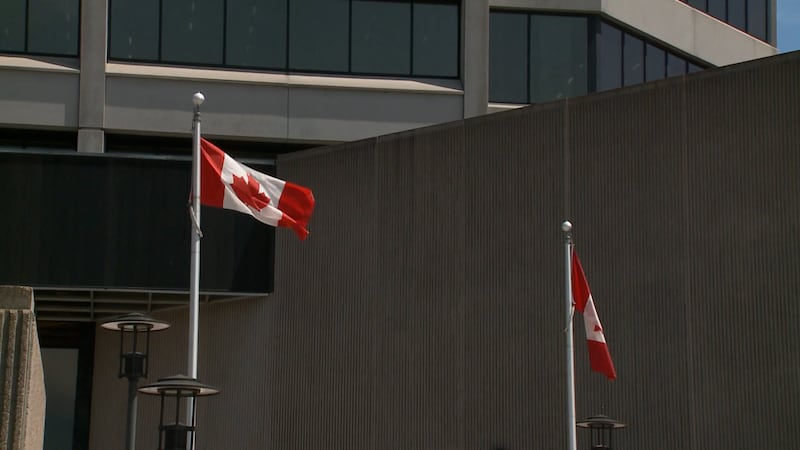 Federal goverment flags The federal government launched a new system to monitor whether IRCC employees are meeting in-person work mandates. Friday, Oct. 17, 2025. (Natalie van Rooy/CTV News Ottawa) ‘Who’s going to build them?’
Meanwhile, the federal government has been in talks with various partners to aid the nation-building projects in the pipeline.
According to a survey by KPMG Canada shared Monday, businesses in Canada are planning to make major acquisitions in the next 18 months to find ways to capitalize on opportunities.
Lamanna says Canada is ill-prepared for the need of skilled labour that these projects are going to require.
“It’s interesting to me that we’re reducing these numbers at the exact same time that the federal government is announcing some much-needed nation building projects,” he said. “Who’s going to build them?”
Canada does not have enough skilled labour to be able to support massive projects like these, Lamanna said.
“We have a very intelligent, educated, hardworking workforce,” he said.
“It’s not a matter of Canadians not being good enough or not being willing to take the work. We just need more people to do it.”
With files from CTV News’ Miriam Katawazi, Genevieve Beauchemin, Haeley DiRisio, Kayla Thompson and the Canadian Press