
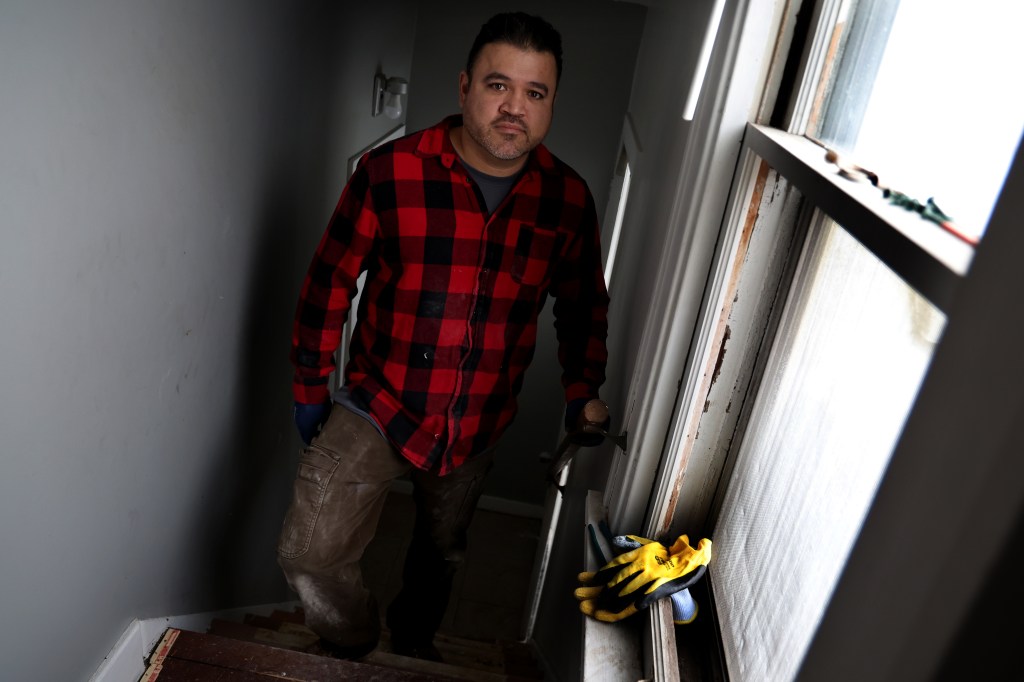
Frustrated with the way the country was headed, Pablo Payan cast a ballot for Donald Trump in 2024, mainly drawn to the Republican presidential candidate’s pledge to bring economic strength to the nation as well as an America First mindset.
The father of four from Merrillville usually favored Democrats in the past but was hoping for a nationwide change of direction. Less foreign aid. More border security. Lower inflation. Greater economic growth.
Yet roughly a year into Trump’s second presidency, Payan has buyer’s remorse.
“I did vote for Trump. But now I regret it,” Payan said. “He’s contradicting everything he said he would do. And now it’s extremism. And immigration. And racial profiling. And sending money to foreign countries.”
As the one-year milestone of the second Trump administration approaches, various polls indicate waning approval for the president compared with the higher ratings he had at the start of his second term.
A Reuters/Ipsos poll earlier this month showed 42% of Americans approved of Trump’s job overall. This was up slightly from lower percentages throughout most of the fall and winter but still down from the 47% approval rating around the time Trump took office in January 2025.
While the president has kept his MAGA base largely intact, the Tribune interviewed several Trump voters who have expressed dissatisfaction with aspects of his leadership during the first year of his second term.
Although they favored the president over Democrat Kamala Harris during the campaign, they now share grave concerns over the Trump administration’s handling of everything from economic strategies to foreign policy to domestic problems.
Aggressive immigration enforcement was a repeated complaint from those who backed the president during the election but now have doubts about his leadership. Chicago was the epicenter of Trump’s mass deportation policy this fall, an effort that relied heavily upon racial profiling and largely failed to target the “worst of the worst” criminals as promised.
One man from Skokie grew incensed after witnessing Border Patrol agents question U.S. citizens who were working on his property during an immigration enforcement onslaught across the Chicago area on Halloween.
A Navy combat veteran was angered after immigration officials detained his wife — a foreign-born green card holder — at O’Hare International Airport over the summer.
Payan, a 41-year-old general contractor whose parents were born in Mexico, said he believed campaign rhetoric that the administration would target felons and violent criminals who were here without legal permission, a mission he supported.
But the reality of immigration enforcement — which has included turbulent protests, detained U.S. citizens and the violent arrests of both residents who are legally in the U.S. and those without legal permission — has been a stark contrast to those promises.
“Going door to door, just asking people at the gas stations or at Home Depot, ‘Hey, what’s your status?’ That’s racial profiling at its best,” Payan said.
While there isn’t evidence of a mass exodus of Trump supporters, there are signs of weakening favor among those who cast a ballot for the president, said Alexander Theodoridis, associate professor and co-director of the UMass Poll at the University of Massachusetts Amherst.
Of Trump voters polled in July, 69% expressed confidence in their choice and only 1% said they regretted their vote; 2% said they had some regrets and might make a different choice if they could go back, according to the UMass Poll.
Another 3% said they wished they hadn’t voted at all and 6% had mixed feelings, the survey found.
But 19% responded that they had some concerns about his presidency — a contingent the Trump administration and other Republicans might find troubling later this year in the midterm elections, which can reshape control of Congress, Theodoridis said.
Historically, the midterms often go against the incumbent party, he noted.
“We’re very likely to see it this time around too,” he said. “It doesn’t necessarily mean lots of people are regretful of their Trump vote in an open or even self-aware way. But they might just not be enthusiastic enough to turn out and vote for … the Republican running for Congress in their district.”
The dip in support comes as some high-profile cracks are emerging among Trump’s often-lockstep base.
Once a loyal champion of the president, former U.S. Rep. Marjorie Taylor Greene of Georgia has severely criticized Trump over his handling of files related to financier and convicted sex offender Jeffrey Epstein, as well as foreign policy and health care issues.
The feud intensified with Trump calling Greene a “traitor” and “wacky,” while pledging to endorse a challenger if she sought reelection. Amid the public fallout, Greene announced her resignation in November and stepped down earlier this month.
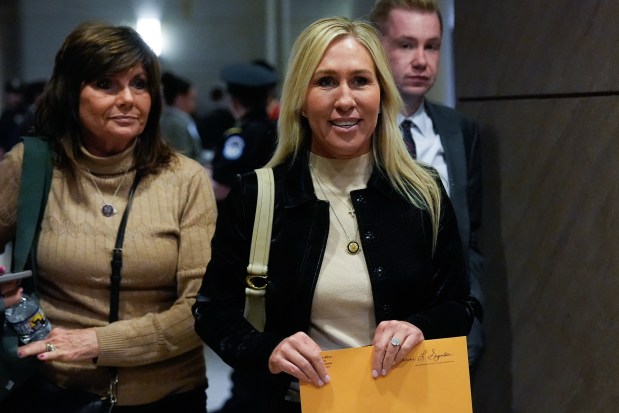 U.S. Rep. Marjorie Taylor Greene, R-Ga., departs a briefing on military strikes near Venezuela, Dec. 16, 2025, at the Capitol in Washington, D.C. (Julia Demaree Nikhinson/AP)
Elon Musk, a top donor during the 2024 election and former leader of Trump’s Department of Government Efficiency, has posted a flurry of attacks on his X social media platform targeting the president’s handling of the Epstein files as well as spending and tariffs. He and the president seem to be on better terms now, as Musk recently shared a picture of them dining at Mar-a-Lago on social media.
And despite intense pressure from the White House, a group of Republican state senators from Indiana helped defeat a Trump-backed redistricting plan that would have favored their party.
Among them was northwest Indiana Republican state Sen. Michael Bohacek, 8th District, who threatened to vote against the redrawn congressional map after Trump used a slur for people with intellectual abilities in reference to Minnesota Gov. Tim Walz.
Bohacek, whose daughter has Down syndrome, rebuked the president’s offensive language and encouraged him to “use the next 10 months to convince voters that his policies and behavior deserve a congressional majority.”
As for Payan, he’s worried about the nation’s increasingly hawkish foreign policy, climaxing earlier this month with the U.S. capture of then-Venezuelan President Nicolás Maduro and Trump’s increasing desire to control Greenland.
“It’s the dictator blueprint,” he said.
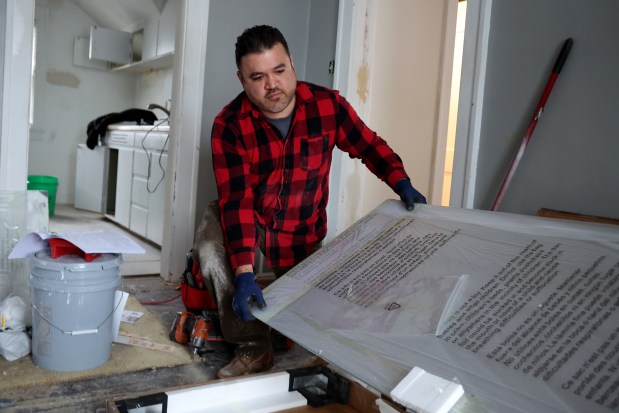 General contractor Pablo Payan, of Merrillville, renovates a home in Crown Point, Jan. 14, 2026. (Antonio Perez/Chicago Tribune)
Payan said he’s faced backlash from Democrats because he voted for Trump. He’s also been castigated by Republicans for opposing the president.
But he believes it’s everyone’s civic duty to criticize leaders when they’re wrong, even if it’s a candidate they supported during the election.
“Be vocal and express your voice,” he said. “A lot of people are scared to talk because they might get fired from work or their friends might unfriend them. And I think, what’s more important? Your voice or your relationship with your co-worker or friend?”
‘Poor choices’
While voting in person on Election Day in November 2020, Morgan Krupinski spent about five minutes holding his pen and grappling with the final decision at the top of his nearly completed ballot: The options for president, as Trump faced Democrat Joe Biden.
“I couldn’t do it,” he recalled. “I voted. But I abstained from the presidential choice. It’s kind of a reflection of where our leaders are. We have a lot of poor choices, many times.”
The 30-year-old who works in technology had voted for Trump in 2016 but grew disappointed by the end of his first term, as unrest gripped the country amid the COVID pandemic and protests following the murder of George Floyd by a Minneapolis police officer. Neither Trump nor Biden seemed equipped to lead at the time, he recounted.
Afterward, the Jan. 6, 2020, insurrection in the U.S. Capitol deeply upset Krupinski.
As the 2024 election approached, he highly favored another Republican candidate, U.N. Ambassador Nikki Haley.
He saw her as a strong leader who could help quell two major wars plaguing the globe — the Russian invasion of Ukraine and the Israel-Hamas war — while uniting a largely fragmented United States.
But Haley, the last significant Republican challenger to Trump, withdrew her longshot candidacy in March 2024.
Then the July assassination attempt on Trump marked a turning point for Krupinski, who was moved by the candidate’s speech a few days later at the Republican National Convention in Milwaukee.
“Together, we will launch a new era of safety, prosperity and freedom for citizens of every race, religion, color and creed,” Trump told the crowd. “The discord and division in our society must be healed.”
That moment held echoes of President George W. Bush’s address following the Sept. 11, 2001, attacks and President Barack Obama’s words after the death of terrorist Osama bin Laden, two historical messages that had seemed to bring the nation together, Krupinski recalled.
So in 2024, he returned to his polling place and cast a hopeful vote for Trump.
Krupinski was gratified by some of the president’s international accomplishments, including a Trump-led plan for peace in Gaza in early October and release of the Israeli hostages by Hamas.
There were also concerns. Krupiniski criticized the administration’s steep tariffs, which “are not really a traditional Republican free-market issue.”
The self-described Reagan-style conservative grew troubled by “hyper-nationalistic rhetoric” among some in the MAGA contingent, which he believes Trump has an obligation to condemn.
But his worries for the new administration culminated on Halloween, when Trump’s often-combative immigration crackdown touched Krupinski’s home in Skokie.
While working inside his house, several Border Patrol vehicles suddenly pulled up on his quiet north suburban street.
Led by Border Patrol Cmdr. Greg Bovino, a swarm of armed immigration agents filled the scene, demanding documents from two workers from an American company who were providing flood control on Krupinski’s front lawn.
They were able to provide proof that they were U.S. citizens. But the encounter disturbed Krupinski.
“I believe we need to have a strong border and we need to get rid of people who are committing crimes and who are doing the wrong thing,” he said. “But for that to happen in such a way that’s so indiscriminate: Going down residential streets and stopping people based on their appearance and what they’re doing, without a true, reasonable cause?”
Immigration officials had no reason to stop and question those workers, Krupinski added.
“If you’re going to do immigration enforcement you have to do it legally and constitutionally,” Krupinski said. “Now what I think is going on is a very strained and expansive view of the authority that they have. And it’s very unsettling.”
Many Chicago residents agree with him in the wake of the Trump administration’s local ramped-up immigration enforcement, dubbed Operation Midway Blitz. Asked if immigration enforcement has gone too far, 65% of Chicagoans said it has, according to a recent survey conducted by NORC at the University of Chicago. Almost 13% of those polled supported enforcement activities and more than 8% said they have not gone far enough; 14% of those surveyed were unsure.
Krupinski believes he made the best decision he could on Election Day in November.
Yet he’s been speaking out against the administration’s immigration enforcement methods, particularly to fellow conservatives and others who voted for Trump.
Amid a highly polarized and divided political climate, they might be more inclined to listen to him than a staunch Democrat or more liberal voice, Krupinski reasoned.
“So I feel like I have a unique opportunity to speak to the people on my side of things,” he added. “I hope I can change people’s minds to say no one is above criticism and no one is above being called out when they do something bad, particularly in the government. This is the right we have as citizens.”
Partisan strife
The Missouri couple were returning home from a trip to Ireland for a family memorial when they were stopped by federal authorities at O’Hare International Airport in July.
Donna Hughes-Brown, an Irish citizen and legal permanent resident of the United States, was detained by immigration authorities.
Although she’s been a green card holder for decades, Hughes-Brown said the officials cited two misdemeanor offenses against her for writing bad checks in 2012 and 2015.
The 58-year-old grandmother was held at O’Hare for several days and then transferred to a facility in Campbell County, Kentucky, where she was detained for more than four months.
Her husband, Jim Brown, a Navy veteran who fought in Operation Desert Storm, had cast a ballot for Trump in 2024. But this wasn’t the kind of immigration enforcement the campaign had promised, he said.
“What they were doing to my wife was wrong,” said Brown. They live in northeastern Missouri about 20 miles from the Illinois border.
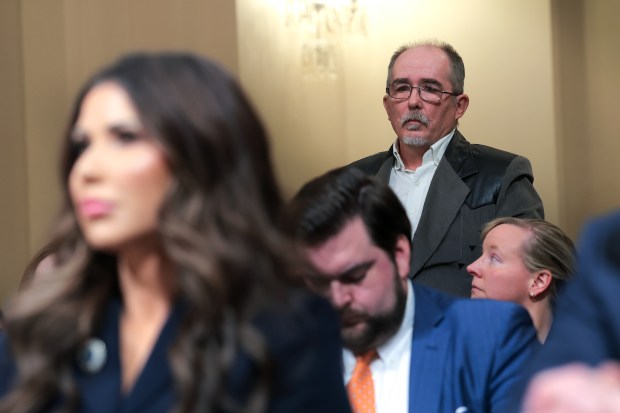 Jim Brown, whose wife, Donna Hughes-Brown, was detained by Immigration and Customs Enforcement agents, stands as U.S. Department of Homeland Security Secretary Kristi Noem testifies before the U.S. House Committee on Homeland Security, Dec. 11, 2025 in Washington, D.C. (Anna Moneymaker/Getty)
Homeland Security officials did not respond to Tribune requests for comment.
The case made international headlines and a contingent of Democratic lawmakers, including Illinois Sen. Tammy Duckworth, advocated for Hughes-Brown’s release.
During a U.S. House Homeland Security Committee hearing in December, U.S. Rep. Seth Magaziner of Rhode Island grilled Homeland Security Secretary Kristi Noem on the matter.
Brown attended the hearing as well.
“She did not come here illegally and she has never committed any crime other than writing two bad checks, totaling $80, 10 years ago. She is currently in prison and facing deportation,” Magaziner said during the hearing. “Ms. Noem, will you thank Mr. Brown for his service to our country?”
“Thank you, Mr. Brown, for your service to our country,” Noem responded.
The Homeland Security secretary added that it’s not her job to pick and choose which laws get enforced, though Noem did pledge to review the case.
In mid-December, Hughes-Brown was released and returned to her Missouri home. The couple are now working on the process for her to become a naturalized citizen.
“I’m relieved that Donna is finally back home with her family and look forward to supporting her in her naturalization journey, but she never should have been detained in the first place,” Duckworth said in a written statement.
During a recent interview with the Tribune, Brown had harsh words for the Trump administration.
“They sold a whole different idea than what’s actually happening. The cruelty and the nonsense that’s going on right now is just wrong,” he said. “If you watched between the first Trump presidency and now, it’s completely different. We’re trying to bully other countries and do things we shouldn’t be doing.”
Yet he stressed several times that he didn’t want to “get partisan,” noting that some immigration laws the administration’s enforcing have been on the books for years. Former President Obama, a Democrat, had been dubbed “the deporter-in-chief,” by immigration advocates, Brown correctly noted.
Since his wife’s story went viral, Brown said he’s been lambasted by liberals for voting for Trump and admonished by conservatives for criticizing the administration.
The only way to improve the country is “to stop being partisan,” Brown said, adding that he blames much of the nation’s strife on the two-party political system.
“It’s the fomentation,” he said. “When you fight with each other instead of coming up with a solution.”