
He has purged government agencies and sent the Department of Justice against perceived enemies. He has launched an immigration crackdown and deployed troops into cities. He has built a tariff wall around the economy. And he has suborned businesses and universities, forcing them to pay hefty sums of money and follow his orders.
In his first year back in the White House, U.S. President Donald Trump has markedly expanded the power of his office and wielded control over the world’s wealthiest country in unprecedented ways. Now, he is seeking to project that power outward. Since attacking Venezuela to capture its leader and take its oil, Mr. Trump has threatened to invade Greenland, send troops into Mexico and Colombia, and bomb Iran.
“My own morality. My own mind,” he said this month when asked by The New York Times if there was anything to limit him. “It’s the only thing that can stop me.”
Such efforts to dominate the country – drawing accusations of authoritarianism – were once unthinkable in a mature, stable democracy. The sharp turn toward imperialism, meanwhile, is a contrast with the President’s previous non-interventionist rhetoric.
It is all a stark divergence from Mr. Trump’s first term, in which he raged on social media but often failed to implement his policies. Now, he is taking action across a wide front and facing relatively little check from other branches of government. The only question is where this mercurial leader takes his country and the world in the balance of his term.
“Central to understanding Trump is: he doesn’t have a philosophy, domestic or international,” John Bolton, the President’s national security adviser for part of his previous term, told The Globe and Mail. “It’s not about policy or strategy. It’s about Donald Trump.”
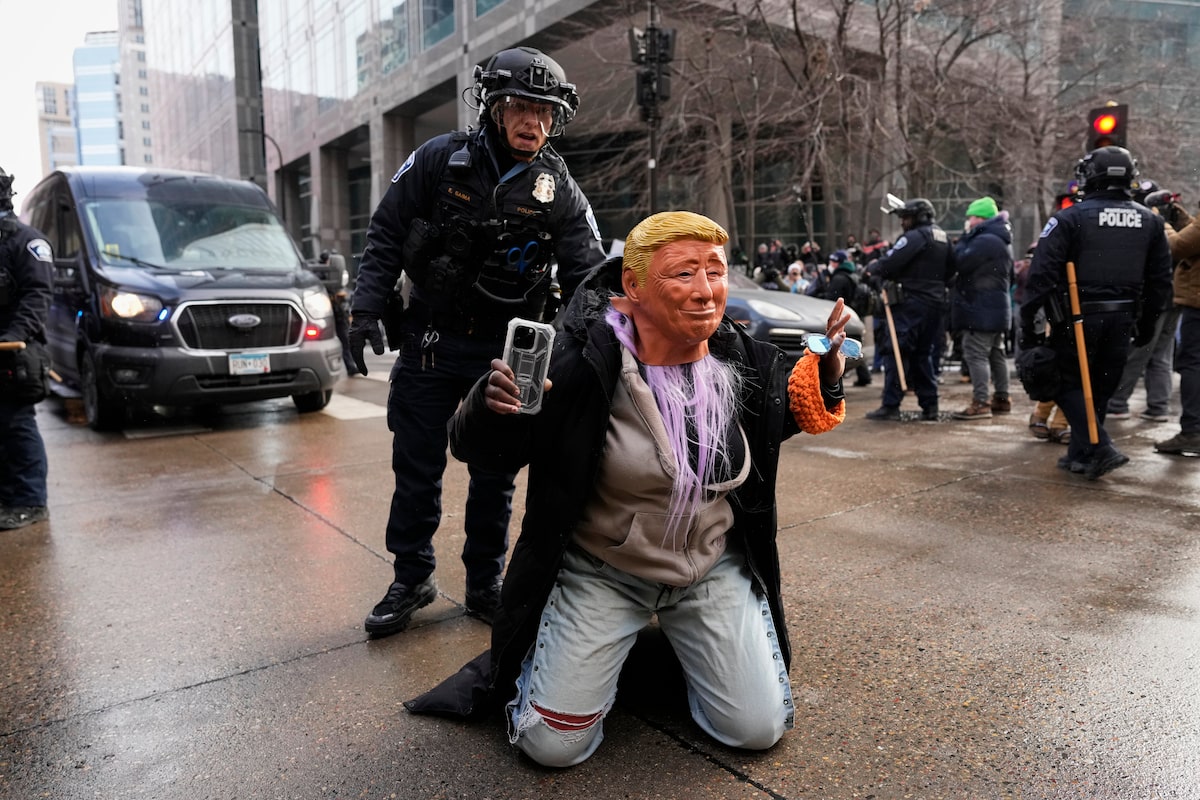
ICE agents continued their raids in Minneapolis-St. Paul this past weekend, days after one of their own shot and killed a local woman, Renee Good, in front of protesters. Since Donald Trump came to power promising mass deportations, they have uprooted thousands and brought protests to several cities.
Scott Olson/Getty Images; Leah Millis and Ryan Murphy/Reuters
Immigration policy is only one of the things Mr. Trump has drastically changed since his swearing-in as President last Jan. 20 – this time with a fully Republican-controlled Congress, unlike in the 2010s.
Kenny Holston/AFP via Getty Images; Mark Schiefelbein/AP
From purges to tariffs to soldiers in the streets
One Saturday night this past September, Mr. Trump openly pressured Attorney-General Pam Bondi to go after three people he views as nemeses: former FBI director James Comey, who investigated ties between Mr. Trump’s 2016 election campaign and Russia; New York Attorney-General Letitia James, who brought a civil fraud case against Mr. Trump’s companies; and California Senator Adam Schiff, who led the first of Mr. Trump’s two impeachments.
“What about Comey, Adam ‘Shifty’ Schiff, Leticia??? They’re all guilty as hell,” Mr. Trump wrote in a Truth Social post addressed to Ms. Bondi, misspelling Ms. James’s name. “We can’t delay any longer.”
Mr. Trump’s thirst for revenge was certainly well-known. His newly-installed loyalists at the Department of Justice had purged prosecutors involved in cases against Trump supporters who stormed the Capitol on Jan. 6, 2021, while Mr. Trump pardoned nearly 1,600 of the rioters.
But the brazenness of his orders to Ms. Bondi – reportedly intended as a private message and posted publicly by mistake – were nonetheless arresting, making crystal clear how directly the President intended to use the machinery of government for retribution.
Open this photo in gallery:Open this photo in gallery:
Adam Schiff, James Comey and Letitia James are some of the people to face consequences for investigating Mr. Trump’s alleged misdeeds.Jonathan Ernst/Reuters; Brendan Smialowski and TIMOTHY A. CLARY/AFP via Getty Images/AFP/Getty Images
In the weeks that followed, prosecutors charged Mr. Comey with lying to Congress and Ms. James with mortgage fraud. Both indictments were thrown out after a judge determined that Mr. Trump’s hasty appointment of a lawyer to prosecute them had been illegal.
Federal Reserve Chair Jerome Powell, who has rebuffed Mr. Trump’s demand that he cut interest rates, revealed this month that he has also been subject to a federal investigation.
Ty Cobb, who served on the White House legal team during Mr. Trump’s first term, said the President’s behaviour is “as un-American and as un-presidential as can be,” a sea change from how the country was historically governed.
“This is not a one- or two-degree deviation,” he said in an interview.
“This is a wholesale revision of the norms and guardrails that previously existed in America – the independence of the Justice Department – and the total elimination of rule of law, where a tyrant says, ‘I don’t like this guy, put him in jail.’”
Mr. Trump’s purges have extended to other federal government departments as well, with about 300,000 of 2.4 million public employees fired, including shuttering the U.S. Agency for International Development on the orders of Elon Musk, the billionaire Trump donor given free rein to make cuts.
Mr. Trump and Elon Musk would have a falling-out after this Oval Office meeting last February. But by then, Mr. Musk’s department had made far-reaching cuts to U.S. public services.Jim Watson/AFP via Getty Images
The President has benefitted from a Republican congressional caucus that is mostly either fully aligned with his agenda or too meek to oppose it.
Nowhere is the acquiescence more in evidence than on his tariff policy, which seeks to dismantle the free-trade system promulgated by former president Ronald Reagan, a hallowed figure to Republicans, and has drawn either support or silence from his party.
Mr. Trump has imposed tariffs on nearly every country in the world with the aim of curbing imports to the U.S. He has also taken partial public ownership of corporations ranging from U.S. Steel to semiconductor firm Intel to rare-earth company MP Materials.
“Republicans are getting behind the idea of having a government stake in private companies. What planet are we living on?” said Inu Manak, a trade expert at the Council on Foreign Relations.
In 2017, for instance, then-agriculture secretary Sonny Perdue, along with Republican legislators and U.S. industry leaders, convinced Mr. Trump not to unilaterally pull the country out of its free-trade deal with Canada and Mexico. Such pushback is almost entirely absent now.
One U.S. industry official in Washington said no one in the business community has had any traction in getting the White House to back down on tariffs. The source, whom The Globe is not identifying as they could face repercussions from the administration, said companies have also been less publicly vocal because they do not believe that pushing back would do anything.
Open this photo in gallery:Open this photo in gallery:
Protesters at the Peace Bridge offered Canada some encouragement early in the trade war, which by spring would widen to dozens of other countries.Adrian Kraus and Mark Schiefelbein/AP
Alongside trade protectionism, there is no issue more central to Mr. Trump’s agenda than slashing immigration. He has launched a sweeping roundup of the country’s estimated 11 million undocumented people, stripped status from 1.6 million legal immigrants and frozen processing of immigrant visas for people from dozens of countries.
Masked agents from Immigration and Customs Enforcement have raided farms, restaurants, factories and Home Depot parking lots. During one midnight operation at a Chicago apartment building in September, agents rappelled onto the roof from a Blackhawk helicopter.
At anti-ICE protests, agents have arrested and pepper-sprayed demonstrators. In Minneapolis earlier this month, ICE agent Jonathan Ross shot and killed Renee Nicole Macklin Good, an American woman. Mr. Trump has deployed National Guard troops to Los Angeles, Chicago, Washington and Memphis to, in part, support the deportations.
U.S. universities, including Harvard, are under pressure from the Trump administration to toe an ideological line or face financial penalties.Brian Snyder/Reuters
Mr. Trump has also extended his control far beyond government to target corporate America and academia.
Under threat of getting frozen out of government contracts, a string of law firms have committed to spending nearly US$1-billion on pro bono work for causes of Mr. Trump’s choosing. ABC and CBS paid US$15-million and US$16-million, respectively, to settle lawsuits brought by Mr. Trump after he threatened to have their broadcast licences revoked.
The President pulled funding from universities, ostensibly to punish them for pro-Palestinian campus protests and diversity, equity and inclusion programs. Several – including Columbia, Cornell, Brown and Pennsylvania – have agreed to pay hundreds of millions of dollars in fines and make Trump-ordered changes to faculty or policy as a result of the pressure.
One of the few holdouts, Harvard, is locked in a court battle with the administration.
Harvard political scientist Steven Levitsky can enumerate the ways that Mr. Trump’s funding freeze is being felt on campus. People are losing their jobs, programs are being shuttered and the number of graduate students accepted is down. International students have to self-censor on social media and are afraid to leave the country for fear of having their visas revoked.
“In an authoritarian regime, you pay a price for opposing the government,” said Prof. Levitsky, who co-authored the book How Democracies Die. “Harvard’s paid a huge price.”
Mr. Trump’s capture of Venezuelan autocrat Nicolás Maduro alarmed Latin America earlier this month, as did Washington’s talk of a new Monroe Doctrine in the Western Hemisphere.
Tuane Fernandes and Adam Gray/Reuters
The Donroe Doctrine
In 2018, Mr. Trump asked Mr. Bolton, his then-national security adviser, to look into the possibility of the U.S. buying Greenland. One of Mr. Trump’s businessman friends had suggested the idea, Mr. Bolton recalled.
Mr. Bolton assigned his staff to research it. Their work focused on the 1951 Defense of Greenland treaty, under which the U.S. already has broad ability to send more troops and build more military facilities on the Arctic island, an autonomous Danish territory.
Before any discussion between the two countries over the treaty could happen, however, the President got into a public contretemps with Danish Prime Minister Mette Frederiksen, who rejected the President’s annexation overtures. The White House dropped the subject. But for Mr. Trump, apparently, the dream never died.
Former Trump adviser John Bolton, alongside the then-president at a 2018 NATO summit, recalls how efforts to buy Greenland that year went nowhere.Kevin Lamarque/Reuters
Protesters rallied at Nuuk’s U.S. consulate this past week to make it clear that Greenland is still not for sale.Evgeniy Maloletka/The Associated Press
In the weeks since U.S. forces shot their way into the bedroom of Venezuelan dictator Nicolás Maduro and spirited him and his wife away to face narcotrafficking charges, the President has repeatedly threatened to seize Greenland, either by military invasion or by imposing tariffs on countries that oppose the move. He has also talked about sending U.S. troops into Mexico to fight drug cartels, taking out Colombia’s leftist president as he did Mr. Maduro, and bombing Iran.
He has dubbed his new foreign policy the “Donroe Doctrine,” a reference to former president James Monroe’s 1820s policy of U.S. hegemony in the Western Hemisphere.
Attacking Greenland, which is part of NATO, would almost certainly end the mutual defence pact that has held Western countries together since the 1940s.
“It was a Soviet goal during the Cold War to split America from the rest of the NATO alliance,” Mr. Bolton said, adding that the current leaders of Russia and China would certainly be happy to see such a thing come to pass. “What Trump is doing is what the Soviets wanted and I think what Putin wants, what Xi Jinping wants.”
Open this photo in gallery:Open this photo in gallery:
Mr. Trump authorized air strikes on the Fordow nuclear complex in Iran. Its mountain fortifications – at top on June 20, before the attack – looked visibly scorched on June 22, at bottom.Maxar Technologies via Reuters
While Mr. Trump is hardly the first U.S. president to favour the violent projection of power around the globe – from James Polk’s 1846 to 1848 war with Mexico to George W. Bush’s 2003 invasion of Iraq – this newfound expansionism stands in stark contrast with his previous non-interventionism.
Jorge Castañeda, a former Mexican foreign minister, said Mr. Trump seems to have been emboldened by his bombing of Iran’s nuclear facilities and brokering of a deal on Gaza last year to go further in asserting U.S. international dominance. The military operations he has either ordered or threatened so far, Mr. Castañeda said, “look like easy pickings” from the President’s point of view.
“He can see it as low-hanging fruit that gives him a great deal of stature in the world, and it doesn’t cost very much,” he said. “As long as there is no significant pushback, he is going to continue.”
Jorge Guajardo, a former high-ranking Mexican diplomat, contends that Mr. Trump’s behaviour may be purely tactical, employing a version of “the Madman theory.” The doctrine, favoured by former president Richard Nixon, consists of convincing opponents that you are willing to take unpredictable and extreme actions as a way of forcing them to appease you with concessions.
“It has gained him a lot of leverage for now,” Mr. Guajardo said, adding that there is nevertheless a risk in overusing it. “It cannot be held over people’s heads for years because it becomes too destabilizing. Either countries will seek new alliances or factor in the risk of going their own way.”
Prime Minister Mark Carney, for instance, cut a deal with China last week that breaks with Washington.
To Mr. Bolton, attempts at discerning a guiding theory to Mr. Trump’s method of governing are misguided.
“The decisions are like a bunch of points in the atmosphere, they’re just sort of out there and you can try and draw lines between them, but he can’t even draw lines between them,” Mr. Bolton said. “This is just so contrary, so different from every other Western leader that we’ve seen in modern times, that people don’t grasp how aberrational Trump is.”
The U.S. Supreme Court is meant to be a check on the president’s power. In his first term, Mr. Trump put conservative judges there that have been critical to recent rulings in his favour.SAUL LOEB / AFP via Getty Images
Presidential scholar Barbara Perry draws a contrast between Mr. Trump’s current lack of checks and balances and the historic norm. When then-president Richard Nixon attempted to shut down an FBI investigation into the Watergate burglary, for instance, he faced resistance from the Justice Department and was ultimately pushed to resign after losing a major Supreme Court ruling and the support of his own congressional caucus.
Mr. Trump, for his part, has mostly had favourable rulings from the conservative-dominated Supreme Court, a pliant congressional caucus and a firm grip on the DOJ. “That pressure from Congress and the Supreme Court is now missing,” Prof. Perry, of the University of Virginia, said, “which is why we are in an unprecedented era.”
Previous presidents, such as Abraham Lincoln and Franklin D. Roosevelt, expanded the office’s power, she said, but only in response to existential crises for the country. “What’s unprecedented for Trump is that he’s taken on power when there has not been a genuine emergency.”
Harvard’s Prof. Levitsky contends that at least one factor in Mr. Trump’s expanding control is cultural. Because Americans have no collective memory of authoritarianism – unlike, say, Germans or Brazilians or South Koreans – they are in denial that democracy could crumble.
“We in the United States continue to cling to exceptionalism. Most CEOs, university presidents, senators still do not believe that authoritarianism can happen here,” he said.
The result is that many companies, universities and politicians chose to cut deals rather than stand up to the President. “The idea was appeasement. When dozens of universities and law firms and media companies all respond the same way, you end up with a society that has retreated to the sidelines and allowed Trump to move much further and faster than we expected.”
Open this photo in gallery:Trump and Monroe 2.0: More from The Globe and MailThe Decibel podcast
Donald Trump shows little patience for those who say he’s violating international law. But how is the rules-based order supposed to work? Researcher Michael Byers spoke with The Decibel about the treaties that govern foreign affairs, and what countries can and can’t do to wrongdoers. Subscribe for more episodes.
Four views of the new U.S. empire
Manitoba: Trump’s threats give new urgency to expand Churchill port and protect Canadian sovereignty
Greenland: People of Nuuk hold their collective breath
Mexico: A cool-headed Trump strategy faces new tests after Venezuela
David Shribman on U.S. politics
Democracy in the U.S. uncertain after a year of the Trump stress test
Despite Trump’s push for isolation, the U.S. is now more engaged overseas
Trump’s preoccupation with Greenland reflects how his presidency is reshaping the world order