
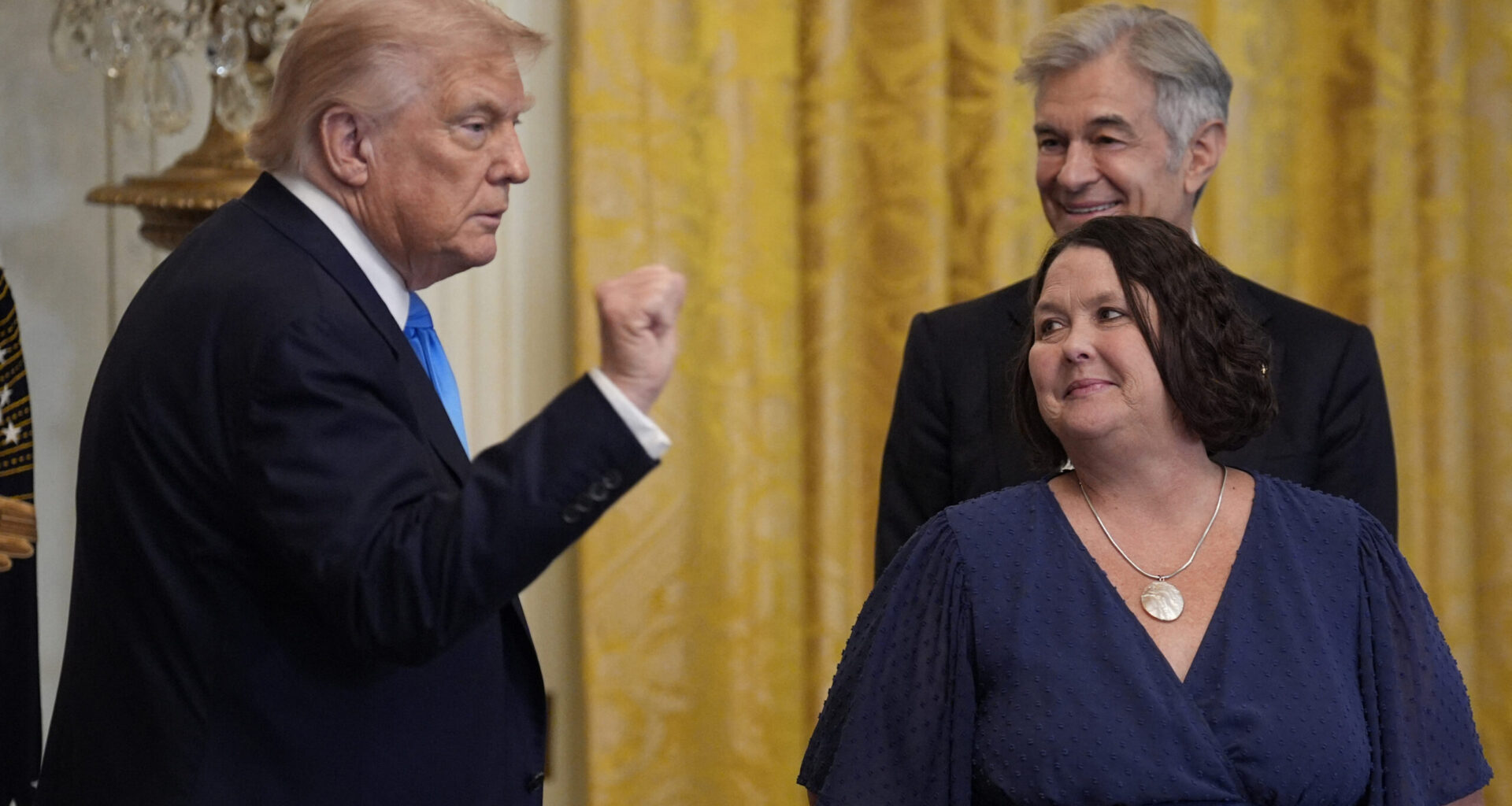
 President Donald Trump, Mehmet Oz, Administrator of the Centers for Medicare and Medicaid Services, and Amy Gleason, acting Administrator of DOGE (Department of Government Efficiency), during Making Health Technology Great Again event in the East Room at the White House in Washington on July 30, 2025. Photo by Yuri Gripas/Abaca/Sipa USA(Sipa via AP Images)
Federal officials acknowledged that Department of Government Efficiency (DOGE) employees coordinated with a political advocacy group on a “voter data agreement” aimed at analyzing voter rolls in an effort to challenge election outcomes.
In a court filing Friday, the Social Security Administration (SSA) revealed that DOGE staffers engaged in unauthorized communications and data planning tied directly to election denial efforts, crossing legal and ethical lines meant to protect voter’s personal information.
Although SSA said it has not yet found proof that its data was actually shared with the group, it did admit the agreement bypassed internal safeguards designed to prevent exactly this kind of misuse of government data.
The court filing does not name the political advocacy group involved. But in early March 2025, the election denier group True the Vote publicly appealed to DOGE to investigate voter registration systems nationwide, urging the agency to combine its access to federal records with outside voter roll data to identify alleged irregularities.
“We’ve received word that this message is being carried forward,” True the Vote founder Catherine Engelbrecht wrote of the effort.
True the Vote played a key role in creating the lie that the 2020 election was stolen, in part by contributing to the debunked conspiracy film “2000 Mules”.
The group did not immediately respond to a request for comment sent via their website.
The admission by SSA comes amid ongoing litigation over DOGE’s access to SSA systems that hold deeply sensitive data on millions of people.
“SSA determined in its recent review that in March 2025, a political advocacy group contacted two members of SSA’s DOGE Team with a request to analyze state voter rolls that the advocacy group had acquired. The advocacy group’s stated aim was to find evidence of voter fraud and to overturn election results in certain States,” the Department of Justice, acting on behalf of the SSA, wrote in the filing. “In connection with these communications, one of the DOGE team members signed a ‘Voter Data Agreement,’ in his capacity as an SSA employee, with the advocacy group. He sent the executed agreement to the advocacy group on March 24, 2025.”
SSA officials disclosed that DOGE staffers were approached in March 2025 by a political advocacy group seeking help scrutinizing voter rolls — and that at least one DOGE team member formally engaged.
“Email communications reviewed by SSA suggest that DOGE Team members could have been asked to assist the advocacy group by accessing SSA data to match to the voter rolls, but SSA has not yet seen evidence that SSA data were shared with the advocacy group,” the filing reads. “At this time, there is no evidence that SSA employees outside of the involved members of the DOGE Team were aware of the communications with the advocacy group. Nor were they aware of the ‘Voter Data Agreement.’ This agreement was not reviewed or approved through the agency’s data exchange procedures. SSA first learned about this agreement during a review unrelated to this case in November 2025.”
The filing also details severe security failures that compounded the risk. DOGE team members used unapproved third-party servers to share data, leaving SSA unable to account for what information may have been exposed.
SSA has referred the conduct of the staffer for Hatch Act review, signaling potential violations of federal laws that prohibit government employees from engaging in partisan political activity.
The disclosure comes months after the Supreme Court allowed DOGE to gain access to SSA data, lifting a lower court that had temporarily barred the agency from accessing it. And after the 4th Circuit heard arguments in September on whether to reinstate the lower court’s injunction — a decision remains pending.
The conduct described in the filing occurred in early 2025 but was not disclosed to the court until last week.
The litigation challenging DOGE’s access to SSA systems remains ongoing, but disclosure aligns with concerns plaintiffs, and government accountability groups, have raised previously about the potential misuse of protected data.