
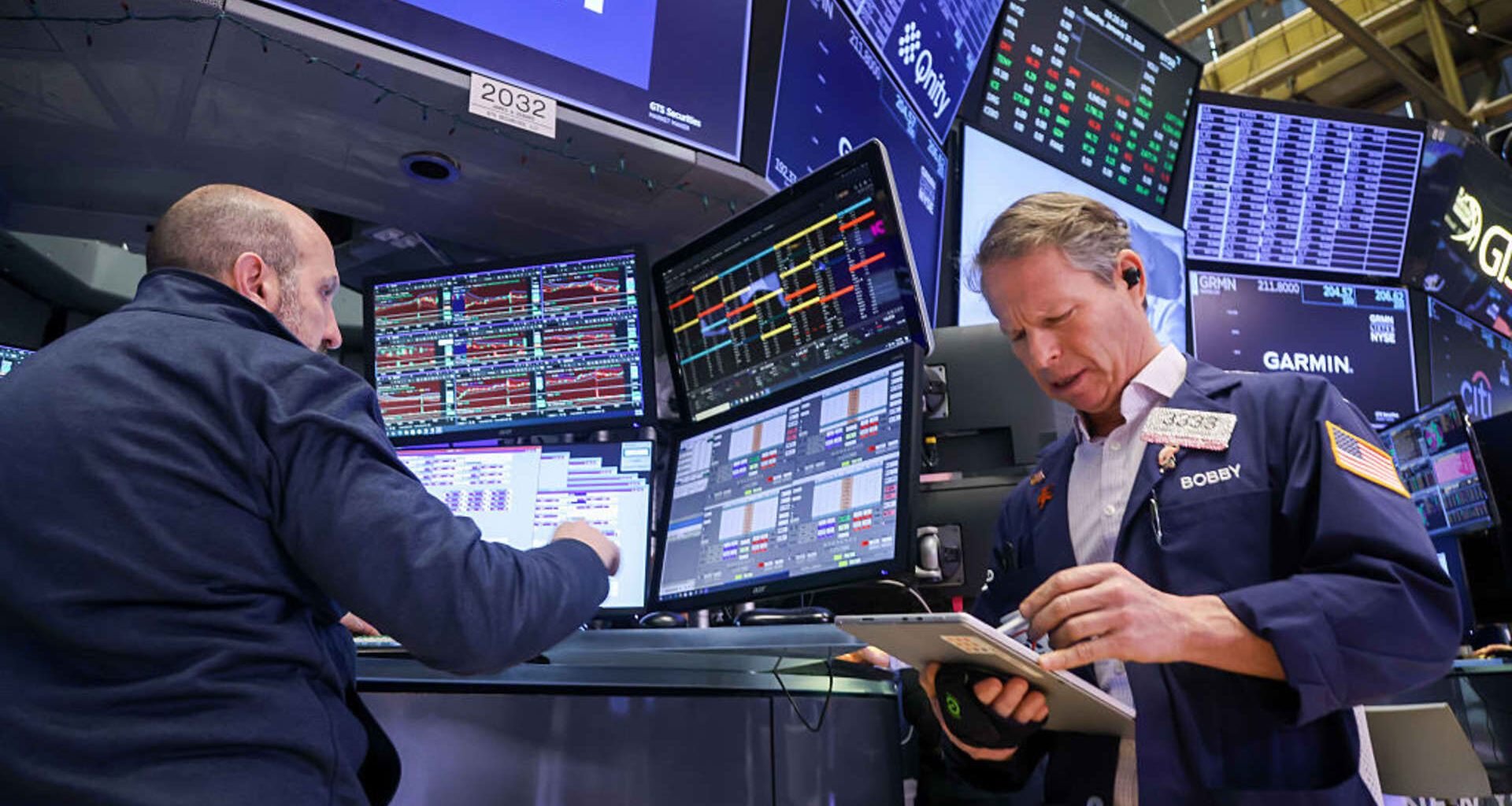
Traders work on the floor at the New York Stock Exchange, Jan. 20, 2026.
Michael Nagle | Bloomberg | Getty Images
Stock futures ticked higher on Wednesday morning, signaling a tentative recovery from Wall Street’s worst day in three months.
Futures tied to the Dow Jones Industrial Average advanced 116 points, or 0.2%. S&P 500 futures added about 0.4%, and Nasdaq 100 futures were 0.4% higher.
U.S. equities posted sharp losses in Tuesday’s session as President Donald Trump escalated his Greenland tariff threats ahead of his scheduled appearance at the World Economic Forum in Davos, Switzerland, on Wednesday. The 30-stock Dow slipped more than 870 points, or about 1.8%, while the S&P 500 lost roughly 2.1%. A drawdown in technology stocks led the selloff, with the Nasdaq Composite sliding 2.4% on the day. All three benchmark indices logged their worst daily performances since Oct. 10. The selloff also dragged the S&P 500 and the Nasdaq into negative territory for 2026.
The so-called sell America trade on Tuesday was accompanied by a spike in U.S. Treasury yields and a decline in the U.S. dollar. The 10-year Treasury yield surged and briefly topped 4.3% at the high of the day.
On Tuesday, Trump declined to say how far he’d go to make Greenland part of the U.S., telling a reporter, “You’ll find out.”
Trump has not ruled out military action to seize the island, and recently threatened to put tariffs of up to 25% on eight NATO members if they block his takeover bid.
Speaking in Davos on Tuesday, European Commission President Ursula Von der Leyen called Trump’s new tariff proposals a “mistake” that would plunge Europe and the U.S. into “a dangerous downward spiral.”
“Our response will be unflinching, united and proportional,” she said, adding that the EU stood in “full solidarity” with Greenland and Denmark.
Bernd Lange, who chairs the European Parliament’s international trade committee, will hold a press conference in Strasbourg, France, later on Wednesday. The BBC, citing unnamed sources, reported that he will announce a suspension of the U.S.-Europe trade deal finalized over the summer.
Also speaking at the WEF on Tuesday, French President Emmanuel Macron said a potential response to new U.S. tariffs was to use the EU’s Anti-Coercion Instrument, which would restrict U.S. businesses’ access to Europe’s single market. Triggering the ACI could exclude American suppliers from participation in EU public tenders, place export and import restrictions on goods and services and put limits on foreign direct investment.
Danish pension operator AkademikerPension said Tuesday that it is exiting its roughly $100 million position in U.S. Treasurys because of finance concerns over U.S. debt. The move came as tensions between the U.S. and Denmark escalate over Greenland.
“It’s not a major pullback yet, and so we do think there’s a possibility and a very realistic possibility for things to go perhaps a more negative turn before they get better, and that’s something that investors could want to position for,” Yung-Yu Ma, chief investment strategist at PNC Asset Management, said Tuesday on CNBC’s “Closing Bell.”
On Wednesday morning, Treasury Secretary Scott Bessent told reporters in Davos that the Trump administration was “not concerned” about the previous day’s sell-off.
This week is a busy one for corporate earnings, which U.S. investors are hoping will continue to prop up the stock market this year. Netflix shares slid in after-hours trading on Tuesday after the streaming giant posted a narrow fourth-quarter earnings beat.
Johnson & Johnson, Halliburton and Travelers are slated to report on Wednesday.