

Listen to this article
Estimated 4 minutes
The audio version of this article is generated by AI-based technology. Mispronunciations can occur. We are working with our partners to continually review and improve the results.
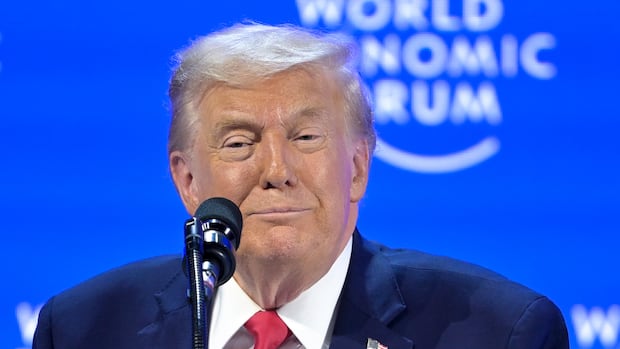
U.S. President Donald Trump claimed on Wednesday that Canada owes its continued existence to the United States while calling out Prime Minister Mark Carney for delivering a speech that condemned coercion by great powers.
Speaking in Davos, Switzerland, where he made the case for a U.S. acquisition of Greenland, Trump said he needs the Danish territory for his proposed “golden dome,” a missile defence system that could cover North America.
Trump said the dome will protect Canada due to geography and the country isn’t grateful enough that such a system is in the works. Carney has been non-committal in the past about Canada participating in or paying for what Trump is floating.
WATCH | ‘Canada lives because of the United States,’ Trump says in Davos speech: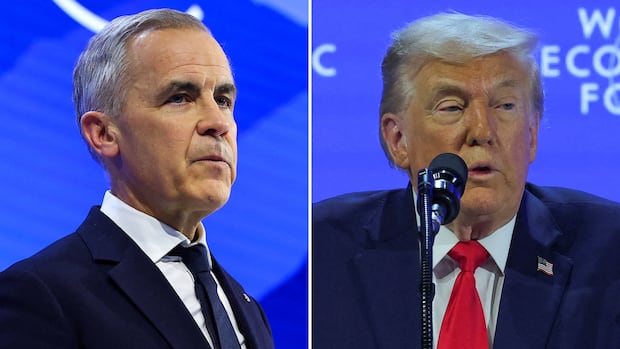
‘Canada lives because of the United States,’ Trump says in Davos speech
In a speech to the World Economic Forum, U.S. President Donald Trump said he watched Prime Minister Mark Carney’s speech the previous day and ‘he wasn’t so grateful – they should be grateful.’ Trump added that ‘Canada gets a lot of freebies from us.’
“Canada gets a lot of freebies from us. By the way, they should be grateful but they’re not,” Trump said.
“I watched your prime minister yesterday. He wasn’t so grateful — they should be grateful to the U.S., Canada. Canada lives because of the United States,” Trump said, an apparent reference to the military protection the U.S. provides to the continent.
“Remember that, Mark, the next time you make your statements,” he said, but not to the prime minister directly, who left the summit before Trump delivered his remarks. The two did not meet on the sidelines of the summit.
Without invoking Trump by name, Carney referenced “American hegemony” and said Tuesday world powers are using economic integration as “weapons.”
“Canadians know that our old, comfortable assumption that our geography and alliance memberships automatically conferred prosperity and security is no longer valid,” Carney said.
As it grapples with this new dynamic, Carney said Canada must be “principled and pragmatic” and turn inward to build up the country and diversify trading relationships to become less reliant on countries like the U.S., now that it’s clear integration can lead to “subordination.”
WATCH | Carney says ‘the old order is not coming back’ in Davos speech: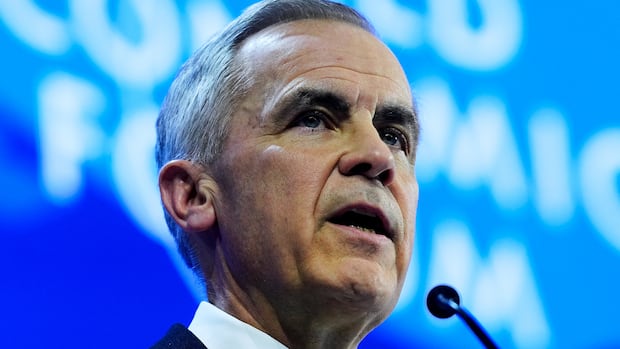
Carney warns allies to act together or be ‘on the menu’ of great powers
In a bold speech at the World Economic Forum in Davos, Switzerland, Prime Minister Mark Carney warned allies the ‘old order is not coming back,’ and that middle powers must work together or end up ‘on the menu’ of great powers weaponizing economic integration.
Carney said this more isolationist approach, where there’s a “world of fortresses,” will make countries poorer, fragile and less sustainable. But, he said, it’s coming nonetheless and Canada must work with like-minded allies where possible to push back against domination by larger, wealthier and well-armed countries.
“The old order is not coming back. We should not mourn it. Nostalgia is not a strategy. But from the fracture, we can build something better, stronger and more just.”
During his long, rambling remarks, Trump again referenced Canada while he was touting the supposed benefits of his global tariffs regime.
He said these levies are bringing “hundreds of big factories [and] car plants” back to the U.S.
“[They’re] coming in from Canada, coming in from Mexico, from Japan. Japan’s coming in and building plants here in order to avoid tariffs,” Trump said.
Trump is fixated on the damage he has inflicted on the Canadian auto sector.
At a White House news conference on Tuesday to mark one year since his second inauguration, Trump cited trouble in Canada’s automotive industry as one of his accomplishments.
Trump told workers at a Ford factory in Dearborn, Mich., last week that Americans “don’t need cars made in Canada.” Vehicles are the second-largest Canadian export by value at $46.5 billion in 2024, of which 92 per cent was exported to the U.S.
Auto assembly plants in Brampton and Ingersoll, Ont., have been idled since Trump launched his trade war. And some automakers like General Motors and Chrysler parent company Stellantis have announced new investments in the U.S.
Yet despite the president’s rhetoric, preliminary data from the U.S. Bureau of Labor Statistics shows there has actually been a contraction in auto industry jobs south of the border over the last year.