


Listen to this article
Estimated 4 minutes
The audio version of this article is generated by AI-based technology. Mispronunciations can occur. We are working with our partners to continually review and improve the results.
The federal government hasn’t yet secured a permanent removal of tariffs on Canadian products like canola, in part because of ongoing negotiations with Beijing over Chinese steel and aluminum.
Agriculture Minister Heath MacDonald, in response to a reporter’s question, said this was among the reasons China has agreed to relax its tariff on some Canadian agri-goods only until the end of this year.
Canada levies tariffs on Chinese steel and aluminum. In Ottawa’s view, the Chinese government engages in unfair trading practices that include pervasive subsidization of its metal industries to produce low prices, which distort global trade.
MacDonald, back from the government’s recent visit to China, told reporters on Tuesday that both Ottawa and Beijing are working on “remissions relative to steel.” The Canadian government offers remissions or relief from tariffs it places on certain Chinese steel and aluminum products that typically are unavailable or in short supply in Canada.
Ottawa announced that Canada is extending those remissions measures until the end of 2026.
“So we’ve got some work to do on that,” MacDonald said.
When pressed for further details, the minister said, “On steel and aluminum, we need to further identify the situation with China and the federal Canadian government to ensure that we’re meeting their demands and they’re meeting our demands.”
MacDonald’s office sent CBC News a followup statement emphasizing that the sticking point wasn’t just steel and aluminum but that “there are still a number of issues and concerns on both sides that need to be worked through.”
It did not mention what those other issues are.
‘We were leaning on an open door’: minister
On Friday, the Liberal government reached a deal with Beijing to allow tens of thousands of Chinese electric vehicles into the domestic market in exchange for China lowering duties on Canadian canola products.
Prime Minister Mark Carney described this as a “preliminary but landmark” agreement. Ottawa expects Beijing to drop canola seed duties from 84 to 15 per cent by March 1. Tariffs on canola meal, lobsters, peas and crabs will be lifted on March 1 until the end of this year.
Canola seed is the raw product from which canola oil is made, whereas canola meal is the byproduct that is often used as feed for animals.
The agreement signalled that the progress made is only a first step and that there could be more to come.
“We were leaning on an open door,” MacDonald said during the news conference on Tuesday, describing trade negotiations with China. “And we’ll keep moving forward.
“We feel that there’s more opportunities in China for other products when we talk about energy, minerals, and so on and so forth,” he added.
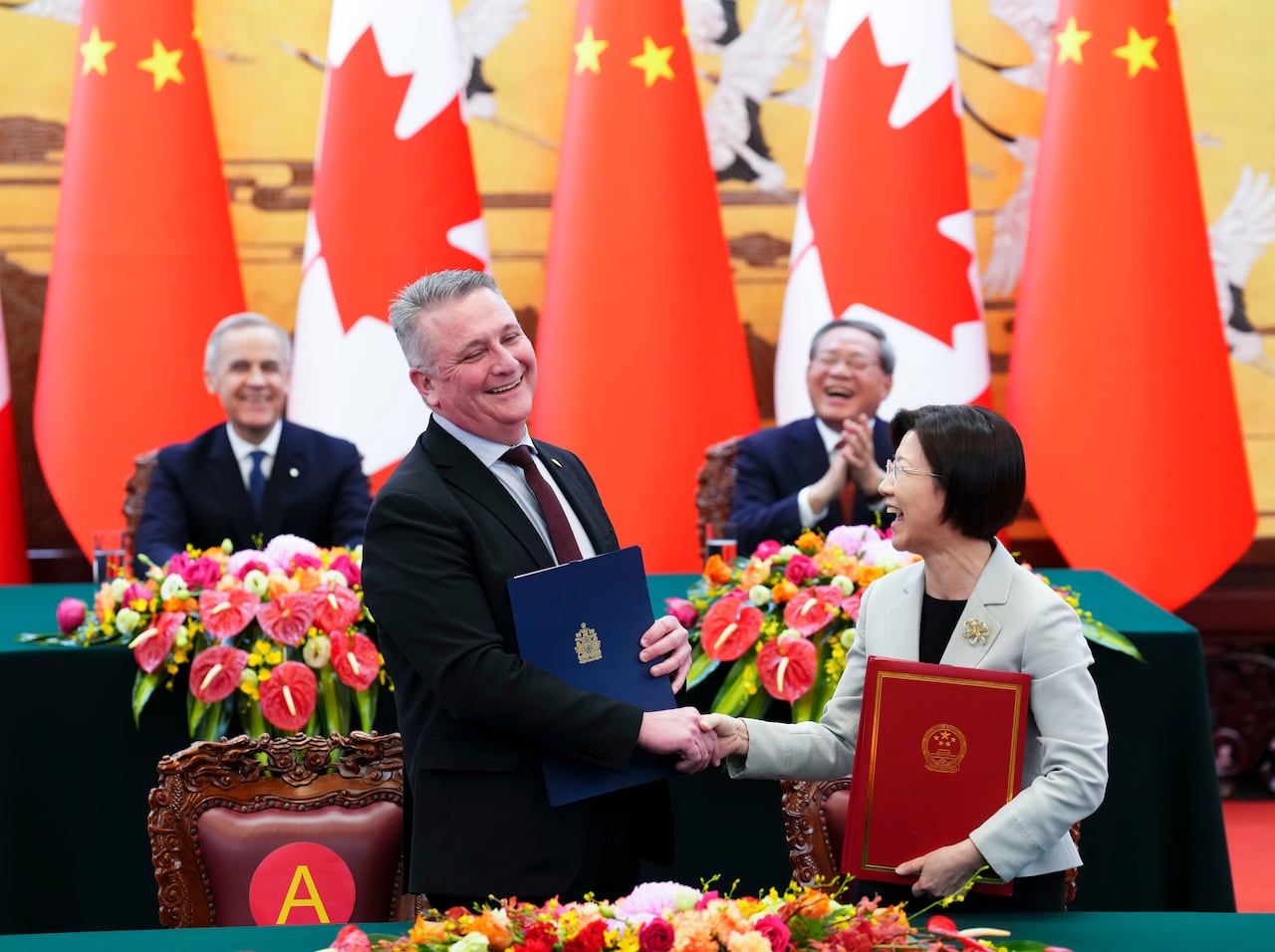 Prime Minister Mark Carney, back left, and Chinese Premier Li Qiang, back right, look on as MacDonald, front left, and Sun Meijun, China’s minister of the general administration of customs, take part in a signing ceremony at the Great Hall of the People, in Beijing on Jan. 15. (Sean Kilpatrick/The Canadian Press)
MacDonald said when the Canadian delegation arrived in Beijing last week, “there was nothing etched in stone.”
But when he met with Sun Meijun, China’s minister of the general administration of customs, she told him “there’s good news on beef.”
There was no heads-up.
“That’s how quickly this all happened,” MacDonald said. “We were there, we were ready, and we’ll be ready in the future — and we’ll get the deals done that need to be done for a long-term relationship.”
China places canola and beef orders
MacDonald also said that China is moving quickly to import Canadian canola seed and beef.
He said a Chinese importer has ordered 60,000 tonnes of canola seed, and he’s aware of a Canadian company shipping its first load of beef to China next week.
It’s expected be the first time China has purchased Canadian canola seed and beef since it imposed measures to block such products.
MacDonald announced China was lifting its ban on Canadian beef imports days after Ottawa and Beijing struck the deal to reduce tariffs on Canadian canola and Chinese electric vehicles.
China banned Canadian beef in 2021, after an atypical case of bovine spongiform encephalopathy — known as BSE or mad cow disease — was found on an Alberta farm.
BSE is a fatal brain disease in cattle, and atypical strains pose no health risks to humans.
Tariffs remain on Canadian pork, but MacDonald said negotiations are continuing — although he noted China produces 90 per cent of the pork it consumes.
“There still is a market there for us,” the minister said.