
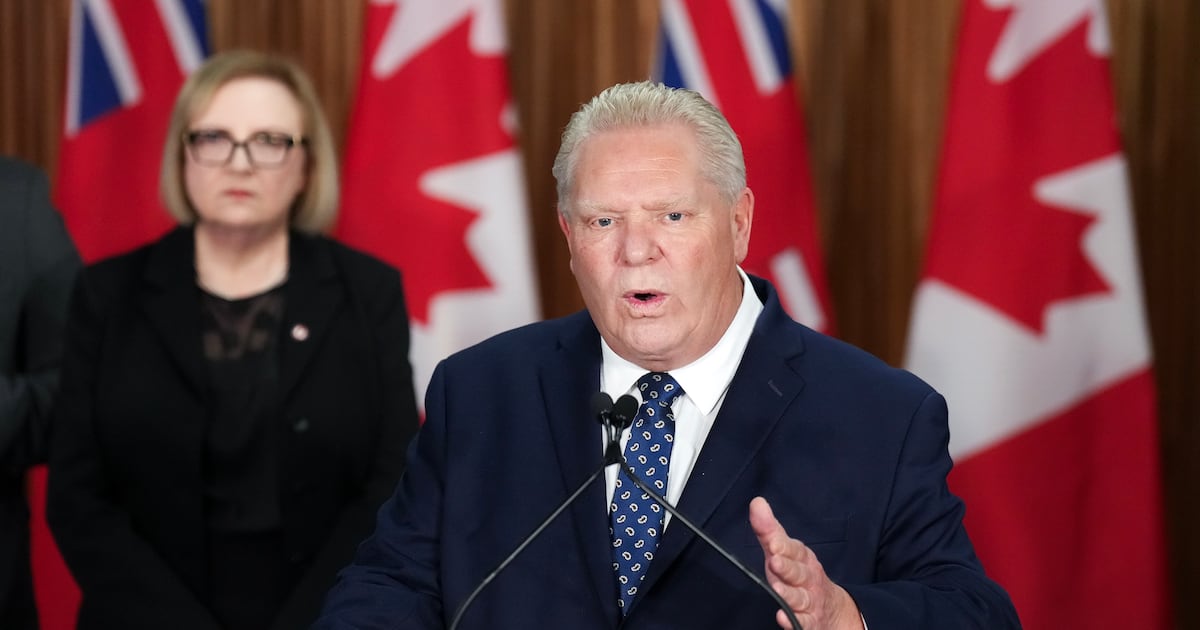
Ontario Premier Doug Ford says he’s ‘discouraging’ Canadians from buying Chinese-made EVs, warning Canada is facing pressure from both China and Trump.
Ontario Premier Doug Ford is calling on Canadians to boycott Chinese-made vehicles in the wake of a federal trade deal that will allow them into the country.
“Boycott the Chinese EV vehicles. Support companies that are building vehicles here,” Ford said at a news conference at Queen’s Park Wednesday, flanked by representatives from the auto industry.
“This is a team Canada approach. We gotta stick together.”
Last week Prime Minister Mark Carney announced a trade deal with China that will see the federal government allow close to 50,000 Chinese-made electric vehicles a year to come into Canada in exchange for greatly easing tariffs on Canadian agricultural products.
Ford has called the move “a terrible deal” and has said it will come at the expense of Canadian workers and Ontario’s auto industry. He said Carney did not reach out to him about the deal beforehand, despite the fact it could greatly impact Ontario’s auto sector, and the two haven’t spoken since.
“Maybe a few people might buy them, and I discourage anyone from buying a Chinese vehicle,” Ford said. “But if they decide to do that, at what cost is it? Is it at the cost of your neighbor down the street that’s working in the auto sector that he’s not going to have, or she’s not going to have a job?
‘Fight of our lives’: Industry calls for support
Ford held the news conference along with Canadian Vehicle Manufacturers’ Association President and CEO Brian Kingston, Automotive Parts Manufacturers’ Association President Flavio Volpe, and UNIFOR President Lana Payne.
All three echoed Ford in calling on the federal government to do what it can to support Ontario’s existing automotive industry, including scrapping federal EV mandates and fees that add to vehicle costs.
“There’s no sugar-coating this. We are in the fight of our lives here fending off Trump’s tariffs, and that fight just got a little harder,” Payne said. “We must collectively come together to stabilize and protect the auto sector we have so we can actually have a future one.”
Payne said nearly 4,000 Unifor members are without work, with 1,000 more workers expected to be impacted in the near future with the elimination of a shift at General Motors in Oshawa.
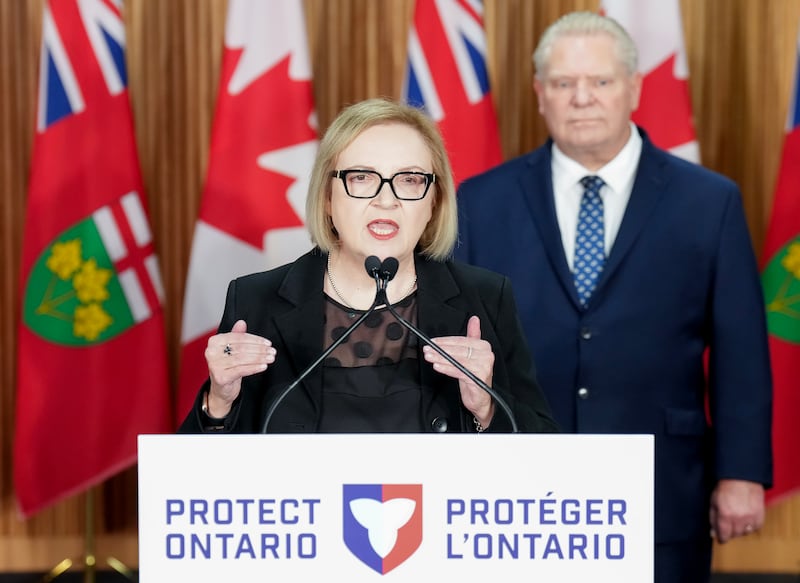 Lana Payne, Lana Payne, National President of Unifor speaks to the media with Ontario Premier Doug Ford regarding the federal governments decision to allow Chinese EV’s into Canada at Queen’s Park in Toronto on Wednesday, January 21, 2026. THE CANADIAN PRESS/Nathan Denette
Kingston said his association sees the idea of manufacturing Chinese cars in Canada as unworkable.
“There is no industry without U.S. access and North American integration,” Kingston said. “Diversification is not an option for automotive as markets in Europe and Asia are better served by assembly plants in those regions.”
Volpe pointed out that 50,000 vehicles represents a shift at an auto plant and said “those jobs don’t exist comfortably in this new world.”
Payne added that China has little need for additional EV production facilities.
“Given China’s massive, and I say massive over-capacity in EV production, there is little reason for those companies to establish real and meaningful manufacturing operations in our country,” she said.
Ford to meet with Carney next week
Asked what his government could do in response to the deal, Ford said he plans to sit down with Carney and the other premiers next week and he will hear them out before responding.
“I want to find out what is the big auto deal that they have here for Ontario to protect auto workers. This is all about protecting our workers. And I’ll see what they have to say, then we’ll respond appropriately,” Ford said.
Asked if there’s any way he would support Chinese vehicles being manufactured in Canada, Ford said “the numbers just don’t add up” and the idea would not be desirable if all the parts were being imported.
“Even if they do start assembling, how about the supply chain? They come and they assemble, but they bring all Chinese parts in; that means nothing,” Ford said. “We want to make sure we produce Canadian cars by Canadians, with the R and D and the specs and everything, and the steel, and the aluminum from Canada. It’s as simple as that.”
 Argentina China EV Cars The BYD Changzhou car carrier is docked at Terminal Zarate in the Buenos Aires province of Argentina, Tuesday, Jan. 20, 2026, where hybrid and electric vehicles shipped from China are parked next to the ship. (AP Photo/Victor R. Caivano)
Ford previously called Chinese EVs “spy cars” that could undermine trade negotiations with the U.S.
Canada had been imposing a 100 per cent tariff on Chinese-made EVs since 2024, in lockstep with the U.S., until Carney’s deal was announced.
The prime minister has said the country needs to accept the fact the U.S. wants to change its trade relationship with Canada and look elsewhere for other trade partners.
Green Leader calls for Ontario EV incentives
In a statement, Ontario Green Leader Mike Schreiner said that the province should be doubling down on its own EV strategy to protect Ontario’s economy in the face of the deal.
“The federal government’s deal with China threatens Ontario’s automotive industry. This is even more reason for the premier to take bold action to bring forward a complete plan to protect Ontario workers by going all-in on incentives to create demand for Ontario-made EVs,” Schreiner said in a statement.
He pointed out that EV sales are “skyrocketing” in other parts of the world, but lagging in Ontario.
“The premier must reverse course on his hostility to incentives that create demand for EVs. Ontario must incentivize demand by making EVs more affordable with rebates, by investing in charging stations across the province and by implementing a procurement program for public-sector fleets,” Schreiner said.