
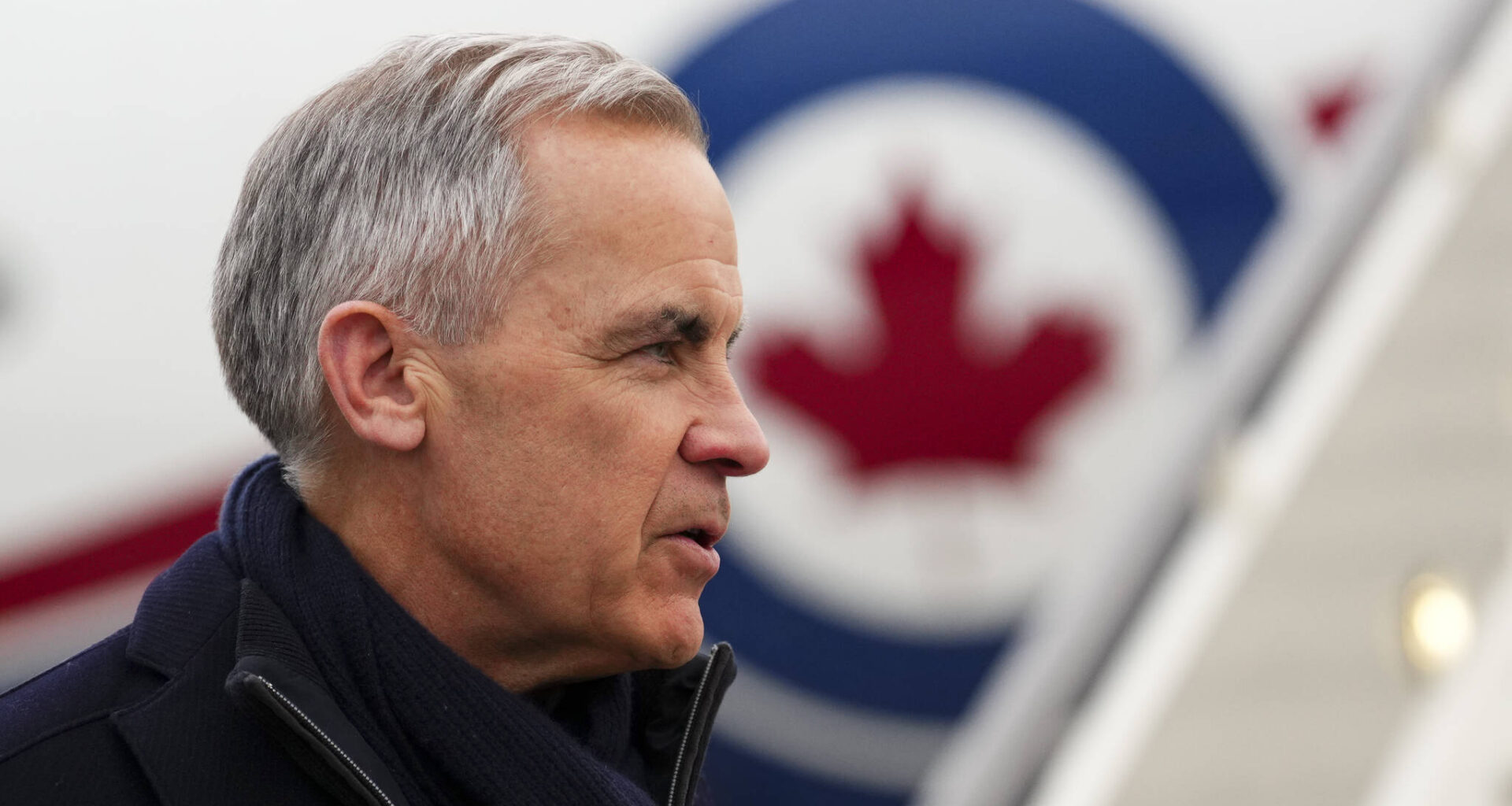
Prime Minister Mark Carney’s decision to spend a few days this week rubbing elbows with the global elite in Davos has, predictably, sent his critics into a froth.
According to Conservative Leader Pierre Poilievre, the World Economic Forum is little more than a convention of “globalist elites” who are out of touch with ordinary Canadians. The implication is that nothing good for Canada can possibly come from talking to people who manage capital, shape markets and influence global investment flows.
He’s wrong.
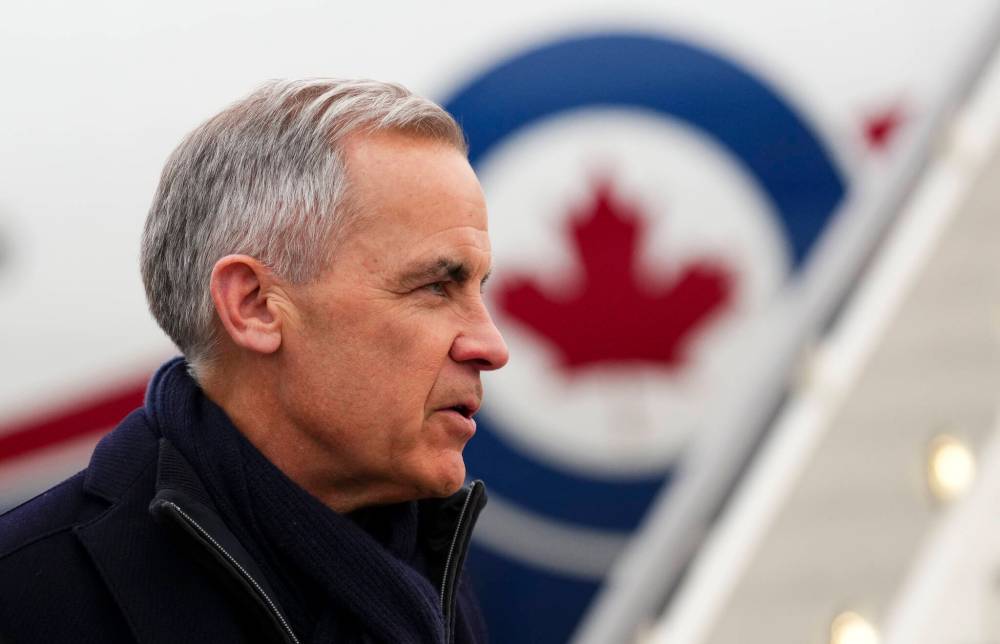
SEAN KILPATRICK / THE CANADIAN PRESS FILES
Prime Minister Mark Carney arrives in Zurich, Switzerland on Monday, Jan. 19, 2026, to attend the World Economic Forum in Davos.
That argument may be emotionally satisfying in an age of populist anger, but it is also deeply unserious and dangerously wrong for a country whose prosperity depends on its ability to sell itself to the world.
Let’s start with a hard, cold fact: countries that want investment have to go where investors are. That has always been true.
It was true when then-prime minister Stephen Harper showed up at Davos in 2010 and 2012, pitching Canada as a safe, well-regulated place to park capital after the global financial crisis.
It was true when Justin Trudeau went while he was prime minister, albeit with less gravitas. And it is certainly true now, when Canada faces a far more volatile and uncertain global economic environment than it did a decade ago.
Carney is not going to Davos for the fondue or the photo ops. He is going because Canada needs money — private capital — to build things. Big things. Clean-energy projects. Critical minerals supply chains. Advanced manufacturing. Infrastructure that can actually support economic growth.
Governments cannot finance those things alone. Anyone who pretends otherwise is selling fairy tales.
What makes Poilievre’s opposition especially hollow is that he knows this. He sat in Harper’s caucus when Conservatives embraced the very same logic: Canada had something to say, something to sell and Davos was one of the places to say it.
Back then, Conservatives didn’t whine about “Davos elites.” They bragged about Canada’s stability, its banks, its resources and its rule of law. Somehow, what was pragmatic conservatism then has become populist posturing now.
The stakes today are higher. For decades, Canada has relied far too heavily on the United States as its economic lifeline. Geography made that easy, and free trade made it profitable.
But Donald Trump has blown a hole through the comforting assumption that the U.S. will always be a predictable, reliable partner. His trade wars, casual threats to tear up agreements and open disdain for multilateralism have forced a rude awakening in capitals around the world — including Ottawa.
When Trump treats trade as a weapon and alliances as optional, smaller countries don’t get the luxury of sulking at home. They adapt or they get squeezed. Diversifying Canada’s economy and its trade relationships isn’t some abstract “globalist” obsession. It’s basic risk management.
That’s where Davos matters. Not because it is perfect — it isn’t — but because it is one of the few places where political leaders, investors and corporate decision-makers are in the same room at the same time.
Countries that stay home and pout get ignored.
Carney, unlike most politicians, doesn’t need to fake credibility in that environment. He earned it. As a former central banker, he speaks the language of capital fluently.
That matters when Canada is competing with dozens of other countries for a finite pool of investment dollars. You don’t win that competition by shouting slogans about “elites.” You win it by demonstrating competence, stability and opportunity.
Poilievre’s alternative appears to be economic nationalism wrapped in grievance politics: denounce global forums, promise to boycott them and somehow expect investment to magically materialize anyway. It’s a nice applause line at rallies. It’s also a recipe for economic marginalization.
There is a legitimate debate to be had about how investment benefits are shared, how workers are protected and how communities see real returns. But refusing to engage with the global economy doesn’t empower ordinary Canadians, it impoverishes them.
Jobs don’t get created because a leader refuses to talk to people with capital. They get created when investment flows into productive projects here at home.
Wishing the old U.S. relationship back into existence is not a strategy. Building alternatives is. That means deeper ties with Europe, Asia and emerging markets.
Winnipeg Free Press | Newsletter

In the end, Carney’s trip to Davos is not about elitism. It’s about realism. Canada is a mid-sized economy in a turbulent world. It cannot afford ideological purity tests when its prosperity is on the line.
Courting investment, diversifying economic partners and reducing reliance on an increasingly unpredictable United States is not just smart policy, it’s necessary.
Poilievre may score points by sneering at Davos. Carney is doing the harder, less glamorous work of making sure Canada still has a seat at the table.
In times like these, that’s not globalist betrayal. It’s responsible leadership.
tom.brodbeck@freepress.mb.ca

Tom Brodbeck is an award-winning author and columnist with over 30 years experience in print media. He joined the Free Press in 2019. Born and raised in Montreal, Tom graduated from the University of Manitoba in 1993 with a Bachelor of Arts degree in economics and commerce. Read more about Tom.
Tom provides commentary and analysis on political and related issues at the municipal, provincial and federal level. His columns are built on research and coverage of local events. The Free Press’s editing team reviews Tom’s columns before they are posted online or published in print – part of the Free Press’s tradition, since 1872, of producing reliable independent journalism. Read more about Free Press’s history and mandate, and learn how our newsroom operates.
Our newsroom depends on a growing audience of readers to power our journalism. If you are not a paid reader, please consider becoming a subscriber.
Our newsroom depends on its audience of readers to power our journalism. Thank you for your support.