
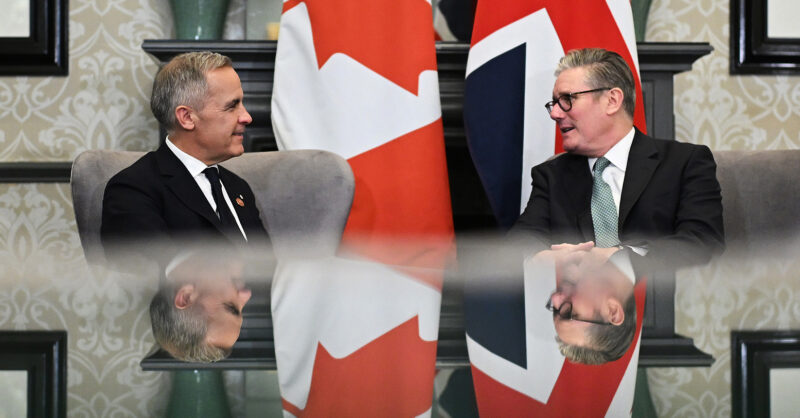
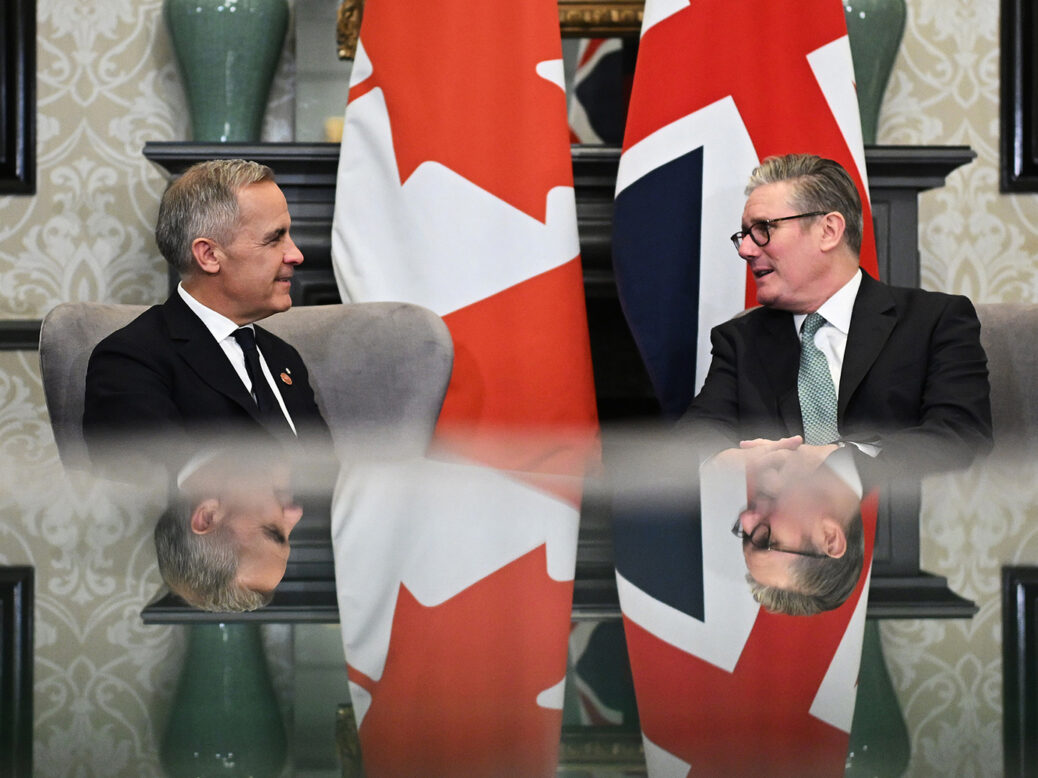
Photo by Leon Neal/Getty Images
What does a speech that meets the moment look like? Mark Carney showed the world at Davos yesterday. As an exercise in articulating a new geopolitical reality, his 30-minute address bears comparison with Harold Macmillan’s “Wind of Change”, the speech that drew the curtain on British colonialism. “The old order is not coming back,” said Carney, as he channelled Thucydides and Václav Havel. “We should not mourn it. Nostalgia is not a strategy.”
Carney has long loomed larger in British politics than seemed likely after his undramatic exit from the Bank of England six years ago. Back in 2023, in a pre-recorded video for Labour’s conference, he endorsed Rachel Reeves as the next chancellor, prompting some to later explore whether a place could be found for him in the administration.
Then last year his landslide Canadian election victory was celebrated as a model of progressive recovery (one invoked at Labour’s political cabinet earlier this month). In recent weeks, as the UK has grappled with Trump’s hyper-unilateralism, Carney’s oratory and world-view have been cited by government sources as a template for Starmer.

New year, new read. Save 40% off an annual subscription this January.
Close
What’s notable about the “Carney doctrine” – as it has quickly become known – is that it represents a version of the “progressive realism” that David Lammy and his adviser Ben Judah, who left government last week to return to the think-tank world, championed at the Foreign Office but that Starmer didn’t embrace as his own.
“Our new approach rests on what Alexander Stubb has termed ‘values-based realism’ – or, to put it another way, we aim to be principled and pragmatic,” said Carney. “Principled in our commitment to fundamental values: sovereignty and territorial integrity, the prohibition of the use of force except when consistent with the UN Charter, respect for human rights. Pragmatic in recognising that progress is often incremental, that interests diverge, that not every partner shares our values.”
Here, if Starmer is willing to use it, is a model for British foreign policy, one defined by neither naive idealism nor cynical realpolitik. It would offer a framework for explaining closer cooperation with China – Starmer will soon become the first UK leader to visit since 2018 – and an enduring commitment to multilateral institutions and to the aspiration, if far from the reality, of international law. In the case of the US it places clear and new boundaries on the relationship, rejecting both the Reform vision of the UK as a junior pirate to Trump’s America and the CND unilateralism of the left-populist Greens.
A progressive realist speech from Starmer would explain the desirability and the necessity of closer ties with Europe – for reasons of economic and national security – and, summoning the spirit of Clement Attlee and Ernest Bevin, the shared sacrifices that will have to be made to fund a new era of higher defence spending. It would abandon any notion that foreign policy can be deprioritised in favour of domestic policy and instead articulate a doctrine that recognises the interconnectedness of the two. Above all, it would demonstrate leadership of a kind that both party and country crave. But does Starmer have the political imagination to make it?
This piece first appeared in the Morning Call newsletter; receive it every morning by subscribing on Substack here
[Further reading: The turn to Europe is inevitable]
Content from our partners