

Ontario’s licensed child-care centres are increasingly relying on underqualified staff, a new analysis of provincial data shows.
Ontario’s licensed child-care centres are increasingly relying on underqualified staff, a new analysis of provincial data shows.
A report by the non-profit group Building Blocks for Child Care, based on data obtained through a freedom of information request, found that there has been a spike in the use of “director approvals” — exemptions that allow non-Registered Early Childhood Educators (RECEs) to fill roles that normally require certification.
The data showed that the number of director approvals in Ontario has risen from 159 in 2020-2021 to 1,997 in 2024-2025, a staggering 1,156 per cent increase.
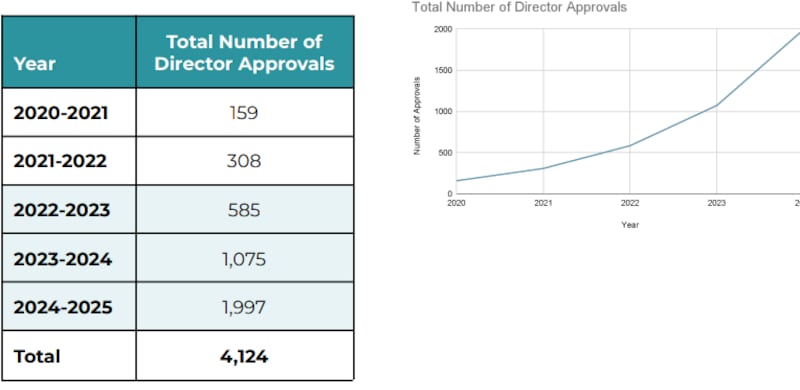 chart A visual representation showcasing the increase of director approvals from 2020-2025 (Photo by Building Blocks for Child Care).
“I think it’s alarming,” said Asvini Uthayakumaran, a policy researcher at Building Blocks for Child Care (B2C2) who worked on the report. “How is this a sustainable way forward? It doesn’t seem like there’s any plans to address it.”
“An increase of over 1,000 per cent in the use of Director Approvals is definitely extreme,” added Susan Colley, who is chair of Building Blocks for Child Care.
In order to become a registered Early Childhood Educator in Ontario you need to earn a Early Childhood Education diploma – typically a two-year program – or complete other programs recognized by the College of Early Childhood Educators.
But director approvals allow individuals without these credentials to work in registered child-care centres, including in supervisory roles.
Researchers say these approvals were originally intended to be a short term tool to address staffing shortages. However, data outlined in the report shows it’s being used for supervisory and program staff at a rising rate.
For example, between 2022-2025 the number of non-RECE supervisors increased by 151 per cent in Ontario. Meanwhile, the share of new supervisors who are “formally registered” only increased by 118 per cent.
“When you start adding more and more unqualified staff, it puts pressure on the existing staff, who have to do more work, explain more, and are accountable to the college for their conduct,” Colley said.
The trend comes as Ontario attempts to rapidly expand its childcare system under the Canada-wide Early Learning and Child Care agreement. The province’s own auditor general has estimated Ontario will need up to 10,000 additional RECEs to meet its expansion targets by 2026.
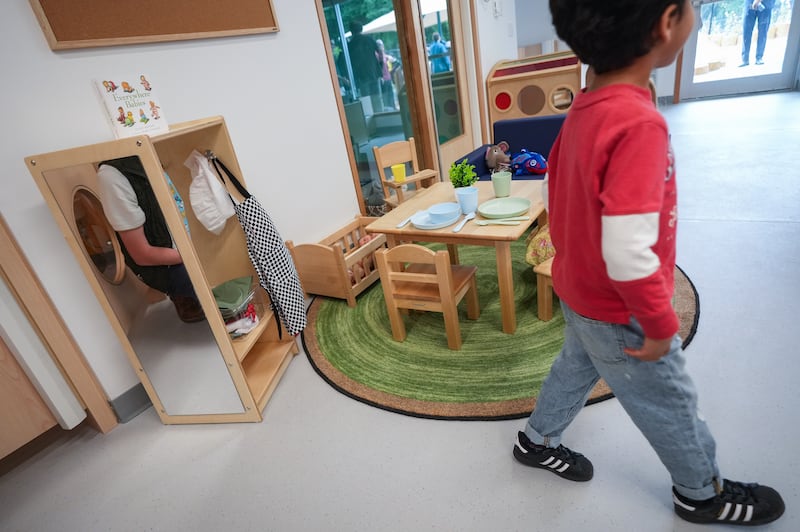 kid A young boy walks past a play area at a facility operated by the YMCA, on Thursday, July 3, 2025. THE CANADIAN PRESS/Darryl Dyck Which region stands out?
The data suggests that the use of director approvals fluctuates considerably from community to community.
Ontario’s East Region had the highest use of director approvals.
In that region, director approvals are used in 84 per cent of child-care centres. Ottawa and Prescott and Russell both saw a rise of more than 100 per cent, a move researchers say is likely tied to multiple exemptions by the ministry.
York Region also shows heavy reliance, with 74 per cent of centres using director approvals.
By contrast, Toronto and Peel report much lower rates, at 25 per cent and 21 per cent, respectively.
In a statement to CTV News Toronto, Toronto Mayor Olivia Chow’s office says “qualified staff are critical to the success of CWELCC and ensuring quality child care.”
“The Mayor is focused on supporting recruitment and retention, while continuing to advocate to the Province for the investments in wages and benefits needed to stabilize the sector,” the statement reads.
 chow Toronto Mayor Olivia Chow visits Albion Heights Junior Middle School in Toronto on Friday, March 21, 2025. THE CANADIAN PRESS/Richard Lautens-Pool
Several northern and rural regions also show especially high reliance on director approvals to hire staff who are not registered ECE’s.
“The fact that director approvals and staffing shortages are even more acute in northern and remote regions, underscores the need for targeted workforce strategies to attract and retain qualified educators where they are needed most,” said Emis Akbari, a professor at George Brown Polytechnic.
A statement from the province
In a statement, Education Minister Paul Calandra’s office said director approvals provide the necessary flexibility to keep centres operating.
“The flexibility provided through director approvals allows licensed child-care programs to continue operating in situations where they may have otherwise been unable to do so,” the ministry said.
 PC Paul Calandra visits children at the Blessed Chiara Badano Child Care Centre in Stouffville, Ont., Friday, May 2, 2025. THE CANADIAN PRESS/Nathan Denette
The ministry said director-approved staff must meet certain requirements, and may have backgrounds in teaching, social work, Montessori training, or be working toward their ECE diploma.
It should be noted that Ontario has also raised wages for RECEs, increasing the starting wage to $25.86 an hour as of 2026, a move the province said was aimed at addressing those widespread staffing shortages.
But the report notes that when Ontario signed the federal childcare agreement in 2022, 59 per cent of full-time staff were RECEs. That share has since fallen to 56 per cent, moving the province further away from its own 60 per cent target.
Experts: long-term impacts are ‘significant’
CTV News spoke to several experts who warn the exemptions will lead to consequences that go far beyond staffing logistics.
“Strong, warm and nurturing relationships are key in supporting young children and there’s no way those can be formed when staff turnover is high,” said Michal Perlman, a professor of early childhood education at the University of Toronto.
“While parents may see short-term staffing solutions as necessary to keep programs open, the longer-term impacts on children’s development and well-being are significant.” Kerry McCuaig, a senior fellow in early childhood policy at the Atkinson Centre, added.
“Without action, these staffing patterns risk becoming permanent rather than temporary fixes,” she said.
Uthayakumaran, for her part, said the data should be a call to action.
“My message to parents would be to use this information as a push to advocate for these issues … I really believe that people have the power to change situations … this should be a sort of catalyst for further action.”
—
Do you have a child in a licensed daycare in Ontario? Have you noticed staffing shortages, frequent changes, or classrooms run by educators without formal ECE qualifications? Has it affected your child or family?
Share your story by emailing us at torontonews@bellmedia.ca with your name, general location, and phone number in case we want to follow up.
Your comments may be used in a CTVNews.ca story.