
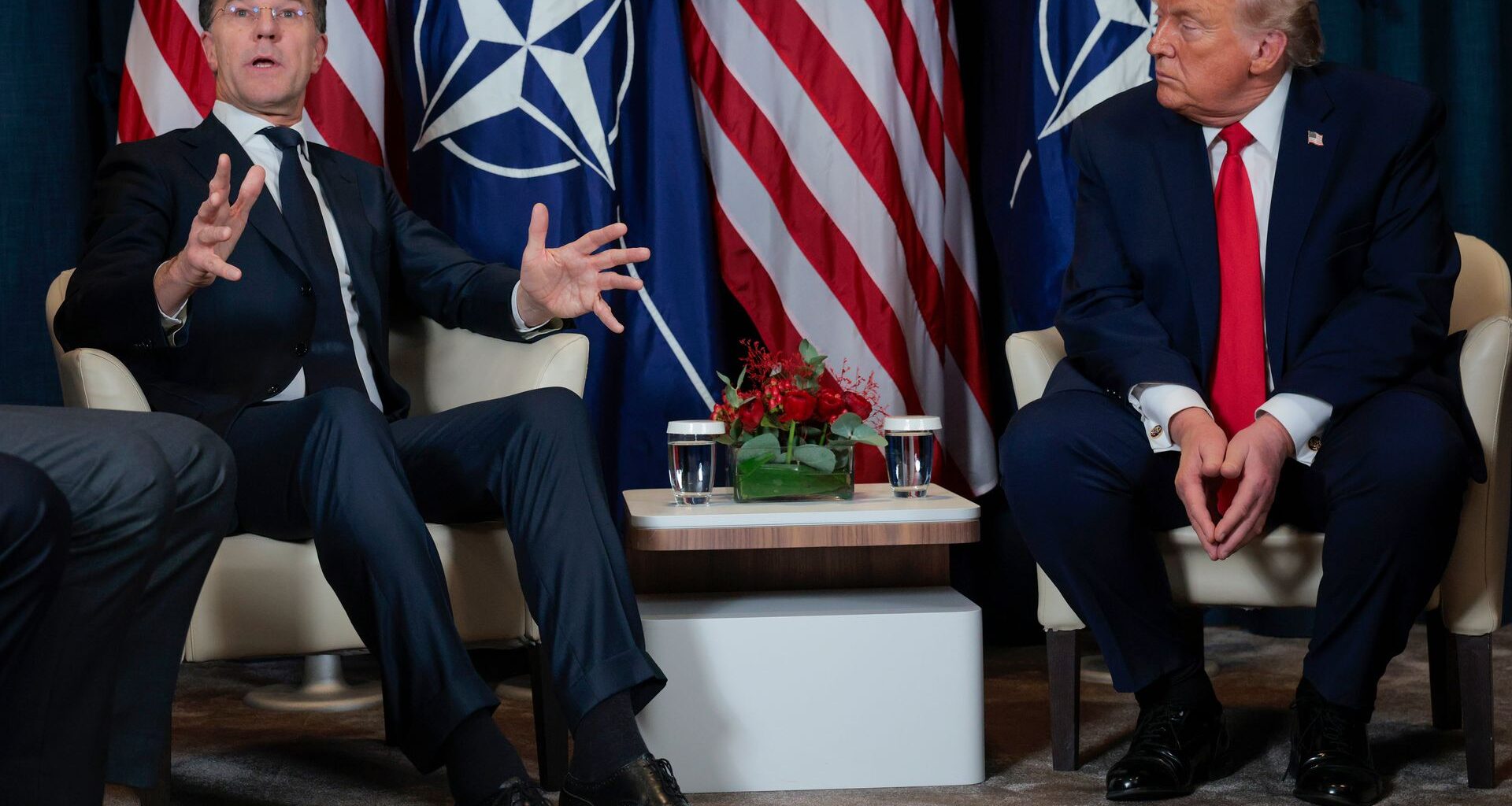
U.S. President Donald Trump said on Jan. 21 that Washington has formed a “framework of a future deal” on Greenland, adding that he would refrain from imposing tariffs on European nations following talks with NATO Secretary General Mark Rutte.
“This solution, if consummated, will be a great one for the United States of America, and all NATO Nations,” he wrote on social media, offering little clarity on what the framework actually entails.
Speaking to reporters later, Trump said the U.S. “gets everything we wanted, including real national security and international security” under the proposed deal, adding that it would last for an “infinite” period of time.
CNN reported, citing a NATO official, that Denmark is considering allowing the U.S. to build additional military bases in Greenland, although the plans have not been finalized.
Rutte told Reuters that the deal would also hinge on NATO allies doing more to strengthen Arctic security, while the issue of mineral extraction was not part of the discussions.
Danish Foreign Minister Lars Lokke Rasmussen welcomed Trump’s decision to de-escalate, including pausing the trade war, saying Denmark is open to dialogue on addressing U.S. security concerns.
“The day is ending on a better note than it began,” he added.
The announcement marked a shift from Trump’s earlier threats to impose sweeping tariffs on U.S. allies. On Jan. 17, he said Washington would impose 10% tariffs on France, Sweden, Denmark, Norway, Germany, the U.K., the Netherlands, and Finland unless the U.S. secured a deal to buy Greenland, with the tariffs set to rise to 25% later this year.
The tariff threat followed the arrival of European troops from France, Germany, and other countries in Greenland for military exercises, fueling concerns in European capitals that Trump’s rhetoric is expanding into economic pressure.
The dispute intensified after Trump renewed calls for the U.S. to acquire Greenland, an autonomous territory of Denmark, and earlier hinted he could use military force.
Analysts have described Trump’s approach as confrontational. Celia Belin, a senior policy fellow at the European Council on Foreign Relations (ECFR), called the Greenland push an “unacceptable demand,” accompanied by threats that amount to political blackmail.
“It comes after many other instances of unacceptable behavior by this administration: political interference, trade wars, pressure for digital concessions, general disregard for European allies,” Belin told the Kyiv Independent.
Just hours before announcing the framework deal, Trump told the World Economic Forum in Davos that Washington was seeking “immediate negotiations” over Greenland.
“It’s the United States alone that can protect this giant mass of land, develop it and improve it, and make it so that it’s good for Europe and safe for Europe,” Trump said.
“That’s the reason I’m seeking immediate negotiations to once again discuss the acquisition of Greenland… People thought I would use force. I don’t have to use force.”
Trump also suggested a softening of his position on the use of force.
“People thought I would use force. I don’t have to use force,” he said, later adding that the military was “not on the table,” despite previously refusing to rule that option out.
Greenland, home to about 56,000 people, has grown in strategic importance as Arctic ice melts, opening new shipping routes and access to mineral resources.
Trump framed U.S. interest in Greenland as a protective measure rather than coercion, echoing arguments he has used to justify American claims over Venezuela’s oil sector.
“This enormous unsecured island is actually part of North America, on the northern frontier of the Western Hemisphere. That’s our territory,” Trump said. “After the war, we gave Greenland back to Denmark. How stupid were we to do that?”
Jose-Ignacio Torreblanca, a distinguished policy fellow at the ECFR, said Europe’s chronic NATO underspending is clear, but warned that higher defense budgets cannot fix an alliance weakened by eroding trust, which he said Trump’s unpredictability undermines.
“(Trump) may sign up to a deal and then break it, as Europeans have experienced on trade. Or he may threaten you with force to annex territory, as he’s done with Greenland, in a move which reminds of Russia’s obsession with Crimea,” he said.
“Therefore, the transatlantic relationship is broken. Europe is on its own.”
During the Davos speech, Trump also reiterated that he sees Russia’s war in Ukraine primarily as a European responsibility, criticizing U.S. involvement and financial support.
“What does the U.S. get out of all of this work, all of this money, other than death, destruction, and massive amounts of cash going to people who don’t appreciate what we do,” he said, adding that Europe “has to work on Ukraine,” while the U.S. is separated by “a big, beautiful ocean.”
Trump said he plans to meet President Volodymyr Zelensky in Davos, though Zelensky has said he will not attend the forum, choosing to remain in Ukraine amid continued Russian strikes on energy infrastructure.