

There has been booing at Scotiabank Arena before. And Maple Leaf Gardens before that.
This is, after all, the Toronto Maple Leafs we’re talking about.
The fans have booed the home team off the ice dozens of times over the past 30 years. They’ve booed bad power plays and bad periods and a coach they grew to hate. They’ve booed overwhelmed goaltenders, underwhelming offensive stars and defensemen who couldn’t stop turning over the puck.
And, on a couple of occasions, they’ve booed players returning in another jersey, with Larry Murphy and Phil Kessel two prominent examples.
Friday, it’s going to happen again. But I suspect this time will be different.
As you may have heard, Mitch Marner is coming back to Toronto with the Vegas Golden Knights. It will be the first time in a decade (and 707 games) in the NHL that he will play in his hometown for the visiting team.
There will be a nice tribute video from the Leafs, with whom Marner played 657 of those games, beginning as an undersized teenager back in 2016-17.
It will be booed, along with all of his shifts.
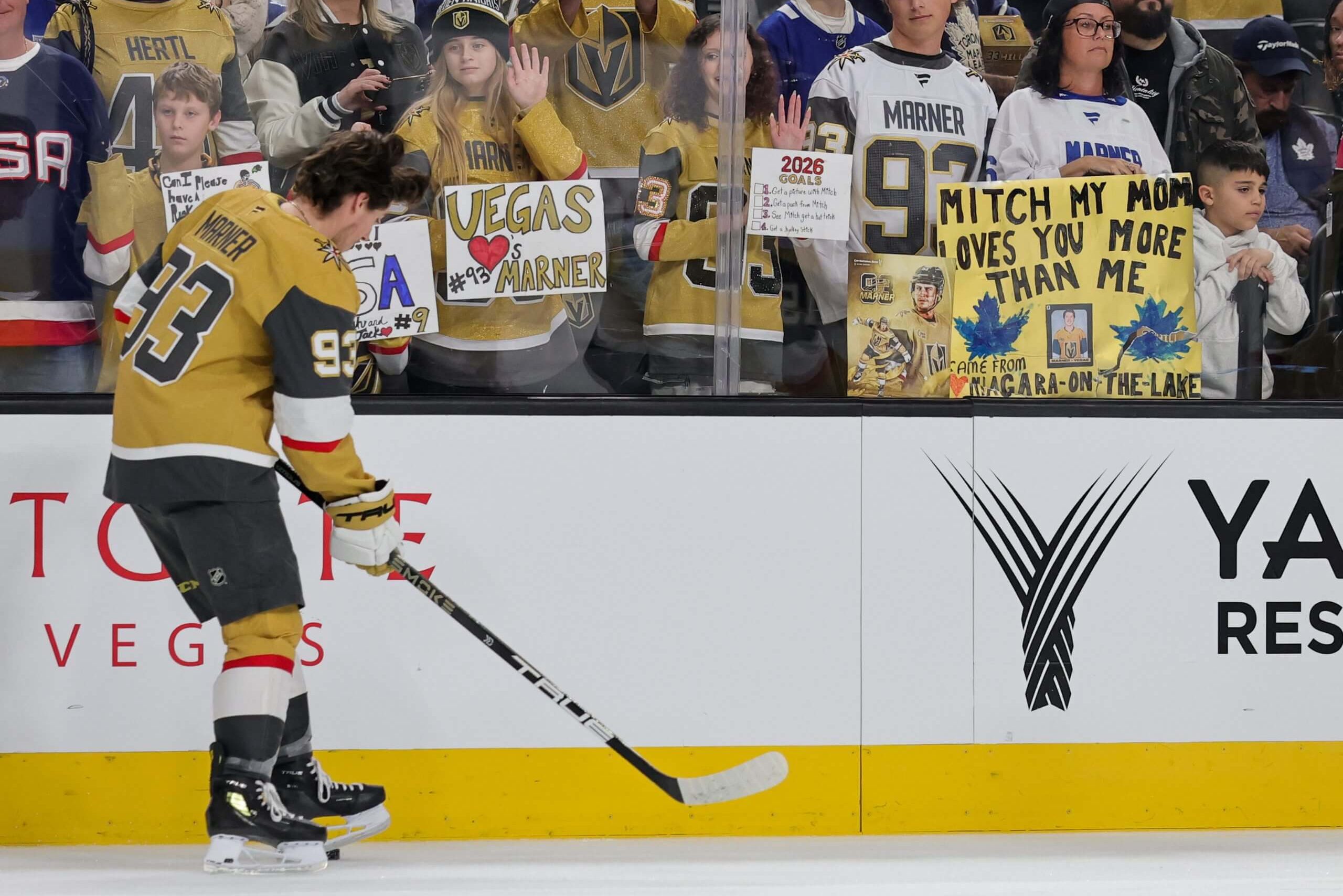
Mitch Marner was booed on home ice when the Maple Leafs visited the Golden Knights last week. It was Marner’s first time facing his former team. (Ethan Miller / Getty Images)
How we got from there to here — with Marner going from one of the new faces of the franchise after being taken with the No. 4 pick in the 2015 NHL Draft to becoming public enemy No. 1 — is a long, tortured story that has a lot of tentacles to it. Honestly, you can probably ask a dozen different Leafs fans, and they’ll all give you a different answer as to how they feel about Marner and why they might boo him in this game.
All of the losing was certainly part of it, with the Leafs eliminated in heartbreaking Game 7s again and again and getting to the second only round twice — and never beyond. Marner was part of that, certainly, but it was really the Core Four, the coaching staffs and management who collectively earned the goat horns for those failings over the years.
Altogether, Marner piled up 741 regular-season points over nine seasons in Toronto — the eighth most in the NHL in that span and the sixth most ever for a Maple Leaf — but only 63 playoff points, which was tied for 34th.
There were also the protracted contract negotiations when Marner first became a free agent in 2019, talks that finally ended after the first day of training camp with a massive six-year, $65.4 million deal ($10.9 million a season) that was out of step with what comparable young RFAs were signing at the time. Having what at the time was the NHL’s seventh-highest cap hit and not having playoff success was a tough combination over those six seasons, especially when the salary cap stagnated for years after the COVID-19 pandemic.
More than those two things, however, the biggest source of the booing is likely going to be how Marner left. After playing out that six-year RFA deal, he declined to sign an extension, used the no-movement clause in the final two seasons of his deal to block a trade to Carolina and signed in his preferred new home (Las Vegas) as soon as he could.
The Leafs received a consolation prize, of sorts, in third-line center Nicolas Roy as part of a sign-and-trade deal with the Golden Knights in June, but it could have been so much more. Last season, Mikko Rantanen was willing to come to Toronto and sign, and there were multiple trade scenarios cooked up that could have resulted in Marner being a part of that blockbuster move.
When swapping Marner for Rantanen one-for-one became a no-go, with Marner unwilling to join the Hurricanes late in the year, the Leafs then pursued a three-way deal that involved both the Hurricanes and Golden Knights. What’s interesting there is that Marner was likely willing to waive his NMC to go to the Golden Knights if a trade could be reached before that deadline, but the transaction fell apart due to some of the other pieces not coming together.
Carolina received a better offer from Dallas for Rantanen and made that move instead; Marner stayed in Toronto and played through a ninth straight disappointing exit in Game 7 of the second round.
The reality, however, is that Marner was probably ready to go last season. And it certainly seemed to many on the inside of the organization that that had been the case for a while. All the losing and the pressure, from a rabid fan base that was turning on the team and its stars, had built up over time and worn Marner down to the point that signing on for an eight-year extension in Toronto was never going to happen.
The Leafs certainly tried — and they would have paid Marner more than the $12 million a season he received from Vegas. In the end, he pulled the plug on what had become a dysfunctional mix of players, not the front office.
One wonders how the fan base might feel about Marner had that decision been made a year earlier, the way it went down with Quinn Hughes and the Vancouver Canucks earlier this season. If the Leafs had been able to trade Marner for another superstar — either Rantanen or a player of similar value — how different would Friday’s reception be?
Could there have been more of a reconciliation between a star player and his hometown, had the exodus not been so abrupt and so damaging to a Leafs roster that is now more likely to miss the playoffs than not for the first time in a decade?
Some of that is on Marner, to be sure. He could have been more decisive and not waited until the last moment to leave, giving the Leafs more options to find a replacement. But the fact that it came to that is also on a management team that held firm and fast to keeping that flawed group together, year after year, despite all of the losses telling them it was time to turn the page and try something new.
That stasis doomed the Leafs to failure more than anything.
Marner is going to get booed on Friday night in Toronto, likely more heavily than any former Leafs player ever has. For many fans, that will be a cathartic release — one that’s entirely understandable, given the way this era of the franchise has gone.
But with the way this all played out, there are plenty of folks deserving of blame in the organization — and it’s worth reserving some of those boos for them, too.