
Stay informed with free updates
Simply sign up to the War in Ukraine myFT Digest — delivered directly to your inbox.
The US is pushing for Ukraine and Russia to meet in Abu Dhabi later this week for three-way negotiations on a possible deal to end Moscow’s invasion of Ukraine, according to people familiar with the matter.
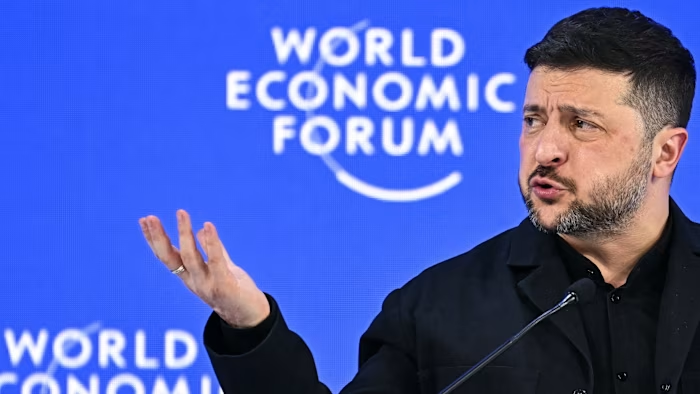
Ukraine President Volodymyr Zelenskyy told an audience at the World Economic Forum in Davos that he supported his team of negotiators meeting Russian and American counterparts on neutral territory.
A senior US official said the trilateral meeting is expected to occur on Friday and Saturday in the Emirati capital. Russia has not yet said whether it has agreed to the meeting.
“It’s better than not to have any kind of dialogue,” Zelenskyy said after meeting US President Donald Trump, adding that the talks would be at a “technical level”.
But progress, he said, would require both sides to make concessions. “Russians have to be ready for compromises because, you know, everybody have to be ready, not only Ukraine,” he said.
Zelenskyy’s office later clarified to the FT that the three-way meeting had not yet been fully confirmed and that the Ukrainian and US sides were awaiting Russia’s response.
US special envoy Steve Witkoff and Jared Kushner, Trump’s son-in-law, are expected to discuss the idea with Russian President Vladimir Putin in Moscow on Thursday. Witkoff said he and Kushner would go “right to Abu Dhabi” for “working groups” after meeting Putin.
A senior Ukrainian official involved in the negotiations said Kyiv would send its chief negotiator Rustem Umerov, Zelenskyy’s chief of staff and former military intelligence chief Kyrylo Budanov and David Arakhamia, leader of the president’s ruling party in parliament.
The Ukrainian official said they expected to meet Russian officials from the military, its GRU military intelligence unit and Kirill Dmitriev, head of the Russian Direct Investment Fund.
Russia told the US this week that Putin was open to holding parallel talks with Ukraine, with mediators shuttling between delegations, according to a person familiar with the matter. But Moscow did not say it would agree to tripartite talks.
The format Russia indicated Putin would propose is similar to talks held in Abu Dhabi last November, where Ukrainian and Russian negotiators met separately with US officials but did not speak directly to each other, the person said.
If Putin does accept the US proposal, the meeting would be the first time US officials sit down together with their Russian and Ukrainian counterparts since Trump returned to office last year.
Recommended

Ukraine and Russia met last year for three rounds of talks in Istanbul that ended without any major progress.
Putin has stalled on agreeing to a US-backed peace plan, drafted last year with significant Russian input, and insisted any peace agreement meet his maximalist demands for ending the nearly four-year war.
Russia has also indicated it will reject amendments subsequently made to the plan by Ukraine and its European allies.
The current 20-point plan “mostly came about because the Ukrainians and Europeans threw out all the points Putin cared about from the initial 28-point plan,” a person in Moscow briefed on the negotiations said. “What’s there to talk about? Obviously Putin can’t agree to that.”
Ukraine’s negotiations with the US have largely focused on territorial concessions Russia has demanded as a precondition for any settlement.
Speaking at a separate Ukraine-themed event in Davos on Thursday morning, Witkoff said there had been significant progress and “we are at the end now”. “I think we’ve got it down to one issue . . . and that means it’s solvable.”
But Putin has also demanded wide-ranging talks on other issues, including a wholesale rewriting of Europe’s security architecture as well as sweeping domestic changes in Ukraine that would move the country firmly into Russia’s orbit.
Sergei Lavrov, Russia’s foreign minister, said earlier this week that “proposals for a settlement aiming to keep the Nazi regime in [what remains of] Ukraine are absolutely unacceptable”, indicating that Moscow would demand a more pliant government be installed in Kyiv.
Though progress on the battlefield remains slow, Russia has stepped up its campaign of air strikes against Ukraine’s energy infrastructure in recent weeks, leaving Kyiv and several other cities across the country without power, heating and water amid the harshest winter of the war.
Recommended

The US and Ukraine have discussed proposing a limited ceasefire to Russia under which Moscow would end the strikes on energy infrastructure in exchange for Kyiv halting its attacks on Russian refineries and “shadow fleet” tankers, two people familiar with the discussions said.
The talks with Russia on the proposal are not at an advanced stage, one of the people said, adding that Putin was unlikely to agree because he sees the pressure on Ukrainian energy infrastructure as important leverage.
A senior Ukrainian official said that Kyiv was also hesitant about an energy ceasefire because its long-range drone programme has been successful in hitting Russian oil and gas facilities — and more recently oil tankers in the Black Sea and Mediterranean — that fuel the Kremlin’s war machine.
Dmitry Peskov, Putin’s spokesperson, declined to comment.