
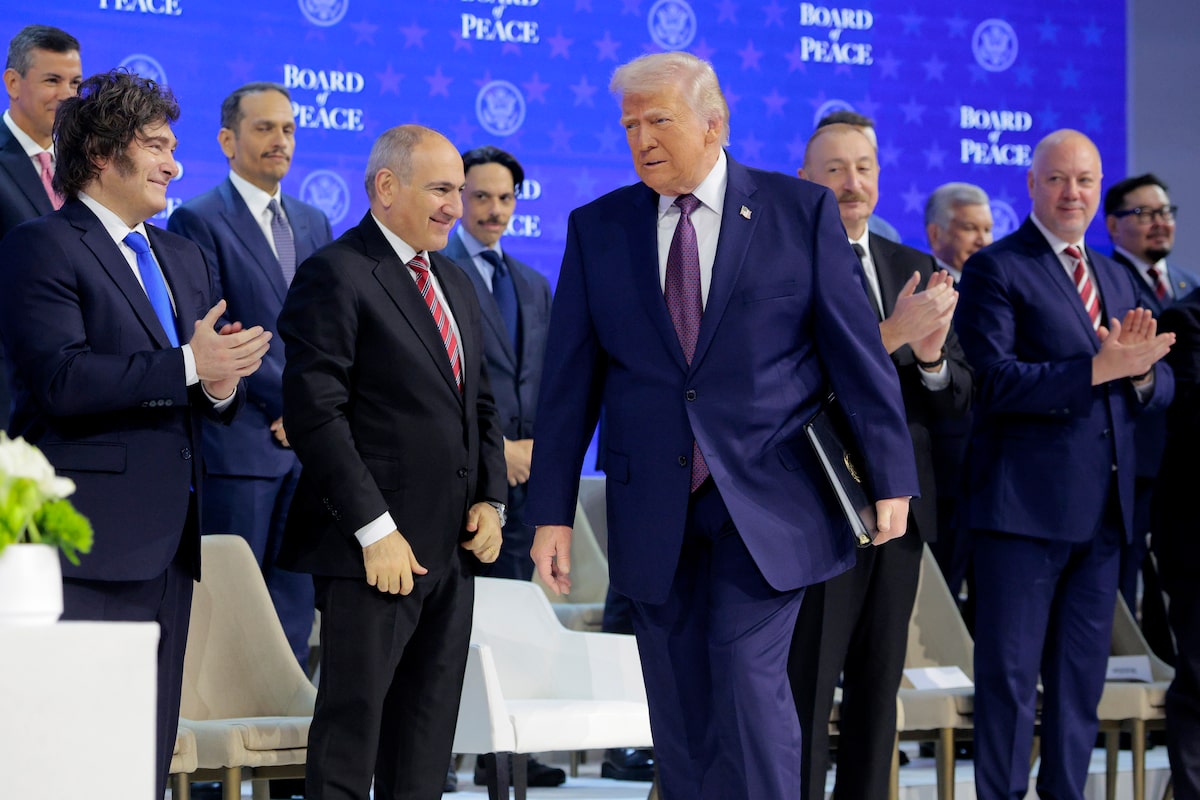
U.S. President Donald Trump arrives onstage at the World Economic Forum in Davos, Switzerland, Thursday.Chip Somodevilla/Getty Images
The United States could be given a form of sovereignty over military bases in Greenland and access to minerals located on the sites as part of a deal to satisfy Donald Trump’s intense desire to own the island, several media outlets have reported. However, the Prime Ministers of Denmark and Greenland have ruled out any negotiations concerning sovereignty.
The U.S. President announced on Wednesday that a framework agreement on Greenland had been reached after he met with NATO Secretary General Mark Rutte in Davos, Switzerland. Mr. Trump also said he would drop his threat to impose additional tariffs on NATO allies that opposed his plan to buy Greenland, a self-governing part of Denmark.
Mr. Trump told reporters that the proposed deal could include mineral rights and collaboration on his Golden Dome defence system. “It’s the ultimate long-term deal,” he said. “It puts everybody in a really good position, especially as it pertains to security and to minerals.”
Analysis: In Davos speech, Trump speaks to allies in language once reserved for adversaries
Mr. Rutte said Thursday that he and Mr. Trump had a “very good discussion” about security in the Far North. He added that the question now is how Arctic allies, including Canada, Iceland, Denmark, Sweden, Finland and Norway can work to boost security. Those discussions will “make sure when it comes to Greenland, particularly, that we ensure that the Chinese and the Russians will not gain access to the Greenland economy or militarily to Greenland,” he said.
The New York Times and London’s Daily Telegraph have reported that alliance officials discussed granting the U.S. sovereignty over land used for military bases. That would mimic an arrangement Britain has in Cyprus.
Trump abruptly stepped back on Wednesday from threats to impose tariffs as leverage to seize Greenland, ruled out the use of force, and said a deal was in sight to end a dispute over the Danish territory.
Reuters
Under a 1960 treaty reached when Cyprus gained independence from Britain, British military bases in Akrotiri and Dhekelia were designated Sovereign Base Areas. They cover around 256 square kilometres, or roughly 3 per cent of the country’s territory.
The SBAs are administered as British Overseas Territories, but the 10,000 Cypriots living on the sites are recognized as citizens of Cyprus and there are no border controls. The U.K. has also not used the SBAs to develop minerals.
The SBAs have been viewed by many Greek and Turkish Cypriots as a relic of colonialism and an impediment to efforts to reunify the divided island.
Trump calls out Carney, says Canada ‘lives because of the United States’ in Davos speech
The U.S. and Denmark have a long-standing defence arrangement that allows Washington to send troops to Greenland, so long as it notifies its NATO ally. During the Cold War, the U.S. stationed around 10,000 troops at 17 bases in Greenland. That number has dwindled to less than 200 at one installation.
The framework agreement reached Wednesday would not involve a sale of Greenland, as Mr. Trump had wanted, but it could allow the U.S. to develop minerals located on its bases without going through the local government process. But it could involve reworking the U.S.-Denmark defence agreement and allowing the U.S. to develop minerals on its military sites without going through the local government process.
On Thursday, Danish Prime Minister Mette Frederiksen rejected any proposal that relinquished Denmark’s sovereignty over Greenland. “NATO is fully aware of the position of the Kingdom of Denmark. We can negotiate on everything political: security, investments, economy. But we cannot negotiate on our sovereignty. I have been informed that this has not been the case either,” Ms. Frederiksen said in a statement. “And of course, only Denmark and Greenland themselves can make decisions on issues concerning Denmark and Greenland.”
Opinion: At Davos, a new great game dawns for the world. Which way, Canada?
Greenland’s Prime Minister Jens-Frederik Nielsen said Thursday that he was waiting to see details of the proposed framework, but nothing could be decided without the backing of Greenland and Denmark.
During a press conference in Nuuk, Mr. Nielsen added that his government was prepared to discuss a range of issues with the U.S., including security and resource development. He also favours a permanent NATO base on the island.
“Sovereignty is a red line,” he stressed. “We choose the Kingdom of Denmark. We choose the EU. We choose NATO. This is not only a situation for Greenland and the Kingdom of Denmark. It’s about the world order for all of us.”
In a fiery post on Facebook late Wednesday, Aaja Chemnitz, who represents Greenland in the Danish parliament, lashed out at Mr. Trump and Mr. Rutte.
“What we are witnessing these days from Trump is insane,” she wrote. “NATO in no way has a mandate of its own to negotiate anything around us from Greenland. Nothing about us, without us. And the fact that NATO should have anything to say about our country and minerals is completely in the hemp. Nothing is negotiable, as we are simply too far apart. As in nothing.”
A NATO spokeswoman said Mr. Rutte did not propose any compromise on sovereignty during his discussions with Mr. Trump.
U.S. President Donald Trump ruled out the use of force in his bid to control Greenland on Wednesday, but said in a speech in Davos that no other country can secure the Danish territory.
Reuters
Leaders across Europe were breathing easier on Wednesday after Mr. Trump appeared to have ruled out taking Greenland by force.
In a speech to the World Economic Forum, Mr. Trump indicated that he would not use force but that he wanted to start negotiations to buy Greenland. He added, “They have a choice. You can say yes and we will be very appreciative, or you can say no and we will remember.”
Hours later, he announced on social media that he and Mr. Rutte had “formed the framework of a future deal with respect to Greenland.” As a result, he added, he would not go ahead with the imposition of an additional 10-per-cent tariff on imports from NATO allies on Feb. 1 as planned.
Eight notable moments from Trump’s Davos speech
In a speech to the World Economic Forum on Thursday, German Chancellor Friedrich Merz welcomed Mr. Trump’s change of position on Greenland but added that the world was heading in a worrying direction.
“The world around us is changing at unprecedented pace. The direction it takes must worry us. A world of great powers is a new reality. Europe has got the message. Germany has got the message. We must and will live up to this challenge,” he said.
Mr. Nielsen said he was glad to hear Mr. Trump’s comments. “Until yesterday, we couldn’t rule out anything,” he said Thursday. “Try to imagine how it is as Greenlanders, as peaceful people in Greenland, to hear and see in the media every day that somebody wants to take your freedom.”