
Unlock the White House Watch newsletter for free
Your guide to what Trump’s second term means for Washington, business and the world
EU leaders have cautiously welcomed Donald Trump’s decision to drop his threat of tariffs against European allies and the apparent softening of his desire to seize Greenland, but they still voiced concern over relations with the US ahead of an emergency summit to discuss the issue.
The Europeans who gathered in Brussels on Thursday evening were also digesting a blistering attack on them by Ukraine’s President Volodymyr Zelenskyy, who accused them of failing to “take the lead in defending freedom”.
The US president dropped his Greenland threats — which had prompted the EU to draw up tit-for-tat trade retaliation options — on Wednesday in exchange for talks over an enhanced military presence on the Danish Arctic island, easing the biggest crisis between the US and Europe for decades.
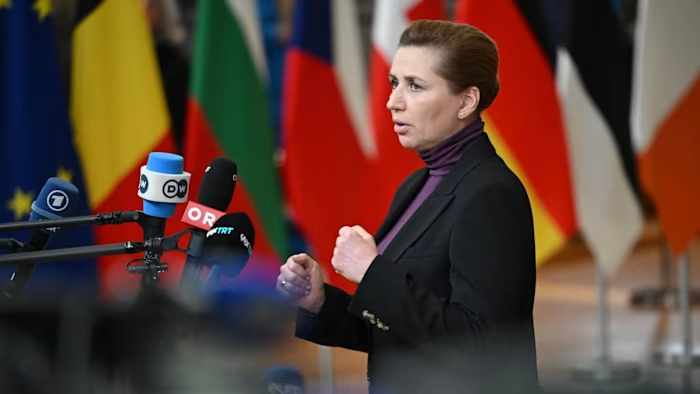
“We have learnt something in the past days and weeks,” said Denmark’s Prime Minister Mette Frederiksen as she arrived at the summit. “When Europe is not divided, when we stand together, and when we are clear and strong also in our willingness to stand for ourselves, the results will show.”
“We have been working very closely with the US for many years but we have to work together respectfully without threatening each other. Therefore I hope to find a political solution within the framework of democracy and how we co-operate as allies.”
Frederiksen said that one of the outcomes of the discussions was that “we need a permanent presence from Nato in the Arctic region including around Greenland”.
Trump’s bellicose rhetoric about how he would “have” Greenland and “remember” if European countries stood in his way had startled European leaders and prompted fears of a rupture in the Nato alliance that has protected the continent for eight decades.
“We always accepted leadership of the US, it’s something absolutely natural,” said Poland’s Prime Minister Donald Tusk. “But it is very important for all of us to understand the difference between domination and leadership.”
Ireland’s prime minister Micheál Martin said the relationship between the EU and US was still a critical one, adding: “Both sides have to work hard on that relationship and to breathe new life into that relationship.
“Undermining that would have very severe consequences for Europe and for the US,” he added.
The dinner discussion, which will address the Greenland crisis, Trump’s controversial “Board of Peace” initiative and broader elements of how to deal with his administration’s aggressive foreign policy, was overshadowed by Zelenskyy’s earlier attack on countries that have provided close to €200bn in military and financial aid to his country since 2022.
Several leaders said it was important not to lose sight of the war in Ukraine amid the discussions over Greenland.
In a speech at the World Economic Forum in Davos, the Ukrainian president said that Europe was a “fragmented kaleidoscope of small and middle powers” and looked “lost” trying to convince Donald Trump to force Russia to end its war.
“Instead of taking the lead in defending freedom worldwide, especially when America’s focus shifts elsewhere — Europe looks lost, trying to convince the US president to change,” he said.
The highly unusual criticism from Zelenskyy followed a meeting with Trump at the Swiss alpine event. Asked by the FT why Zelenskyy chose to criticise Europe so harshly in his speech, a senior aide to the Ukrainian president said that he wanted to spur Europe into action.
Europe, he said, “has so much power” but it consistently underestimated that power. “Every time we try to do something [in partnership] with Europe” they were reluctant to act boldly as a unified force, the official added. Instead, they looked to the US for a “positive” signal of how to act.
“It’s strange,” the official added. “Europe is a great power, but it needs the courage to admit it.”
Dutch Prime Minister Dick Schoof responded by saying he understood Zelenskyy’s frustration.
“He has been waging a war for almost five years, a terrible war, which continues relentlessly, in which Russia’s aggression is definitely not declining,” he said. “The big question is whether he is willing to make peace. In the meanwhile we are talking with each other, Europe, the US and Ukraine. I understand his frustration but we are working very hard on it.”
Additional reporting by Laura Dubois and Henry Foy in Brussels