

First-time mom Celia Johnston was looking forward to going back to work after taking full advantage of her maternity and parental leave.
“I was excited as a new mom to get back to doing something a little bit more for myself and having a purpose that was a little bit separate from just being a mom,” she said.
Before her leave, Johnston, who lives in the Vaudreuil-Soulanges region off the western tip of the Island of Montreal, had been working in e-learning as a project manager.
But one week before her scheduled return on Oct. 12, her employer called to let her know her position had been abolished “due to the company’s financial performance,” she said.
The news, she said, left her feeling a mix of emotions including panic, shock and fear. Johnston said she applied for Employment Insurance (EI) benefits the same week, but it took two months and numerous phone calls before learning her claim had been denied.
“I just received a message in my portal saying that my case is refused. I don’t have enough hours to qualify for EI payments,” she said.
Mouvement Action Chômage (MAC) de Montréal, an advocacy group dedicated to defending the rights of the unemployed, says her situation is far from unique.
“We have calls about this situation maybe once a week,” said Fanny Labelle, head of mobilization and finance at MAC.
Law is discriminatory, advocacy group says
EI rules generally allow combining special and regular benefits for up to 50 weeks in a 52-week period, with maternity and parental leave counting as special benefits.
Labelle explained that in Quebec, a person giving birth can take 18 weeks of maternity leave and then 32 weeks shared parental leave, for a total of 50 weeks. If they are laid off in this scenario, they won’t qualify for regular EI benefits.
Meanwhile, a parent who did not give birth can take five weeks paternity. In a situation where they take full parental leave as well, for a total of 37 weeks, they are still eligible for regular benefits if they lose their job.
MAC de Montréal has been fighting on many fronts to have the Employment Insurance Act changed, saying it is discriminatory.
In 2018, lawyers with MAC de Montréal helped a group of six Quebec mothers who were laid off during their maternity and parental leaves, or shortly thereafter, bring their case to the Social Security Tribunal of Canada — an administrative tribunal that oversees disputes over the interpretation and application of laws and regulations.
Some of the women were denied EI benefits because they hadn’t accumulated enough insurable work hours during the reference period, while others had reached the maximum 50 weeks of benefits.
In 2022, the general division of the tribunal ruled in their favour and agreed that parts of the Employment Insurance Act violated women’s constitutional rights to equality under the law.
The Canada Employment Insurance Commission (CEIC), however, appealed the decision and subsequently won, prompting the group to bring the case to the Federal Court of Appeal, where it was heard in November of last year.
Labelle said the group’s hope is to change the law for “every woman in Canada,” but a decision could be months or even years away, as the case could eventually make its way to the Supreme Court of Canada.
WATCH | Pushing to reform EI: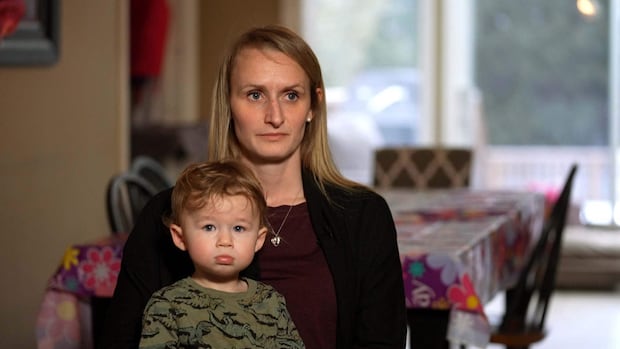
Government pressured to reform EI so those on parental leave qualify
The NDP is leading a push for reform to Employment Insurance so that people who are laid off while on parental leave, or shortly after returning from it, still qualify for benefits. Critics say the current system discriminates against parents.Solution easy to implement, says MP
In the interim, MAC de Montréal has launched a campaign and a petition to draw attention to the issue and is hoping the government will agree to amend two articles of the Employment Insurance Act.
The changes would allow for the accumulation of more than 50 weeks of combined benefits in the event of a maternity leave, and the use of maternity leave as a reason for extending the benefit period — when a claim starts — from 52 to 104 weeks.
The changes would be easy to implement, according to NDP MP Alexandre Boulerice, who tabled a private members bill to that effect at the House of Commons last October.
LISTEN | Quebec woman laid off during maternity leave shares her story:
Daybreak Montreal7:53A Quebec woman was laid off after her maternity leave and didn’t qualify for EI – turns out she’s not alone
Imagine being ready to go back to work after having a baby, only to find out you’ve been laid off. And on top of that – you don’t qualify for employment insurance. This has happened to thousands of women across the country. We spoke to Celia Johnston. She was set to go back to work in October of 2025 only to discover her position had been dissolved and that she did not qualify for EI.
In addition to being an easy fix, Boulerice said the measure would not be costly either.
“It’s not for, you know, millions of people and it’s going to help real people who need those benefits,” he said.
While it’s difficult to assess exactly how many Canadian women are affected each year, Boulerice said estimates place that number around 3,000.
For Boulerice, however, the bottom line is that the “program right now is unfair.”
“I think the Liberals should just take the idea and change the EI program,” he said.
In a statement to CBC News, Samuelle Carbonneau, a spokesperson for Employment and Social Development Canada, did not address the specific issue of birthing parents who are denied EI benefits, but pointed to several changes to the legislation aimed at giving parents more flexibility and support.
“This includes allowing EI maternity to be claimed up to 12 weeks before childbirth, new options for standard and extended weeks of parental benefits and encouraging greater sharing of benefits by both parents,” Carbonneau said.
Navigating child care, job search not an easy task
As for Johnston, upon being denied benefits, she completed an appeal form which she delivered to Service Canada in person. She is still waiting for a response.
She said she’s sharing her story to draw attention to what she feels is a “huge policy gap.”
“After a financially vulnerable year, when you’re on maternity leave, your income is cut significantly and once you’re laid off with no notice, there’s zero income coming in,” she said.
She said mothers in her situation can also be at a disadvantage when it comes to looking for a new job due to a gap in resumes from the past year as well as hitting the job force while caring for a baby.
“It’s really hard to start a new job and have to be able to try to navigate that and prove yourself,” she said.
Beyond getting regular EI benefits, Johnston said she’s hoping for wider change.
“There’s so many resources available that it is quite shocking to hear that other mothers have been through this situation and nothing has changed over the years.”