
Greenland, Trump’s Board of Peace and Ukraine – what’s been happeningpublished at 07:16 GMT
07:16 GMT
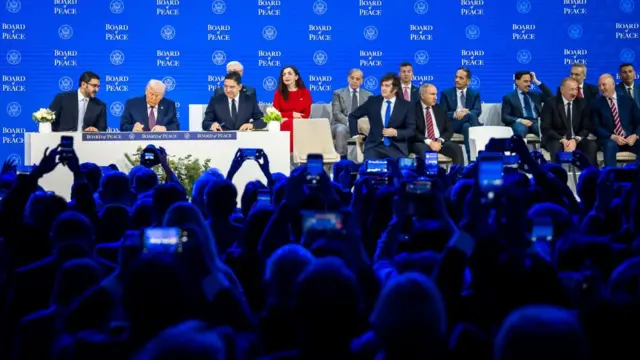 Image source, EPA
Thursday was a heavy day of diplomacy in Davos, Switzerland, where world leaders have been meeting for the annual World Economic Forum this week. Here’s a quick look at the main lines from yesterday:
Greenland
There was plenty of relief in Europe, following Trump’s comments made the night before, in which he appeared to back away from his position that the US must acquire Greenland. He announced that there was a “framework of a future deal” with Nato Secretary Mark Rutte.
Since Wednesday though, little detail has emerged on what that framework might entail. Nato Military Committee chair Admiral Giuseppe Cavo Dragone said the deal is at a “very early stage”, adding “we are still waiting on direction”. In an interview with Fox Business, Trump said it would allow “total access”, and “we’re getting everything we want at no cost”.
Board of Peace
Trump launched his new Board of Peace at a signing ceremony with global leaders.
The board was originally conceived of as a way to implement part of the Gaza ceasefire plan. But Trump and his officials suggested it will work on a range of global issues, with the US president saying it has the potential to be “one of the most consequential bodies ever created”.
UK Foreign Secretary Yvette Cooper said the UK won’t be signing up yet, amid concerns about the participation of Russian President Vladimir Putin. None of the UN Security Council’s permanent members – China, France, or Russia, have committed participation so far.
Ukraine
The US president then met with Ukraine’s Volodymyr Zelensky. After the meeting, Zelensky told reporters the pair has agreed that a document on the issue of security guarantees was “done” – but it still needs to be signed and go to “national parliaments”.
And in a stern address to Davos delegates, Zelensky said that Europe too often avoids “action”, calling on it to do more to “protect itself”.