
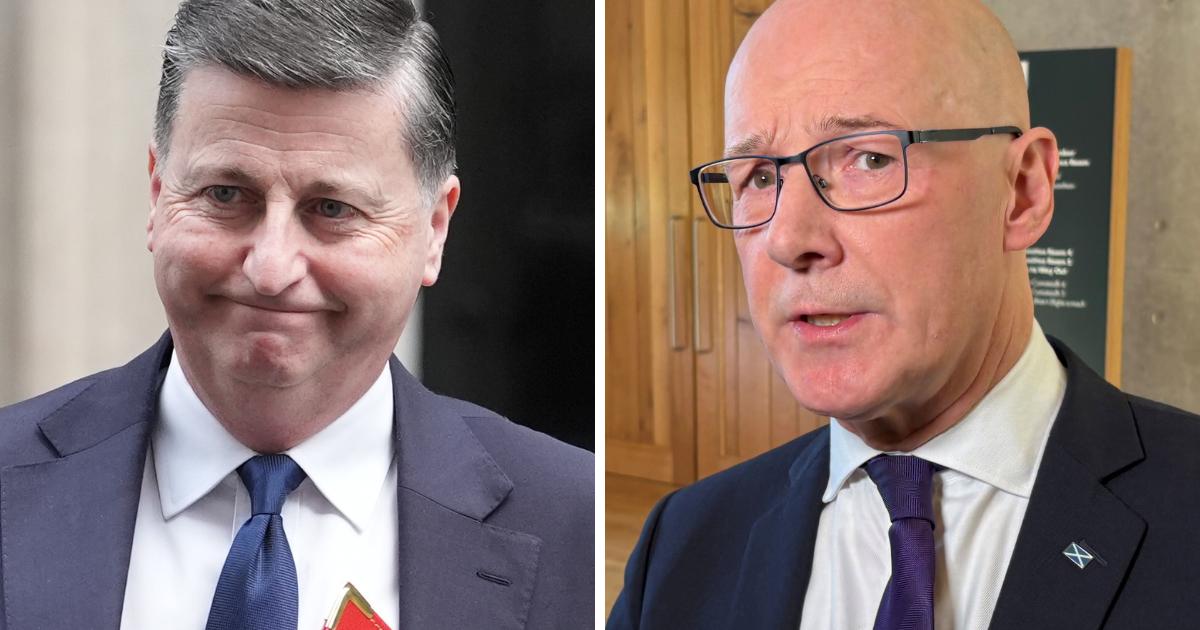
The Edinburgh administration has released four letters between the First Minister, Prime Minister, and Douglas Alexander amid a row over what the UK Government told its Scottish counterpart about a military operation involving Scottish assets and waters.
The background
On January 7 , the US seized the then-Russian flagged oil tanker Marinera with support from UK forces. Wick John O’Groats airport was reportedly used to support the operation.
The following day, Swinney wrote to the Prime Minister saying it was a “matter of significant concern that Scottish Ministers were not notified” ahead of the action.
On January 13 , the Marinera was spotted in the Moray Firth, escorted by the US military. Swinney said he had only learned the ship was in Scottish waters through the media .
Two days later, Scottish Secretary Alexander responded to Swinney’s letter of January 8, insisting that it “would have been inappropriate to brief Scottish Ministers” in advance of the seizure operation for security reasons.

Signing off the letter, Alexander said it also would “not have been appropriate” to brief Scottish Ministers on the Marinera being taken into the Moray Firth. He signed off the letter: “Should you wish to discuss this issue further I would be happy to meet you.”
Alexander then told press on Thursday (January 22), that he had invited Swinney to be personally briefed on the operations, but the SNP leader had not accepted the proposal.
Responding, Swinney said: “If that’s what Mr Alexander is suggesting is an invitation to dialogue, I suggest he goes in and redrafts his letters before he sends them to me.”
The First Minister revealed that he had written to the Prime Minister over Alexander’s response, which he called “juvenile” . That third letter, which was sent on January 15, as well as Keir Starmer’s reply, which was sent on January 21, have now all been released.
The letters at the centre of it all
Here, The National is publishing all four of the letters in full, so you can read the full exchange and make up your own minds.
Letter one:
First Minister John Swinney to Prime Minister Keir Starmer, January 8.
Dear Prime Minister,
I am writing regarding the operation undertaken by the United States yesterday to intercept an oil tanker in the North Atlantic.
There has been speculation that Wick Airport was used in support of this operation. While I fully recognise the importance of co-ordinated responses to international security challenges, it would be a matter of significant concern that Scottish Ministers were not notified of the proposed action ahead of it taking place.
You will recall that, during our discussions at the recent British-Irish Council in Cardiff, I raised my concerns that Scottish ministers had not been formally notified of the military use of Scotland’s infrastructure. I requested that, in future, we should receive formal pre-notification of such actions where they involve Scottish infrastructure or have implications for Scotland.
This is essential to ensure that the Scottish Government can discharge its responsibilities effectively and maintain public confidence in the management of national security matters.
Following yesterday’s operation, I am seeking a clear commitment from the UK Government to notify Scottish ministers in advance when any such operations are being planned. This will help ensure that we can work constructively together in the interests of security and good governance. I look forward to your confirmation of this commitment.
Yours sincerely,
John Swinney MSP
First Minister of Scotland
Letter two:
Scottish Secretary Douglas Alexander to First Minister John Swinney, January 15.
Dear John,
Thank you for your letter of 8 January to the Prime Minister concerning the recent operation to intercept the Bella 1 [the former name of the Marinera].
As you will be aware, the UK, following a request from the US, supported this operation as part of global efforts to crack down on sanctions-busting and shadow shipping activity. The US’s enforcement action was based upon counter-Iran sanctions, aimed at stopping Iran from fuelling instability through the profits of illegal oil sales.
On 7 January, the Defence Secretary updated the House of Commons on UK assistance to the US military operation to intercept the Bella 1, as well as the recent Coalition of the Willing meeting in Paris.
Operations such as this are, by necessity, very sensitive and for operational security, prior notifications are very tightly held on a need-to-know basis. This enhances the likely success of operations and helps reduce the risk to the personnel who risk their lives to carry them out.
Defence, National Security and Foreign Affairs are all reserved to the UK Government in the Scotland Act. In this instance it would have been inappropriate to brief Scottish Ministers in advance. I accept that there are occasions when briefings on reserved issues will be useful to ensure that Scottish Ministers are able to fulfil their responsibilities in devolved policy areas and we will continue to do this as necessary.
I would also like to address recent comments attributed to you in the media criticising the UK Government for not providing advance briefing to the Scottish Government of a replenishment stop by the Bella 1 and its US Coastguard escort in the Moray Firth. This operation was in defence of UK national security and our relationship with a key international ally. As such it would not have been appropriate to provide briefing in advance to Scottish Ministers.
Should you wish to discuss this issue further I would be happy to meet you.
Yours sincerely,
The Rt Hon Douglas Alexander MP
Secretary of State for Scotland
Letter three
First Minister John Swinney to Prime Minister Keir Starmer, January 15.
Dear Keir,
I am in receipt of correspondence from the Secretary of State for Scotland responding to my letter to you dated 8 January, which outlined my concerns over the handling of the recent US-led operation to intercept an oil tanker in the North Atlantic.
I must note at the outset it was both unexpected and disappointing that the reply was not issued from your office. On matters of this significance—particularly those touching on national security, intergovernmental cooperation, and constitutional propriety—it is reasonable to expect a direct response from the Prime Minister, especially given our discussions on this topic at the recent British-Irish Council.
The assertion that Scottish Ministers were excluded from any form of advance notification of a significant military operation solely on the grounds of operational security is wholly inadequate and not credible. Such a position is not only discourteous and disrespectful to the Scottish Government but also displays a concerning disregard for the responsibilities Ministers hold under the devolution settlement.
I fully understand and support the need to protect sensitive operational details. However, it is neither accurate nor reasonable to suggest that such considerations remove the need for, or preclude, appropriate pre-notification to the Scottish Government on such matters.
Given that the Scottish Government owns and is responsible for key national infrastructure, including assets that may be directly implicated in such operations, we have an operational requirement to be advised in advance where feasible.
This is essential to ensure that we as a government can fulfil our statutory duties—including those of the Lord Advocate as well as managing associated risks. Pre-notification also allows us to work collaboratively to uphold public confidence in such operations. A complete absence of notification impedes our ability to discharge those responsibilities effectively.
The reasoning set out in the letter from the Secretary of State fails to respect the principles and practical realities of the devolved settlement, and it falls well short of the standards of co-operation and courtesy that should govern intergovernmental working. Scottish ministers expect a relationship based on mutual respect, candour, and due regard to the responsibilities held by both governments.
In light of the concerns set out above, I would be grateful for an early meeting with you that would enable us to agree how we proceed on such issues given the uncertain international context in which we are all now operating. I will be in London on 26 and 27 January and would be happy to meet with you.
Yours sincerely,
John Swinney MSP
Letter four
Prime Minister Keir Starmer to First Minister John Swinney, January 21.
Dear John,
Thank you for your recent letters regarding the US-led operation to intercept an oil tanker in the North Atlantic.
As you will appreciate, this is a complex and fast-moving situation that requires considerable international coordination as well as across Government. As part of this, we of course intend to work with you where there are devolved equities or matters of Scots Law.
I am aware that your officials were briefed on the matter last week and are fully engaged with Cabinet Office officials, with whom a good information flow has been established. There is also constructive dialogue ongoing between the Crown Office and UK Government lawyers on technical legal issues.
For future security briefings, the Cabinet Secretary’s Office is best placed to facilitate requests on Privy Council terms.
Unfortunately, pre-existing commitments mean it will not be possible to meet when you are in London next week. However, I would like to secure a time for a phone call over the next few weeks. My office will reach out to yours to arrange.
Thank you, once again, for writing.
All best wishes,
The Right Honourable John Swinney MSP [sic. Keir Starmer’s letter signs off with John Swinney’s name].