
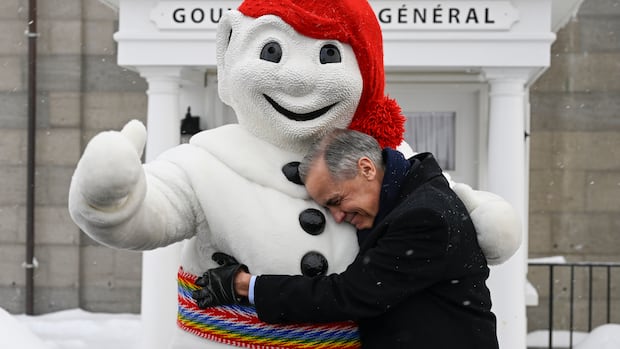
Prime Minister Mark Carney and his cabinet are gathering for a second day in Quebec City as questions mount about whether a war of words with the U.S. will lead to a further fracturing of the bilateral relationship.
Carney used the opening of the two-day cabinet planning meeting on Thursday as an opportunity to respond to U.S. President Donald Trump, who warned the prime minister this week that Canada “lives” thanks to the United States.
“Canada doesn’t live because of the United States,” the prime minister shot back in a nearly 30-minute address.
“Canada thrives because we are Canadian.
WATCH | Can Carney deliver on his Davos speech?:
At Issue | Can Carney deliver on his Davos speech?
At Issue this week: Prime Minister Mark Carney outlines a new era of global politics in an address to the World Economic Forum, but can he deliver on his vision? And Ontario Premier Doug Ford fires back at the Canada-China EV deal.
The theme will be continued as ministers gather for the second and final day of the high-level meetings, where Canada’s sovereignty, trade and security are the agenda.
Carney’s comments on unity come not just against the backdrop of a changed relationship with Trump, but potentially ahead of referendums on separatism in both Alberta and Quebec.
According to the Prime Minister’s Office, the cabinet on Friday will hear from:
Janice Stein, Belzberg professor of conflict management from the University of Toronto.Thomas Juneau, assistant professor at the school of public and international affairs, University of Ottawa.Nadir Patel, former high commissioner to India and former consul general to Shanghai.
The cabinet is also having a discussion on artificial intelligence with Joelle Pineau, with the Canadian AI company Cohere.
Artificial Intelligence Minister Evan Solomon teased that launching an AI strategy will be a priority in the coming weeks, but didn’t go into concrete details.
The cabinet meetings follow Carney’s widely acclaimed speech at Davos on Tuesday in which he laid out a frank assessment of the world order, calling out powers who use “economic integration as weapons.”
Carney’s position drew reaction from both Trump and other senior U.S. officials.
Responding to Carney’s Davos speech, U.S. Commerce Secretary Howard Lutnick told Bloomberg on Thursday that Canada has “the second-best deal in the world and all I got to do is listen to this guy whine and complain.”
In the interview, Lutnick suggested if Canada continues down a path toward closer economic ties with China, “then when [CUSMA] gets renegotiated this year, in the middle of summer, do you think the president of the United States is going to say, ‘You should keep having the second-best deal in the world?'”
Later Thursday, Trump said that he is withdrawing an invitation for Prime Minister Mark Carney to join his “Board of Peace” initiative for Gaza.
“Dear Prime Minister Carney: Please let this Letter serve to represent that the Board of Peace is withdrawing its invitation to you regarding Canada’s joining, what will be, the most prestigious Board of Leaders ever assembled, at any time,” Trump wrote in a post on his Truth Social website.
Are you concerned about Canadian sovereignty or economic threats right now? We want to hear from you. Send an email to ask@cbc.ca.
Foreign Affairs Minister Anita Anand said on Friday that the federal government will work to make sure humanitarian aid flows to the region “without question.”
“Listen, all through, our values have been clear. Hamas should have no role in the future governance of Palestine. Hamas must demilitarize and disarm. There must be a ceasefire and Israelis and Palestinians must be able to live in peace and security side by side,” she said before entering the cabinet meeting space.
“Those are Canadian values, those are our values and we will continue to pursue them, regardless.”
Carney has not taken questions from reporters since his Davos speech
‘Another way is possible’: Carney
Kicking off the cabinet meeting, which is being held at the historic Citadelle atop the Quebec capital, Carney turned to the domestic sphere on Thursday, calling for Canada to be a “beacon” in the face of rising authoritarianism.
“There are billions of people who aspire to what we have built: a pluralistic society that works,” he said in a speech.
WATCH | Carney readying Canada for changes that ‘will test our solidarity as a people’: Herle:
Carney readying Canada for changes that ‘will test our solidarity as a people’: Herle
“Canada cannot solve all the world ’s problems, but we can show that another way is possible: that the arc of history isn’t destined to be warped towards authoritarianism and exclusion, it can still bend towards progress and justice.”
He also used his speech to offer his view of what makes Canada different from other countries, charting a course through history to when the British, French and First Nations battled on the nearby Plains of Abraham.
“Two-hundred and sixty-seven years ago, this ground was soaked with blood. Two empires had collided. One had prevailed. What would come next?” Carney asked.
“The answer that emerged — slowly, imperfectly, not without struggle, but unmistakably — co-operation. Partnership. A shared future.”
Carney’s telling of history attracted criticism in Quebec.
Parti Québécois Leader Paul St-Pierre Plamondon, who has promised a third referendum if elected in this year’s provincial election, accused the prime minister on social media Thursday of of falsifying history in the face of a mounting independence movement.
Poilievre calls out Liberal record
Carney’s biggest political rival criticized the Liberals’ record on reducing Canada’s reliance on the United States.
In a six-page statement released Thursday, Conservative Leader Pierre Poilievre acknowledged that “no one can control what President Trump does or says,” but stressed many Canadians’ jobs depend on trade with our southern neighbour.
“We owe it to those workers, our family, friends and fellow Canadians, to ensure those jobs don’t go away,” he said.
“But we must also remember that our trade and security partnership with the U.S. is centuries-old and will outlast one president.”
Poilievre also took aim at “Liberal words and good intentions.”
“We have had enough words. Now, we need results,” he said.
Carney’s cabinet is also expected to focus on the economy, affordability and security, and ministers and secretaries of state are expected to discuss progress on their mandates during their retreat.
The House of Commons returns Monday for the first time since early December.