
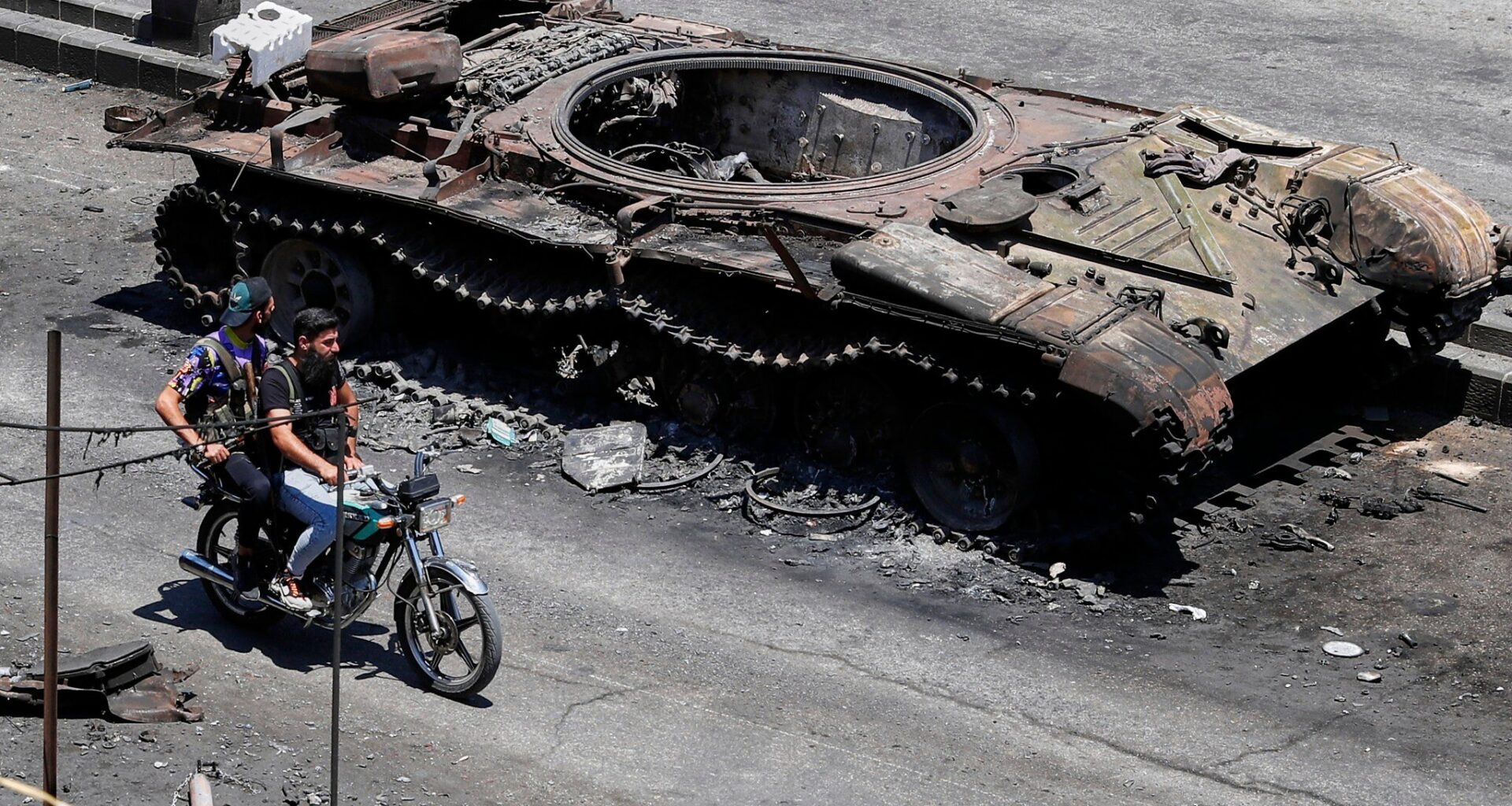
Renewed sectarian clashes in southern Syria’s Druze-majority Sweida province killed at least two people on Sunday, according to reports, in the first deadly incident since a ceasefire last month.
According to the state-run Ekhbariya TV, armed groups attacked personnel from Syria’s internal security forces in Sweida, killing one member and wounding others, and fired shells at several villages in the violence-hit southern province.
The report cited a security source as saying the armed groups had violated the ceasefire agreed on in the predominantly Druze region, where factional bloodshed killed hundreds of people last month.
“A member of the General Security forces was killed and seven others were injured… as clashes erupted with local factions around Tal Hadid in the western Sweida countryside,” said the the UK-based Syrian Observatory for Human Rights, which also reported the death of a “local fighter.”
Tal Hadid is a “key control point” at a relatively high altitude, according to the monitor, allowing whoever controls it to overlook neighboring areas.
Get The Times of Israel’s Daily Edition
by email and never miss our top stories
By signing up, you agree to the terms
Fighting also erupted around the city of Thaala, the Observatory said, “following bombardment of the area with shells and heavy weapons launched from areas under the control of government forces, while the sound of explosions and gunfire was heard in various parts of Sweida city.”
Clashes erupted once again between Druze forces and Syrian Government troops in the western Sweida countryside. Syrian media report Druze gunmen targeted government positions “in violation of the ceasefire,” killing one security officer and wounding others. pic.twitter.com/tlC16zkIk5
— Ariel Oseran أريئل أوسيران (@ariel_oseran) August 3, 2025
According to the monitor and Sweida locals, Damascus has been imposing a siege on the province, with the Observatory saying the government wants to “force inhabitants to comply.”
The road linking Sweida to Damascus has been cut off since July 20, after the province witnessed deadly clashes between Druze fighters and Sunni Bedouins in July that drew the intervention of government forces in the area.
Israeli forces then carried out strikes on Syrian military forces in southern Syria and government targets in Damascus, with Jerusalem saying it intervened to block Syrian troops from entering southern Syria – which Israel has publicly said should be a demilitarized zone – and to uphold a longstanding commitment to protect the Druze, thousands of whose coreligionists live in Israel.
A ceasefire put an end to the week of bloodshed — which killed 1,400 people, according to the Observatory — but the situation remained tense, flaring into violence again on Sunday.
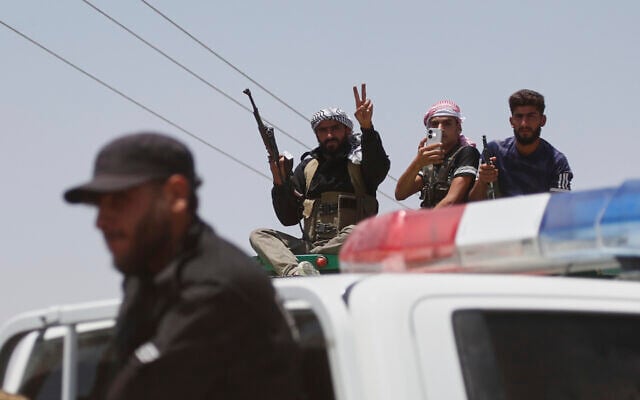
Syrian government security forces, foreground, block Bedouin fighters, background, from entering Sweida province on Sunday, July 20, 2025. (AP/Omar Sanadiki)
The Syrian government accuses Druze groups of blocking the main road, but the Observatory said armed groups allied with the government took control of the area and have been blocking travel.
The government said it would investigate the July violence in the province, and a committee in charge of the inquiry held its first meeting on Saturday.
The government under interim President Ahmad al-Sharaa has been struggling to consolidate control since Sharaa led a surprise insurgency that ousted former president Bashar al-Assad in December, ending the Assad family’s decades-long autocratic rule.
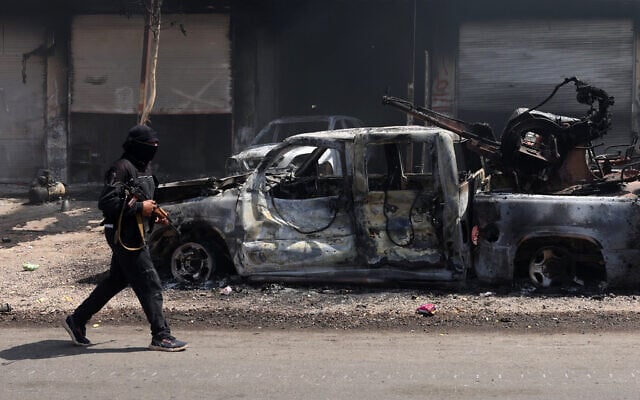
A fighters from Bedouin tribes walks past a burnt vehicle in al-Mazraa village in Syria’s southern Sweida governorate, July 18, 2025. (Bakr ALKASEM / AFP)
Political opponents and ethnic and religious minorities have been suspicious of Sharaa’s de facto Islamist rule and cooperation with affiliated fighters that come from militant groups.
Though his own fighters have roots in al-Qaeda, Sharaa has promised to protect members of Syria’s many sectarian minorities. But that pledge has been challenged, first by mass killings of members of Assad’s Alawite sect in March, and now by the latest violence in the southwest.
Is The Times of Israel important to you?
If so, we have a request.
Every day, even during war, our journalists keep you abreast of the most important developments that merit your attention. Millions of people rely on ToI for fast, fair and free coverage of Israel and the Jewish world.
We care about Israel – and we know you do too. So today, we have an ask: show your appreciation for our work by joining The Times of Israel Community, an exclusive group for readers like you who appreciate and financially support our work.
Already a member? Sign in to stop seeing this
You appreciate our journalism

You clearly find our careful reporting valuable, in a time when facts are often distorted and news coverage often lacks context.
Your support is essential to continue our work. We want to continue delivering the professional journalism you value, even as the demands on our newsroom have grown dramatically since October 7.
So today, please consider joining our reader support group, The Times of Israel Community. For as little as $6 a month you’ll become our partners while enjoying The Times of Israel AD-FREE, as well as accessing exclusive content available only to Times of Israel Community members.
Thank you,
David Horovitz, Founding Editor of The Times of Israel