
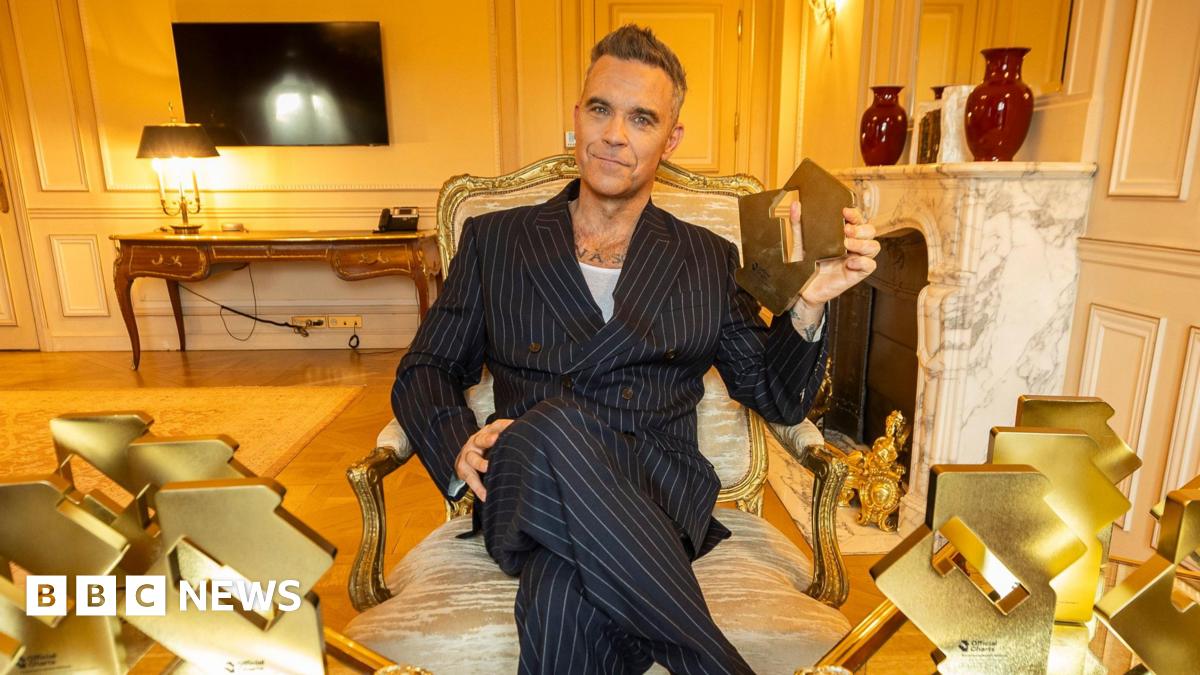
In a neat moment of circularity, Williams’ record-breaking album harks back to the start of his solo career, and the period when he nearly lost himself.
The cover art is based on the famous Mick Hudson photo, taken at Glastonbury festival in 1995, of Robbie with bleached blonde hair and a missing tooth. It was an incident that ultimately led to his dismissal from boy band Take That.
He has called Britpop “the album that I wanted to write after I left Take That” and a celebration of “a golden age for British music” that harnesses the energy of 90s bands like Oasis and Elastica.
Supergrass frontman Gaz Coombes lends a hand on glam-stomp anthem Cocky, and Williams’ former Take That nemesis Gary Barlow appears on a song called Morrissey, written from the perspective of a delusional stalker.
Reviews for the record have been broadly positive.
The Guardian called it “a wayward yet winning time-machine trip to the 90s” in a four-star review, external.
Rolling Stone also awarded four stars, external, saying Williams sounded “liberated” and “unrepentantly mad” as he “delivered some of his best songs in years”.
The NME gave a more cautious assessment, external. “An album to be remembered for? Probably not,” wrote Andrew Trendell. “But it’s bold, it’s a laugh, and he’s done it his way. That’s what makes him Robbie.”
Across his career, the star now has 21 number one albums, including Take That’s chart-topping LPs like Everything Changes and Progress.
Only The Beatles’ Paul McCartney has more in total, with 23 to his name.
Nonetheless, Williams said his family would keep him grounded after he has surpassed some of his musical heroes.
“A couple of weeks ago, I was with my American in-laws,” he told BBC News. “And I said, to my mother-in-law, ‘You know, Gwen, if I get the next number one album, I’ve had more number one albums than anyone ever’.
“And my daughter Teddy, under her breath, turned to the side and went, ‘In the UK’.
“So, you know, I won’t get too carried away.”