
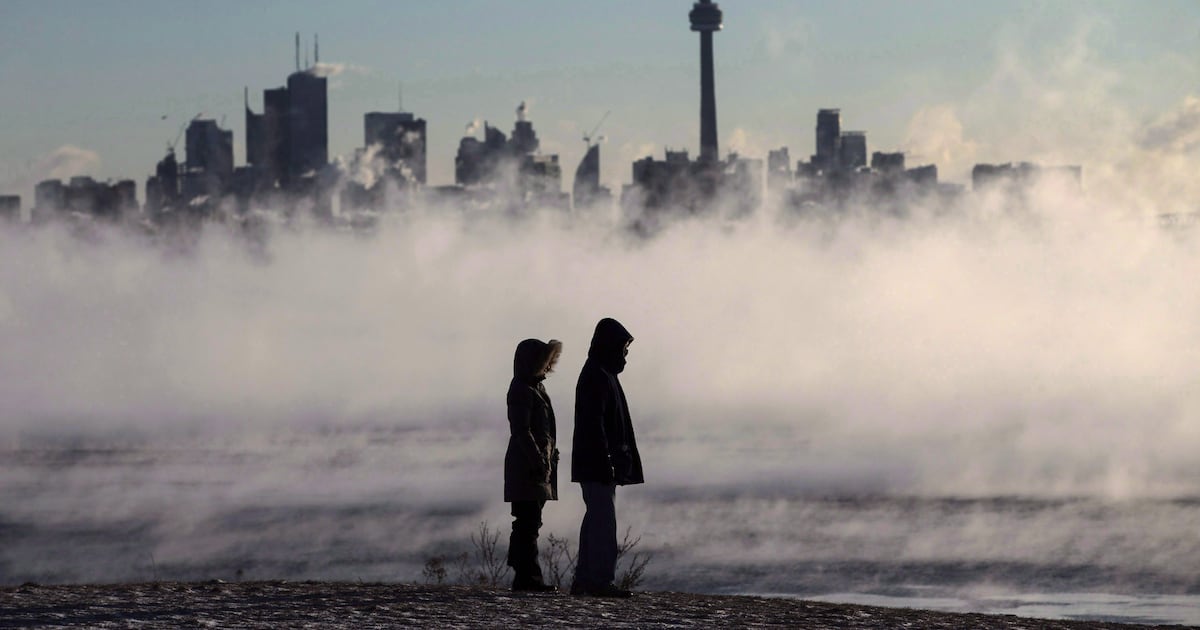
A special weather statement is in effect for Toronto and neighbouring areas, with cold wind chills and significant snowfall expected.
It can take a matter of minutes to experience frostbite.
Toronto is expected to be locked in winter’s frigid grasp for the rest of January, with the city likely to experience some of the coldest temperatures it has seen in a decade this weekend.
The start of the deep freeze will settle over Toronto on Friday, as Environment Canada forecasts the city will see a high of -12 C, feeling more like -24 with the wind chill, at points. The low will likely hit -22 C overnight but it will feel closer to -31 with the wind chill, according to the weather agency.
Anyone spending prolonged periods of time outside during these bouts of frigid temperatures could put their health at risk, experts say.
“It can actually be harmful to your health,” Dr. Allan Grill, chief of family medicine at Markham-Stouffville Hospital, told CP24 Breakfast. “The blood vessels that are sort of on the surface of your skin, they tend to constrict because they want to protect you, your core body temperature.”
With blustering, blistering winds expected to breeze through Toronto—Environment Canada forecasts winds gusting up to 50 kilometres per hour this weekend—it will feel colder faster, partly because the heat produced physiologically dissipates a lot faster.
“To give you an idea, if you’re exposed to -20 (Celsius) on the thermometer, you can start to get frostbite, on average, within half an hour,” Olivier Birot, human physiology professor at the School of Kinesiology and Health Science at York University, told CTV News Toronto in an interview.
That is, Briot notes, if one is remaining idle and unmoving during that period of time. People experiencing homelessness are at a higher risk of cold weather-related injuries as a result, with a Unity Health Toronto study noting they are 14 to 18 times more likely to be sent to the emergency room for it.
When there are big gusts of wind added to the mix, Birot says that time cuts in half, dropping to around 15 minutes.
“If you think about a 60 kilometres wind, which is severe wind, it can fall to two, five minutes to get frostbite,” Birot said.
The range for when frostbite settles varies person by person, according to CTV medical expert Dr. Marla Shapiro.
“Depending on where you are and your age and underlying medical conditions, we’ll say anywhere from 10 to 30 minutes, but it is a range,” Shapiro told CP24 on Friday morning.
Frostbite, hypothermia
Ears, fingers, noses, any extremity that’s exposed to chilling elements are at risk of experiencing frostnip or frostbite, depending on how long one spends outdoors.
With frostnip, Dr. Grill explains is when the skin reddens and stings and can even potentially feel numb.
“The good news is at that point, there’s no permanent damage,” Grill said. “It’s a warning sign: get out of any wet clothes, maybe put a blanket around you to warm you up, drink something warm.”
But, if one continues to stay outdoors when these symptoms sink in, it can develop to frost bite, which, in turn, becomes a medical emergency.
“That’s where you get permanent damage to the skin tissue. Skin gets hard, it can turn blue,” Grill said. “You have to go to the emergency room.”
Prolonged exposure to extremely cold temperatures can lead to hypothermia, which is when the body’s core temperature drops below 37 C.
“When you get frostbite, you can freeze your finger and lose your finger. You’re still not hypothermic,” Birot said, pointing to how one can experience frostbite without experiencing hypothermia.
Hypothermia brings on symptoms like shivering, confusion, exhaustion, slurring of speech and a lack of muscle coordination—all signs to look out for during extreme cold.
“If those signs occur, another medical emergency—go seek care right away,” Dr. Grill said.
Impact on lungs
Breathing in cold air is not harmful to the lungs, according to Birot, stressing that there is “absolutely no danger” to the organ when doing so.
“If you breathe the air at -20, very rapidly, the air is going to warm up in your respiratory tract,” he explained. “So, when the air is going to get into your back of your throat, in your trachea, is going to be already warmed up close to probably like 30 degrees.”
While it may not pose an immediate danger, Jack Goodman says it can be inflammatory and irritating for those with underlying respiratory conditions like asthma.
“They may be a little more vulnerable because of that cold, dry air being an irritant, and it can cause, in some cases, some constriction, which can lead to some challenges,” the professor emeritus at the University of Toronto kinesiology department said.
Goodman advises anyone with respiratory issues to take some caution when exposing themselves to the cold and mitigating how badly they experience that chill by bundling up.
“Thousands, if not hundreds of thousands, of Canadians who snowshoe and cross-country ski and downhill ski … there’s little evidence that it causes problems in terms of your lungs don’t freeze,” Goodman said.
Exercising, shoveling, working
Should someone choose to exercise outdoors, both Birot and Goodman advise dressing up appropriately for the activity they are about to do.
“Many people will dress to go out for a jog or cross-country skiing, and they underestimate how much heat that they’re going to produce from the exercise, and they tend to overdress,” Goodman said.
“A good rule of thumb is to have clothing that breaks the wind, that has some breathability and have layers so that if you’re out for a long time … you may be able to take off a layer.”
Birot says sporting windproof and waterproof clothing would come in handy, as well as wearing gloves and a hat.
“Like, 30, 40 per cent of the heat dissipation is through your head, so it’s very important to wear something on your head, protect your skin,” Birot said.
The cold weather can also impact blood flow, Goodman noted, pointing to how individuals with underlying heart conditions may want to be cautious when performing vigorous exercise.
“Even consider snow shoveling the same way you would consider a run or snowshoeing or cross-country skiing. Warm up slowly,” Goodman said. “Don’t shovel it all at once, try to humidify and warm the air…. Just go about things as you would in really responsible way.”
He advises spending some time warming up before any sort of vigorous work.
Birot says anyone working outside, like construction workers for example, who may feel like taking off their gloves may want to do so carefully.
“The task might be more difficult because they’re going to lose the sensation, they’re going to lose the dexterity, and any piece of metal that they’re going to also use … is going to increase your risk of frostbite,” Birot said.