
People have a lot of opinions about Lisa Banfield. And a lot of those opinions, as Tim Bousquet wrote in an award-winning commentary published in the Halifax Examiner in 2022, are based on “lies, innuendo, misogyny.”
We are already starting to get a new round of people expressing their opinions on Banfield, the common-law spouse of the deadliest mass murderer in Canadian history, and a survivor of domestic violence at his hands. That’s because her new book, co-written with journalist Sherri Aikenhead and Banfield’s sister, retired educator Maureen Banfield, was released on Tuesday by publisher Sutherland House.
Tim Bousquet has a feature interview with Banfield coming today, so please check back later to read that. It is an in-depth and moving article.
I want to look at one aspect of the criticism of Banfield, which Bousquet briefly touches on: the accusation that, by publishing and promoting a book, she is profiting from tragedy — and that the round of interviews she is currently doing is just designed to sell books.
This is absurd, for a number of reasons.
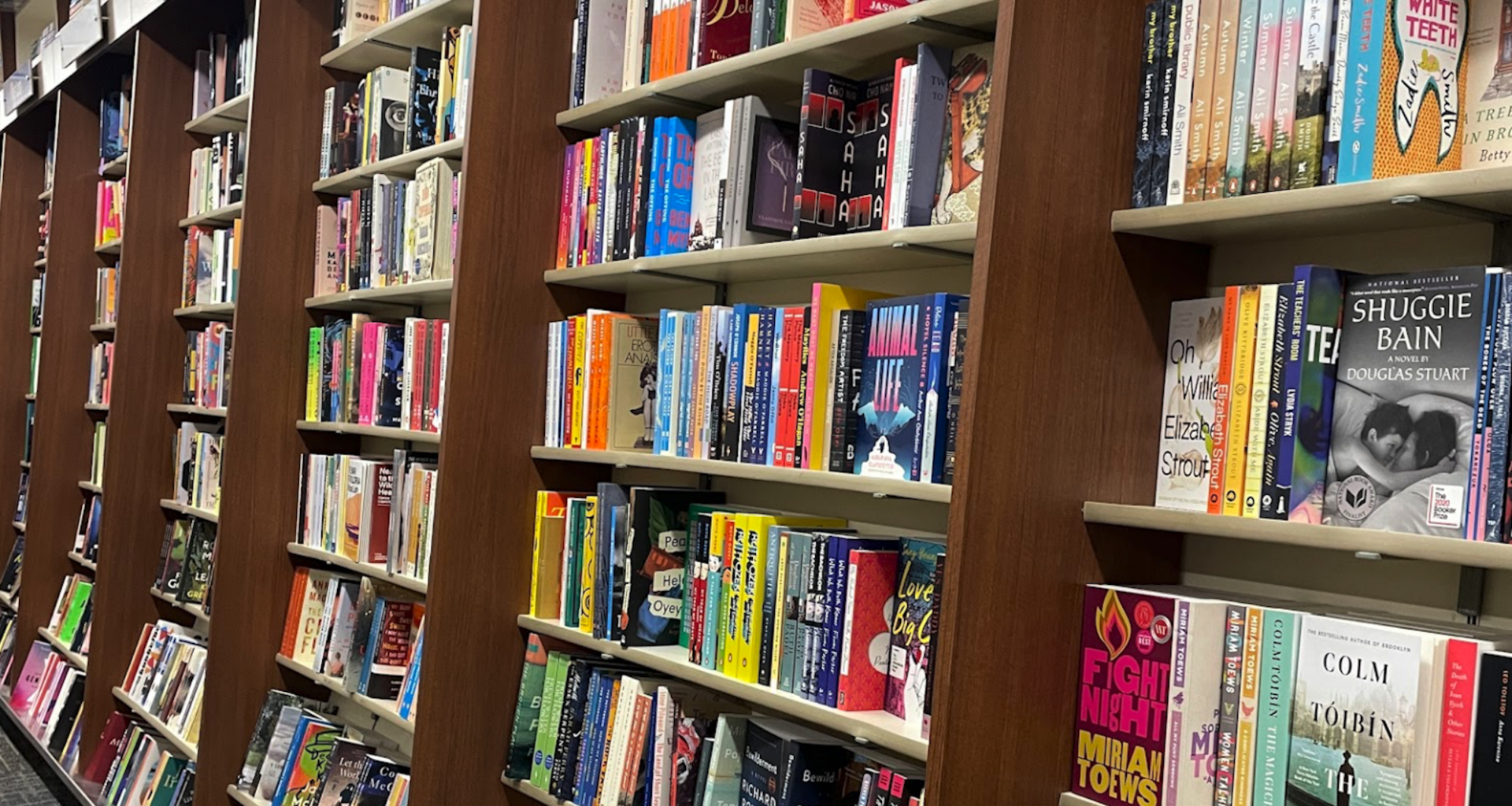
First of all, we are talking about Canadian publishing. A marginal enterprise at the best of times, as is most publishing. I shake my head every time I see some magazine freelancer or low-level book editor in a movie living in a tony Manhattan apartment. No.
There is a persistent misconception that if you are visible, money must be attached. Or that writing pays far beyond a living wage. I recently got a new credit card, and the person at the bank told me that it came with six airport lounge passes a year, which she figured would be very useful for me as a freelance writer, even if it might not be enough.
Yeah, I am jetting all over the world reporting stories.
Here is the very brief rundown of how compensation works in book publishing. Writers get an advance, which is paid out in two or three steps: on signing, on delivery of the manuscript, and on publication. Some publishers don’t offer an advance at all. Others offer tiny ones. We’re talking hundreds, not thousands.
The payment is called an advance because it is an advance on royalties. Let’s say the writer gets a royalty rate of 8% (this is what I got, more or less — it would have gone higher if it had sold way beyond expectations). No royalties are paid out until the publisher recoups the advance. So if you have a $2,000 advance, you’re not going to see any royalty money beyond that until you’ve sold enough books that your royalties are more than that.
Sometimes you can get grants, but these are very competitive and not easy to snag. In my case, the publisher successfully applied for a travel grant, which allowed me to talk to people in person, all over the province, without eating up the whole advance.
Of course, if a publisher has high hopes for a book, and if they have deep enough pockets, the advance will be higher. I have no idea what Sutherland House advances are like, but keep in mind the book has three co-writers, so I presume there is going to be even less money per person.
Writers’ organizations track earnings across the industry, and the results are generally dismal. The Writers’ Union of Canada (disclosure: I am the editor of their magazine, Write) last did an income survey report in 2018.
From the report:
Taking inflation into account, writers are making 78% less than they were making in 1998. In fact, writers are making significantly less from their writing than they did just three years ago: $9,380 in 2017 vs. $12,879 in 2014. That’s a 27% drop over a short period — the same period that has seen a massive increase in uncompensated educational copying. At the same time, 30% of writers say they must do more to earn a living than they did three years ago…
Writers’ writing incomes are far behind the average salary in the information and cultural industries ($65,503), a sector built upon the work of creators…
This is not just a Canadian problem.
In its 2023 survey, the U.S.-based Authors Guild finds a pretty dismal median income for full-time authors:
The median author income for full-time authors from their books was $10,000 in 2022, and their total median earnings from their book and other author-related income combined was $20,000. Book income includes advances, royalties, and fees from licensing and subsidiary rights. Other author-related income includes work such as editing, blogging, teaching, speaking, book coaching, copy writing and journalism.
For in-demand speakers, fees can far outstrip revenue from book sales, so some writers see books as a loss-leader that allows them to command higher fees for other activities.
The Australian Society of Authors surveyed incomes last year, and reports:
This years’ survey results align with our findings year on year: earnings for authors and illustrators remain unsustainably low.
When it comes to advances, 33% of respondents reported not receiving any advance, representing a 7% increase from 2024. 60% of respondents reported receiving an advance under $5,000 – which is untenable when advances are intended to help sustain authors while they write and edit their book.
All right, so Lisa Banfield is unlikely to get rich off her book.
But even if she was, even if she got an astronomical advance…what would be wrong with that?
And doing interviews to sell books? My goodness, what depths of depravity will we sink to next?
We live in a world in which tech CEOs berate us for not using their shitty products, and where companies proudly announce their latest garbage innovations as though they are life-changing. My favourite recent example of this is Google and pizza chain Papa Johns touting their new AI app, which offers “a major transformation of its digital ordering experience.”
Here is one of the innovations announced by the pizza chain:
The agent identifies returning Papa Rewards loyalty customers and proactively asks whether they want to reorder their most recent orders. Because many pizza customers often order the same items, enabling a speedy, convenient flow from opening the app to checking out is paramount.
OK, I have digressed, I know. The point is, these people have no shame in promoting incremental change as revolutionary, while writers tend to apologize for even promoting their work. I cannot tell you how many social media posts I have seen over the years from writers shyly pointing to new work and saying they hope it’s OK to plug it a bit.
Do actors get criticism for doing the rounds of chat shows when they have a new movie coming out? Is it bad for politicians and people running for office to sit down for interviews. Oh, they’re just trying to promote themselves. Yeah, baby! We have fashioned a hustle culture and fetishized people who are always grinding.
But if you are an author, and particularly if you are a woman, and a woman who has been through terrible experiences, there is supposed to be something unsavoury about telling your story and maybe making a few bucks if you’re lucky, even as you help others by sharing the horrors you have been through?
Please.
(To send or post this item, copy the website address at the top of this page.)
NOTICED
1. Hacketts Cove Park clears a hurdle
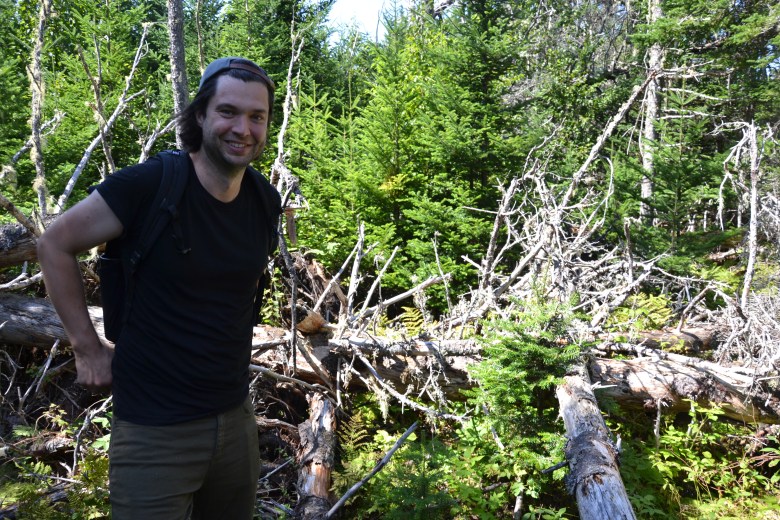 Julien Beale trying to make his way through Hacketts Cove Park and down to the beach in August 2023.
Last summer, I wrote about the years-long fight residents of St. Margarets Bay have waged to develop Hacketts Cove Park.
The land is owned by the city and designated as a park on maps. It has a lovely small beach, but the only access is through heavy woods that have been difficult to traverse. (A couple of years ago, I was invited to visit the park by Julien Beale, pictured above, and it took us over an hour to walk the few hundred metres to the beach.)
Now, $35,000 in funding to design a trail for the park has been put on Halifax’s 2026-2027 draft capital budget. There is no guarantee the funding will still be there once the budget process is over — it may not make the cut, so to speak. But getting this far is a huge step for the Friends of Hacketts Cove Park, who have been hoping to get onto even the draft budget for years.
(Send this item: right click and copy this link)
2. Oscar nominations for Canadians

I don’t particularly care about the Oscars in general, but I do always scan the list of nominees to see if any Canadians are up for Academy Awards.
This year’s nominees include The Girl Who Cried Pearls, directed by the Montreal-based team of Chris Lavis and Maciek Szczerbowski, and produced by the National Film Board. It’s up for best animated short. The pair were previously nominated for their 2007 animated film Madame Tutli-Putli.
Perfectly a Strangeness, written, produced, and directed by Montrealer Alison McAlpine is up for best documentary short. It’s produced by Second Sight Pictures, in association with GreenGround Productions
I’ll hand it over to CBC for the rest of the Canadian nominees:
The directors of Elio and KPop Demon Hunters, Domee Shi and Maggie Kang, respectively, were nominated for best animated feature…
And the Canadian teams behind the look of Frankenstein have been nominated for makeup and hairstyling, as well as production design.
(Send this item: right click and copy this link)
3. Anti-fascist pitmaster and AI art eater
 BBQ Credit: Luis Santoyo / Unsplash
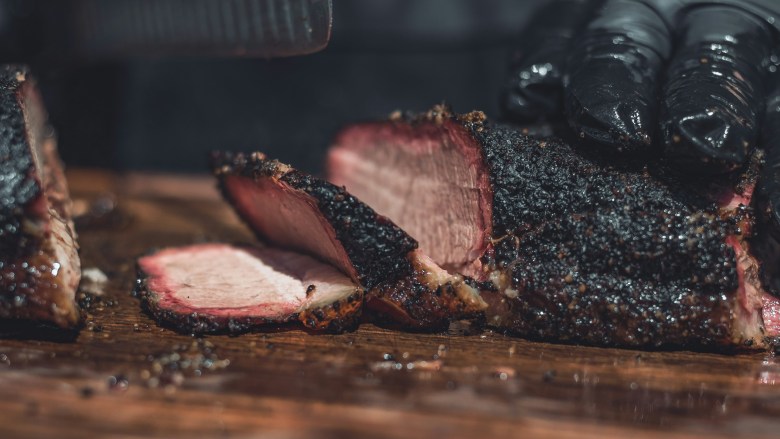
I had to read this article by Kit O’Connell in the Barbed Wire, just for the headline: “‘Barbecue Saved My Life’: Meet Waco’s Antifascist Transgender Pitmaster.”
It’s a profile of Kaleb Blain, who used to work answering calls to 911, but decided that fast-paced, intensely stressful life was not for him. He got a job at a new location of chain restaurant Terry Black’s BBQ, and started posting TikTok videos about food and politics. That did not sit well with the restaurant.
O’Connell writes:
Blain said he was part of a wave of doxxings and firings in the wake of the Kirk assassination, which also led to hundreds of complaints against educators and inflamed a dangerous free speech crisis on Texas campuses. Reuters estimated that at least 600 people were targeted nationwide, some of whom merely quoted Kirk in his own words.
Blain said that Terry Black’s didn’t immediately fire him, but the company forced him to delete some of his videos referencing Terry Black’s brand, and he said they started scheduling him for fewer and fewer shifts. Eventually, Blain said he was let go for smoking on company property. But Blain is convinced he was singled out.
Now, Blain runs his own micro-business in Waco, smoking meats and delivering them.
Because Blain believes that BBQ should be an accessible, working class food, he’s also focused on cooking affordable meat like pork and chicken.
“It’s about … using my skills and my knowledge and my creativity as a pitmaster to make cheaper cuts of food to put on the table for the average family, where everybody can come in and eat once a week and have that tradition,” he told The Barbed Wire. “If we’re going to hit a recession, I’m going to cook recession food because that’s what barbecue is: It’s recession food, it’s poor man’s food.”
He hopes to eventually open his own BBQ restaurant, where trans Texans can feel at home.
Another story I had to read after seeing the headline is “Meet the Alaska Student Arrested for Eating an AI Art Exhibit,” by Colin Warren, in The Nation.
The student is Graham Granger, who studies film and performing arts at the University of Alaska Fairbanks. He was taking in an exhibit at a university gallery when he became disgusted with AI-generated artworks on display as part of a project on AI psychosis by artist Nick Dwyer. Granger began stuffing the artworks into his mouth as fast as possible. He was later arrested, and said the protest was spontaneous.
From the interview:
I think artificial intelligence is a very valuable tool. I think that it has no place in the arts. It takes away a lot of the human effort that makes art. If art cannot be improved upon by criticism, it’s hard to call it art. And there is an argument to be made that you can criticize your AI art by changing the prompts and generating more images to pick from, but that work doesn’t compare to the criticisms that a real piece of art would receive if you critique it…
I say AI isn’t art. I know a lot of people who would agree with me. I don’t think there’s any perfect argument that can be made for this, because no matter what you say somebody will come up with a counterpoint because at its core art is subjective.
However, the process by which art is made is oftentimes more important than the finished product, and if the process of making your art is just typing a prompt in, it just takes away from the accomplishments of other talented artists. And it really hurts the practice of art by commercializing that finished product.
Granger said he spat out some of the chewed-up work “because AI chews up and spits out art made by other people.”
(Send this item: right click and copy this link)
RECENTLY IN THE HALIFAX EXAMINER:
1. NOFRAC is back: Citizens’ group wants details about onshore drilling program
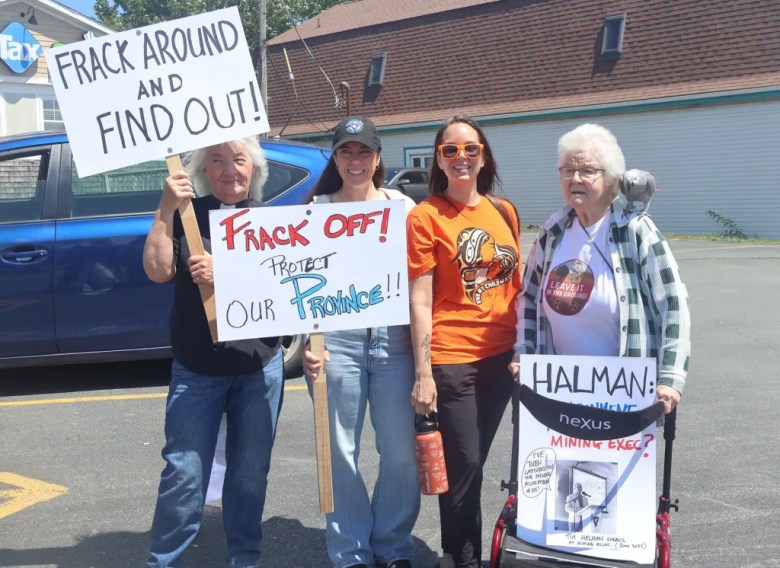 From left to right: Rev. Marian Lucas-Jefferies, Ana Balbino. Jeanine Goulet, Janet Baker at the June 20, 2025 rally against uranium extraction outside Minister Tim Halman’s office. Credit: Madiha Mughees
Jennifer Henderson reports on the return of an activist group dedicated to banning fracking. NOFRAC was active in Nova Scotia from 2010 to 2014, when the province passed a ban into law. Now, the Conservative government of Tim Houston wants onshore gas exploration to start up again, and has contracted Dalhousie University to carry out research to that end.
Henderson writes:
The premier’s full steam ahead approach is irresponsible,” said Jonathan Langdon, the Canada Research Chair in sustainability and social change leadership at St. Francis Xavier University and a member of the NOFRAC coalition.
“Especially as research over the last decade confirms and significantly expands our knowledge about the risks of fracking for unconventional gas to climate, clean water, health and the environment.”
Summers noted that [Graham] Gagnon, [Dalhousie’s acting vice-president of research and innovation], was a member of Nova Scotia’s Independent Panel on Hydraulic Fracturing back in 2014.
Click or tap here to read “NOFRAC is back: Citizens’ group wants details about onshore drilling program.”
(Send this item: right click and copy this link)
2. Bill 12 misses the real cost crisis in Nova Scotia universities
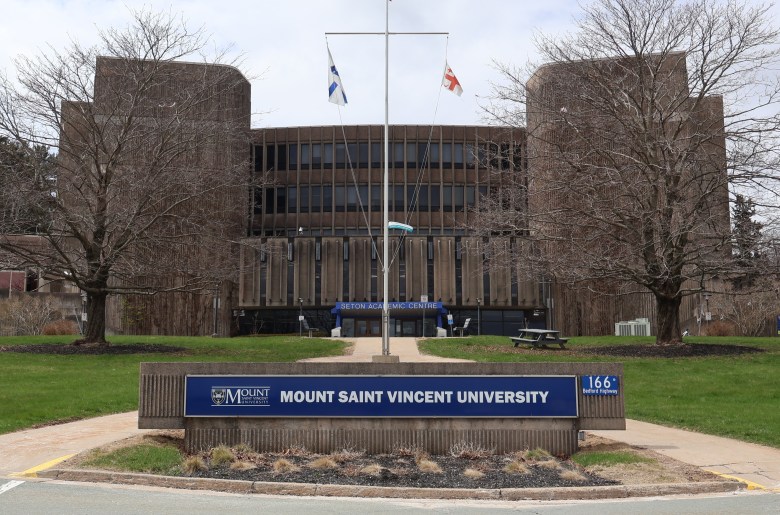 Mount Saint Vincent University in Halifax, N.S. Credit: Suzanne Rent
The Examiner has published a commentary by Mount Saint Vincent University professors Geneviève Boulet and Nathaniel Street on Nova Scotia’s Bill 12, which is supposed to improve the sustainability and accountability of the province’s universities.
Boulet and Street write that those goals are “reasonable” but the bill misses the mark:
Bill 12 misses what has actually made universities unsustainable in the first place. First and foremost, post-secondary education has been chronically and increasingly underfunded over the past several decades, forcing universities to rely on increased tuition and other forms of revenue to make up for decreased public funding.
But this isn’t the only stressor: administrative growth and governance practices have also played a significant role in making institutions increasingly unsustainable. Bill 12 misses this combined reality and instead dramatically expands the government’s authority to intervene in the academic operations of a university by cutting and reorganizing departments and programs and by relocating or firing professors…
In effect, Bill 12 directs its strongest tools toward academic restructuring while bypassing scrutiny of how universities are funded, governed, and managed financially. If sustainability is the objective, then Bill 12 misses the mark.
Click or tap here to read “Bill 12 misses the real cost crisis in Nova Scotia universities.”
(Send this item: right click and copy this link)
IN OTHER NEWS
Case of police officer accused of selling stolen bikes put off until March
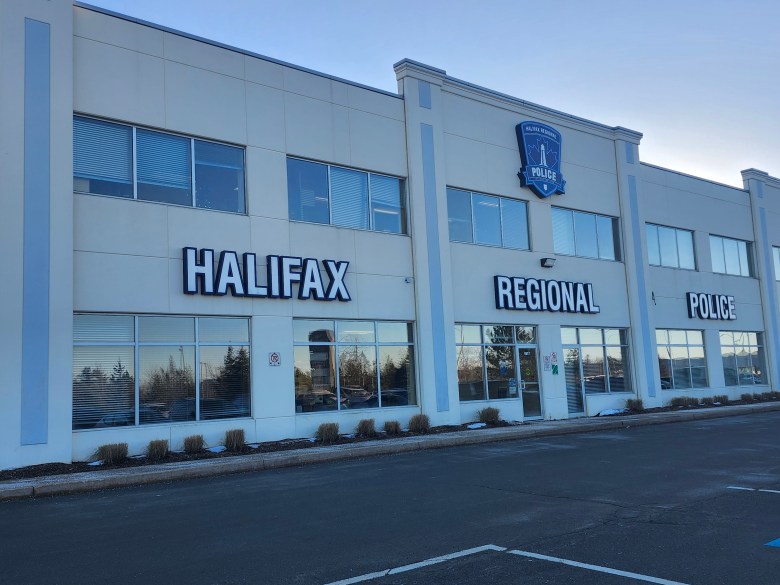 Halifax Regional Police East Division office, in Dartmouth, Nova Scotia, on December 18, 2025. Credit: Philip Moscovitch
Steve Bruce reports for the Chronicle Herald on the latest in the case of Halifax Regional Police officer Fallon Sarah Clarke, who is accused of selling stolen bicycles and other property. Bruce writes:
Charges against a Halifax Regional Police officer accused of selling stolen property have been adjourned until March while lawyers discuss a potential resolution…
The officer was arraigned in Halifax provincial court in November, and the charges were in front of a judge again Tuesday.
Defence lawyer Brian Bailey, who appeared by phone on behalf of Clarke, asked that election and plea on the indictable charges be put off until March to allow for further talks with Crown attorney Melanie Perry about a “possible resolution.”
(Send this item: right click and copy this link)
Government
No meetings
On campus
Dalhousie
The Significance of Occupation Beyond Health (Friday, 5pm, details) — Niki Kiepek will talk
NSCAD
Reception (Friday, 5:30pm, details) — new exhibitions by Quinn O’Connor, soph galway, and Daria Herashchenko
In the harbour
Halifax
05:30: APL Esplanade, container ship (152,350 tonnes), arrives at Pier 41 from Colombo, Sri Lanka
07:30: Nolhan Ava, ro-ro cargo, moves from Pier 25 to Pier 30
09:00: Nolhan Ava moves to Pier 42
18:00: Few BPS, oil tanker, arrives at Tufts Cove from Baton Rouge, Louisiana
18:30: Oceanex Sanderling, ro-ro container, sails from Fairview Cove for St. John’s
20:00: Nolhan Ava sails for Saint-Pierre
Cape Breton
08:30: SFL Trinity, oil tanker, sails from EverWind for sea
09:30: Castor 1, oil tanker, arrives at EverWind from Sikka, India
16:00: AlgoScotia, oil tanker, arrives at Government Wharf (Sydney) from Halifax
Footnotes
One of the reasons Philip K. Dick churned out so many books is that he’d get small advances, and they would be gone by the time he finished the book. He had a family to feed, so he would immediately start in on the next book.
Also, I am told I was in the top 1% of Kid Rock listeners last month. Yee-haw.