
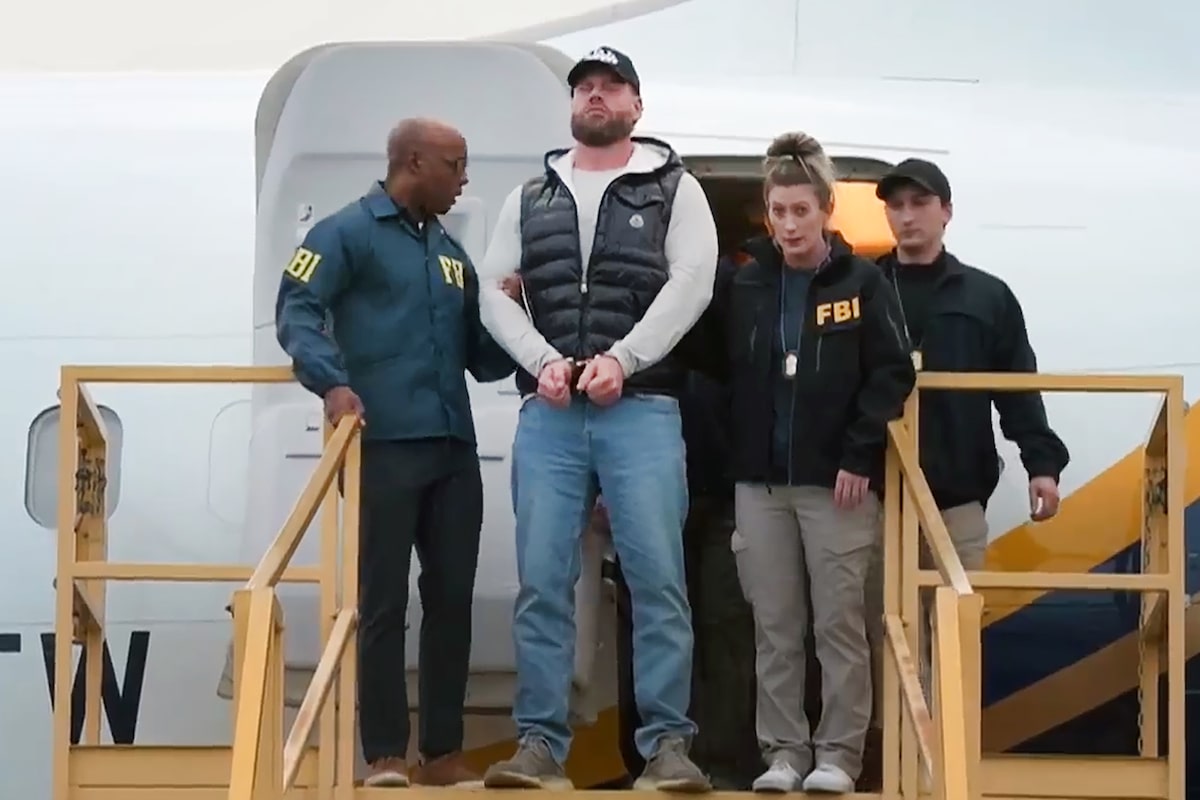
This still photo taken from video and provided by the FBI shows Ryan Wedding being taken off a plane at Ontario International Airport in Ontario, Calif. on Friday.
The circumstances of former Canadian Olympic snowboarder turned alleged cocaine kingpin Ryan Wedding’s arrest and swiftness of his transport from Mexico to the U.S. are raising concerns about the handover, which appears to have sidestepped the norms that have typically dictated such cross-border operations.
Top law enforcement officials from Canada and the United States stood shoulder-to-shoulder in California on Friday morning, to announce the capture of Mr. Wedding in Mexico the previous evening.
By Friday evening, the U.S. Federal Bureau of Investigation released a video of Mr. Wedding, handcuffed and surrounded by officers, stepping off a plane in California.
A more conventional process was followed in Canada in November, when the RCMP, at the behest of the U.S. Department of Justice, arrested eight Canadians facing charges in the U.S. in connection to their alleged ties to Mr. Wedding. The accused are now awaiting extradition hearings in Canada, which could be long and complicated, experts have said.
Former Olympic snowboarder Ryan Wedding has been arrested in Mexico on multiple charges of drug trafficking and murder, authorities announced on Friday (Jan 23). Wedding was among the FBI’s most-wanted fugitives,
The Associated Press
U.S. authorities declined to comment Friday about the circumstances of Mr. Wedding’s quick transport out of Mexico.
But Robert Currie, a professor of law at Dalhousie University in Halifax warned about the implications of apparently disregarding extradition proceedings.
“There is a due process problem when we sacrifice extradition just because the alleged offender is supposed to be very dangerous,” Prof. Currie said. “If you start down that slope there will always be reasons we shouldn’t follow ordinary procedures.”
He added that if lawful processes are being devalued by the U.S. and Mexico, it could devalue extradition treaties elsewhere – including Canada.
Who are the Canadians facing charges connected to Ryan Wedding?
Early last year, Mr. Wedding’s alleged No. 2, Canadian Andrew Clark, was similarly transported quickly to the U.S. after his arrest in Mexico, in the wake of U.S. President Donald Trump’s demands that Mexico crack down on cartels.
Mexican President Claudia Sheinbaum has followed a policy of appeasing Mr. Trump in hopes of avoiding tariffs with dozens of handovers of suspected cartel leaders for U.S. prosecution.
Mr. Trump has further threatened to pull the U.S. out of its free-trade deal with Mexico and Canada, which is up for renegotiation this year, and fears over this prospect is particularly acute in Mexico, where an end to free trade could throw millions out of work.
Despite this pressure, Ms. Sheinbaum has drawn a red line with the U.S. over violations of Mexico’s territorial integrity, including by asserting her country’s right to lead its own law enforcement operations. She has repeatedly said “sovereignty is non-negotiable” – and reiterated the message this month after Mr. Trump renewed threats to send U.S. troops into Mexico to fight drug cartels.
A timeline of Ryan Wedding’s shift from Olympic snowboarder to alleged drug kingpin and his arrest
Ms. Sheinbaum’s government also opposed Mr. Trump’s FBI-led operation in Venezuela this month to capture former president Nicolás Maduro. “The government of Mexico energetically condemns and rejects the military actions recently executed unilaterally by the U.S.’s armed forces,” a statement from the Mexican foreign ministry read.
On Friday, U.S. FBI director Kash Patel said the arrest of Mr. Wedding happened in Mexico City on Thursday night, but he could say nothing more due to “operational sensitivities.” In his remarks, Mr. Patel repeatedly thanked the rigour of an FBI Hostage Rescue Team, a unit which has a taken on a dual role in covert counterterrorism missions.
“Our FBI HRT teams executed with precision, discipline and total professionalism alongside our Mexican partners to bring Ryan James Wedding back to face justice,” Mr. Patel said.
Ryan Wedding, a former Canadian Olympic snowboarder suspected of becoming a cocaine smuggling kingpin, has been arrested in Mexico, FBI Director Kash Patel said on Friday in Ontario, California.
Reuters
Mexican officials did not answer questions about the FBI operation, saying instead that Mr. Wedding voluntarily surrendered at the U.S. embassy in Mexico City.
Ms. Sheinbaum’s office circulated a press release from U.S. Ambassador to Mexico Ronald Johnson, published several hours after Mr. Patel’s news conference, pointing out that the Spanish version of the U.S. government release used the same “voluntary surrender” language as the Mexican government.
The English version said Mr. Wedding’s surrender happened after “pressure applied by Mexican and U.S. law enforcement.”
Ms. Sheinbaum’s office did not respond to a question about what specifically U.S. and Mexican police did to secure Mr. Wedding’s surrender.