
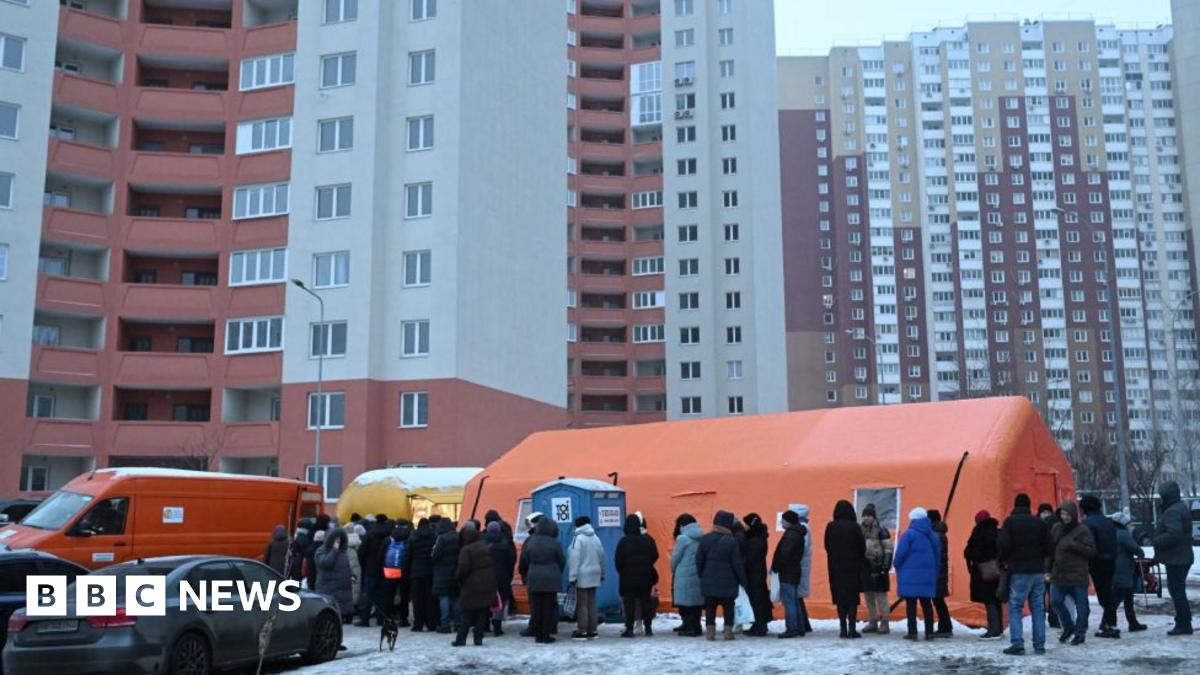
Before Russia’s full-scale invasion of 2022, about 11 million households in Ukraine relied on central heating, compared to seven million autonomously heated households, Ukrainian energy expert Yuriy Korolchuk said.
Cities across the Soviet Union, including in Ukraine, were the focus of huge construction programmes launched in the 1950s to mass produce cheap housing.
The landscapes of cities in the former USSR are dominated by ubiquitous nine-storey residential buildings made from pre-fabricated concrete panels, known as “panelki”, or smaller five-storey blocks of flats known as “khrushchevki”, after Soviet leader Nikita Khrushchev, who oversaw their construction in the 1950s and 1960s.
Heating to such houses is supplied by large plants known as TETs – an acronym that stands for “heat and electricity centrals” in Ukrainian as they generate electricity as well as heat.
Detached houses occupied by a single family, known as “private houses” in Ukraine, are normally found in rural areas and are rare in cities.
“Ukraine inherited the Soviet heating system and it hasn’t changed anything, it stays predominantly centralised,” Korolchuk told the BBC.
“These heating plants were not designed to be attacked with missiles or drones, that’s why these vulnerabilities came to the fore during the war.”
According to him, this is a new tactic used by Russia.
“During the previous winters, there were no such strikes against the heating system. They happened only occasionally, and they didn’t directly target heating plants,” he added.
Referring to ongoing talks to end the war, he says “the factor of negotiations is now possibly playing a role, it’s a form of pressure”.
Large centralised installations bring about efficiencies of scale, but should they be targeted by bombs or drones, the consequences can be devastating for hundreds of thousands of people.
The Ukrainian government is acutely aware of this vulnerability, and is planning to reduce it by making individual heating points mandatory at apartment blocks.
However, undoing decades of Soviet urban planning will not be quick or easy.