
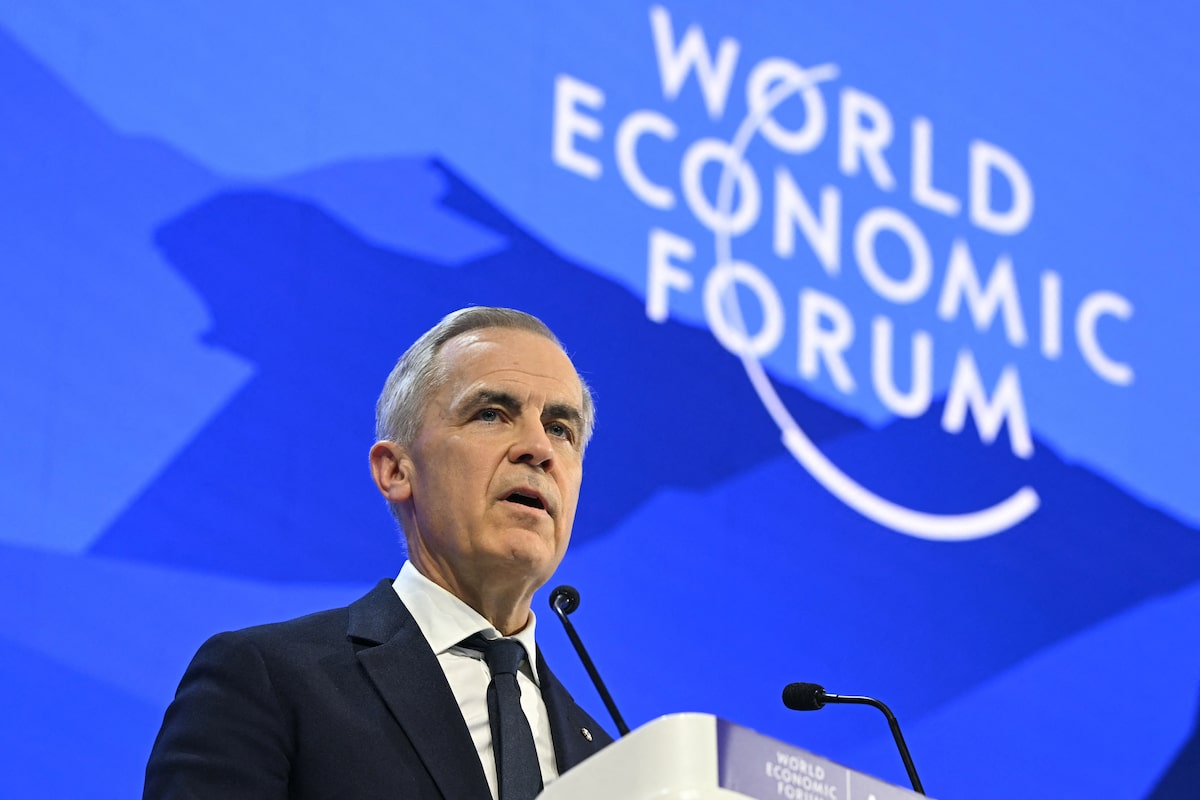
Prime Minister Mark Carney delivers a speech during the World Economic Forum annual meeting in Davos, Jan. 20.FABRICE COFFRINI/AFP/Getty Images
Corporate leaders and chief executive officers are backing Prime Minister Mark Carney’s assertion that Canada needs to reposition itself as the world order ruptures, but say they are also wary of the possible fallout from his blunt remarks at the World Economic Forum this week.
The C-suites across Canada were buzzing about Mr. Carney’s headline-making moment on the world stage in Davos on Tuesday, where he called on middle powers to band together aBusiness leaders endorse Carney’s Davos warnings, but worry about blowbackgainst economic bullying, “coercion” and “subordination” by major powers.
CEOs called his speech on Tuesday a galvanizing moment for Canada. Some told The Globe and Mail they exchanged a flurry of texts and e-mails with each other about how to respond to Mr. Carney’s call to action. They heard an appeal to be deliberate about where they deploy capital, by backing Canadian projects and diversifying their relationships and investments not only with existing allies, but also less obvious partners in the Middle East and China.
Prime Minister Mark Carney gave a speech at the World Economic Forum that blamed U.S. President Donald Trump, without naming him, for what Carney described as a rupture in global relations.
Gord Nixon, chair of the board of Bell Canada parent BCE Inc. and former CEO of Royal Bank of Canada, called it “a seminal speech.”
“His call to action is one of pragmatism,” Mr. Nixon said in an interview. “His message was, ‘Look, the dynamics of the world have changed, and we’re not going back.’ … You can’t just sit back and say we’re going to pretend the world’s going to return to the way it was.”
Yet the pride and patriotism rippling across Bay Street was mixed with a sense of apprehension over the impact the speech might have on Canada’s tense relations with the United States.
Konrad Yakabuski: The hard truths Mark Carney left unsaid in Davos
John Turley-Ewart: At Davos, a new great game dawns for the world. Which way, Canada?
Mr. Carney’s comments were widely interpreted as a broadside against the U.S. administration, even if he chose his words carefully and there was much in his framing of U.S. politics that American leaders might agree with. Business leaders are still wary of poking the bear when it comes to Canada’s powerful trading partner.
“The Prime Minister made a courageous speech,” said John McKenzie, CEO at TMX Group Ltd., in an interview. “There are going to be repercussions for being courageous.”
Already, Donald Trump has fired warning shots toward Canada, saying Mr. Carney’s speech “wasn’t so grateful” and that “Canada lives because of the United States,” adding: “Remember that, Mark, the next time you make your statements.” Then, in a social-media post, Mr. Trump withdrew Mr. Carney’s invitation to join his new Board of Peace, which has drawn a tepid response from European leaders.
John McKenzie, CEO at TMX Group Ltd., says Mr. Carney ‘made a courageous speech,’ and ‘there are going to be repercussions for being courageous.’Fred Lum/the Globe and Mail
U.S. Secretary of Commerce Howard Lutnick also derided Mr. Carney’s position in a television interview on Thursday, signalling that the coming negotiations on the fate of the U.S.-Mexico-Canada Agreement could get tougher if Canada continues on its current path, including opening the door to more trade with China.
“Give me a break, they have the second-best deal in the world, and all we’re going to do is listen to this guy whine and complain,” Mr. Lutnick said.
Even European Central Bank president Christine Lagarde, a key figure in the European coalition Mr. Carney is attempting to rally, said she is “not exactly on the same page” as him in remarks she made Friday in Davos.
European Central Bank president Christine Lagarde says she’s ‘not exactly on the same page’ as the Prime Minister.FABRICE COFFRINI/AFP/Getty Images
Several CEOs said they did not interpret Mr. Carney’s comment in his speech that “it’s time for companies and countries to take their signs down” – a reference to an essay by Czech dissident Václav Havel about shopkeepers displaying pro-government slogans to avoid trouble – as a call for them to speak out against the Trump administration, or to stick their necks out in public.
Some of the business leaders and CEOs who spoke to The Globe asked not to be named, reflecting how sensitive many companies still feel about the risk of becoming a target for reprisals.
With USMCA negotiations looming, major Canadian banks operating in the U.S., oil and gas markets on edge over Mr. Trump’s intervention in Venezuela and trade tensions over key products from the automotive and agricultural sectors, CEOs see plenty of ways Mr. Trump can still punish Canada’s economy if he chooses.
John Rapley: Carney, Trump and the week at Davos that marked the decline of the West
The CEO of the Business Council of Canada, Goldy Hyder, met with U.S. trade representatives and members of Congress in Washington this week. He said people “representing the President” pointed to Mr. Carney’s speech and Canada’s recent trade deal with China as raising questions about Canada’s commitment to renewing the USMCA and its participation in the Five Eyes intelligence-sharing partnership.
“These are the kinds of things that you hear,” he said. “That would make anyone apprehensive. So it’s safe to say business leaders are of the view that we should follow the adage of ‘do no harm’; at the very least, minimize the harm and certainly don’t self-inflict it.”
There was plenty of praise for Mr. Carney’s speech from business leaders, some of whom embraced his argument that expecting a return to the norms of recent decades would be “living within a lie.”
CEO of the Business Council of Canada Goldy Hyder says people representing Mr. Trump pointed to Mr. Carney’s speech and Canada’s recent trade deal with China as raising questions about Ottawa’s commitment to renewing the USMCA.Adrian Wyld/The Canadian Press
Vancouver Fraser Port Authority CEO Peter Xotta said in a statement that the Prime Minister “was bold and clear.” Maverix Private Equity founder and managing partner John Ruffolo said in an e-mail that the speech will be “the standard” when defending sovereignty and is a “wake-up call” to the world’s middle powers. Arlene Dickinson, founder and general partner of District Ventures Capital and a former Dragon’s Den host, called it “true world leadership” in a social-media post.
Build Canada CEO Lucy Hargreaves, who leads a non-partisan civic organization focused on economic growth, also praised Mr. Carney’s speech, but added that “words alone are no longer enough, and what we need now is execution.”
“Rhetoric is easy, delivery is hard,” she said.
Campbell Clark: Carney calls for resistance in a world of ravenous powers
Several CEOs from the financial sector signalled that they want to answer Mr. Carney’s call for action.
Blake Hutcheson, the CEO of the $141-billion Ontario Municipal Employees Retirement System (OMERS) said the country’s pension funds “are builders of the future for Canadians, including the members we serve, and we want to invest more in our country,” in an e-mail.
OMERS CEO Blake Hutcheson says the Prime Minister’s ‘articulate, timely and fearless call for truth, unity and action’ resonated deeply with him.Sammy Kogan/The Globe and Mail
Mr. Carney’s “articulate, timely and fearless call for truth, unity and action resonates deeply with me,” Mr. Hutcheson said.
But pension funds and major Canadian companies have repeatedly made it clear that Ottawa has to make changes to the business environment to attract more investment in Canada, and provide greater certainty that major projects will pay off.
“What we feel we’re hearing from the government is, ‘In the name of patriotism, deploy your capital.’ That’s not how this works,” Mr. Hyder said. “And nobody should know that better than Prime Minister Carney.”
Mr. McKenzie of TMX Group said while federal programs such as the Major Projects Office are welcome initiatives, all levels of government need to make it easier for small- to medium-sized businesses to grow.
He said Canadian companies, including TMX Group, need to keep expanding in the U.S. and other foreign markets, despite the trade uncertainties that come with the Trump administration. While TMX operates Canada’s largest market, the Toronto Stock Exchange, the company earns half its revenues outside Canada.
“This speech should prompt us to get past the inertia that holds back business,” Mr. McKenzie said. “It is a call to action on the structural issues that continue to hold us back, which include substantive tax reform and significant reductions in regulation.”
In key sectors that bind Canada to the U.S., not every executive sees the “rupture” Mr. Carney described as a lasting threat to cross-border business.
Alex Pourbaix, the current board chair and former CEO of Cenovus Energy Inc., said the acrimonious trade relationship between Canada and the United States is unlikely to prevail forever; after all, governments and politicians change.
Alex Pourbaix, the current board chair of Cenovus Energy Inc., says the U.S. is the industry’s largest trade partner and he doesn’t see that changing any time soon.Todd Korol/The Canadian Press
And he doesn’t think that Mr. Carney’s comments about the international order being broken necessarily apply to the energy sector.
Canada’s energy infrastructure has almost exclusively been built north-to-south, Mr. Pourbaix said in an interview, making the two countries’ energy sectors inextricably linked. While it is wise for Canada to boost access to energy markets outside the U.S., he said, the U.S. remains the industry’s largest trade partner and he doesn’t see that changing any time soon.
“To replicate those pipelines, the power transmission grid, you name it – that would be hundreds of billions of dollars to recreate that,” he said in an interview.
“We have to find a way to protect our sovereignty, but also find a way to work with our largest trading partner, because we are not going to change that infrastructure in the next 20 years. It would take decades and decades.”
With reports from Brent Jang, Jameson Berkow, Pippa Norman and Nicolas van Praet
Editor’s note: A previous version of this article incorrectly stated that the Ontario Municipal Employees Retirement System (OMERS) is worth $141-million. It is worth $141-billion.