
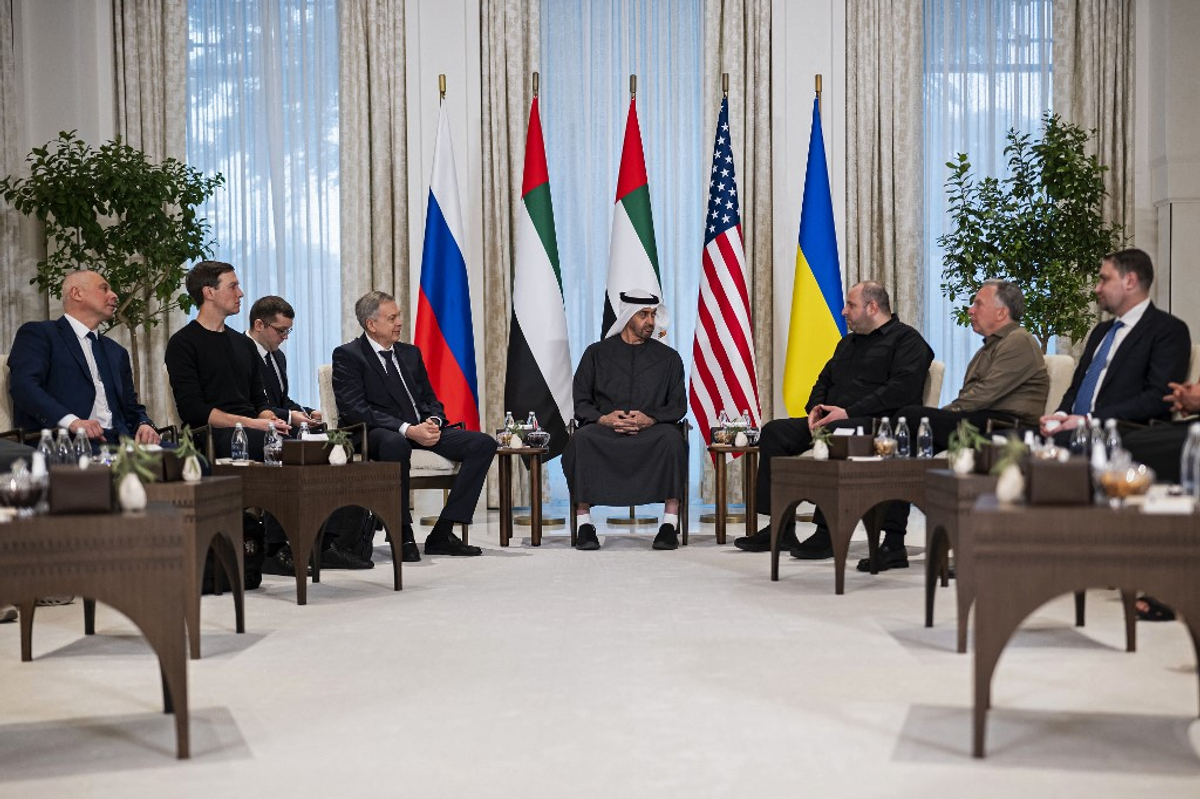
Two days of closed-door talks between Russia, Ukraine and the US concluded in Abu Dhabi, with President Volodymyr Zelensky calling the negotiations “constructive” – even as Kyiv accused Moscow of undermining diplomacy with fresh deadly strikes on Ukrainian cities.
Friday and Saturday saw the first direct Ukraine-Russia talks under the US-led peace plan, with each side testing the waters and laying out what it considers acceptable terms to end one of Europe’s bloodiest wars since WWII.
JOIN US ON TELEGRAM
Follow our coverage of the war on the @Kyivpost_official.
Zelensky said the discussions focused on “possible parameters for ending the war,” with all sides agreeing on the need for US oversight to ensure real security.
“I highly value the understanding that American monitoring and control are necessary in the process of ending the war and ensuring real security,” he wrote on Telegram.
He added that the sides agreed to brief their capitals on all aspects of the talks and coordinate next steps with national leaders.
The third round of trilateral talks between Ukraine, Russia and the US is set to continue in Abu Dhabi next week, a source familiar with the discussions told AFP on Saturday.
The source, speaking on condition of anonymity, confirmed the follow-up after an Emirati official described the second round of talks as held in a “constructive and positive atmosphere.”
An unnamed Ukrainian official echoed this information in a conversation with Axios reporter Barak Ravid. The source said the Abu Dhabi talks were “positive” and “constructive,” and added that another round of negotiations is expected in the UAE next week.
Other Topics of Interest
Russian Army Trainer Jailed 8 Years After Molesting Male Cadet
Case materials said Vladimir Shchekotov, a 57-year-old military school instructor, invited the 16-year-old cadet to a sauna at his countryside house and sexually assaulted him.
Russia’s state-run TASS news agency, citing a source, said the talks produced results but offered no details.
Kyiv’s delegation was led by Ruston Umerov – a veteran negotiator in talks with Moscow – alongside Presidential Office head and former intelligence chief Kyrylo Budanov, negotiator David Arakhamia, and Chief of the General Staff Andriy Hnatov, among others.
The Russian delegation was led by Igor Kostyukov, head of the GRU, Russia’s military intelligence agency. Investigative outlet Agentstvo reported that Alexander Zorin, the GRU’s first deputy head for information, was also part of the Russian negotiating team.
Kyiv shaken by missile barrage amid talks
As negotiators met for a second day Saturday, Ukraine accused Russia of sabotaging the peace effort by launching one of its heaviest attacks in months.
“Peace efforts? Trilateral meeting in the UAE? Diplomacy? For Ukrainians, this was another night of Russian terror,” Ukrainian Foreign Minister Andriy Sybiya said.
Sybiha commented that Russian President Vladimir Putin “ordered a brutal massive missile strike against Ukraine right while delegations are meeting in Abu Dhabi to advance the America-led peace process. His missiles hit not only our people, but also the negotiation table.”
The overnight barrage struck Kyiv’s energy infrastructure, killing one person and injuring at least 22 people in Kyiv and Kharkiv, Ukrainian officials said. Energy company DTEK said the strikes temporarily cut electricity to about 88,000 households in the capital.
The attacks hit amid Kyiv’s worst winter energy crisis since Russia’s full-scale invasion began nearly four years ago, with power outages, water and heating shortages, and repeated strikes on the energy grid leaving large parts of the city in darkness.
Donbas: the key issue?
Before the Abu Dhabi talks, Moscow reiterated that gaining Ukraine’s Donbas – referring to the Donetsk and Luhansk regions – is a prerequisite for engaging in peace talks.
Following the first round of talks on Friday, Russian state media said the delegations discussed “buffer zones, various control mechanisms.”
“Yes, naturally, these aspects: buffer zones, various control mechanisms, are discussed at the meeting along with other important topics,” the unnamed source said.
The idea of a “buffer zone” in eastern Ukraine has been under active discussion since December – under different names.
At the time, President Zelensky said the US had proposed creating a “free economic zone” in Donetsk and Luhansk, under which Ukrainian troops would withdraw, while Russia described the same concept as a “demilitarized” zone, according to Zelensky.
Friday’s Abu Dhabi trilateral talks may be the most promising attempt yet
The talks follow multiple rounds of peace efforts over nearly four years of full-scale war (and after the pre-2022 Minsk agreements). While some initiatives delivered limited results, such as prisoner exchanges and the return of abducted children, none achieved a ceasefire as the war has ground on. Here’s a brief recap:
February-March 2022 | Belarus talks
The first direct negotiations after Russia’s full-scale invasion, held near the Ukrainian-Belarusian border. The talks led to the establishment of humanitarian corridors but otherwise produced no breakthrough.
Denys Kireyev, one of Kyiv’s negotiators, was later found shot dead after security services accused him of treason; he was subsequently identified as a double agent who had warned Ukrainian authorities of the imminent 2022 invasion.
March 2022 | Istanbul talks
Ukraine presented draft neutrality proposals and security guarantees. The talks collapsed after revelations of atrocities – particularly in the suburbs outside Kyiv – where civilian bodies were found on the streets following the withdrawal of Russian troops.
April-July 2022 | Black Sea grain deal
With the backing of the UN and Turkey, Russia and Ukraine in July 2022 agreed to ensure the safe passage of ships carrying grain, easing concerns over soaring global food prices after Russia’s invasion halted Ukrainian exports to developing nations. Russia withdrew from the deal in July 2023.
Early 2025 | Energy and Black Sea ceasefire
At the initiative of US President Donald Trump after his return to office, Ukraine and Russia agreed in principle to refrain from strikes on certain energy infrastructure for a limited period. Another proposal was also put forward to halt strikes on targets in the Black Sea.
The arrangements never came to fruition, however, as both sides accused each other of violations based on terms they said were agreed with the US bilaterally, rather than directly between Kyiv and Moscow. The lack of a monitoring mechanism also contributed to the failure.
Mid-2025 | Istanbul format resumes
Putin proposed reviving the 2022 Istanbul format after Europe threatened Moscow with a sanctions ultimatum if it did not comply with a ceasefire.
Multiple rounds of talks between Kyiv and Moscow followed – at times mediated by the US and Turkey – but yielded no ceasefire. Expectations dimmed further after Putin sent a controversial historian rather than a diplomat to represent Russia, who reportedly threatened the Ukrainian side, with prisoner-of-war exchanges emerging as the only tangible outcome.
Late-2025 | 28/20-point peace plan
In November 2025, Washington delivered a 28-point plan to Kyiv, pressing Ukraine to accept it by Thanksgiving or risk losing US support.
The plan was later revealed to have originated from Moscow, essentially repackaging Kremlin war objectives as “peace terms.” Leaked recordings also reportedly captured US Special
Steve Witkoff coaching Russian officials on how to present the document to Trump.
After multiple rounds of discussions between Kyiv and Washington, the draft was trimmed to 20 points and supplemented with additional documents on security guarantees and Ukraine’s post-war recovery. This package now forms the basis of the ongoing negotiations.