
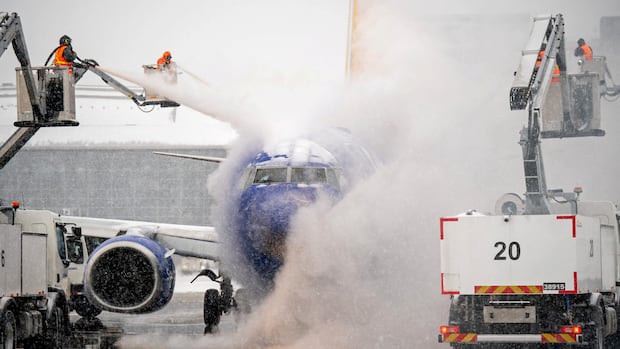
A massive winter storm continued in the United States on Sunday morning, dumping sleet, freezing rain and snow across southern states and up through New England, bringing frigid temperatures, widespread power outages and treacherous road conditions.
The ice and snowfall were expected to continue through Monday in much of the country, followed by very low temperatures, causing “dangerous travel and infrastructure impacts” to linger for several days, the U.S. National Weather Service said.
Heavy snow was forecast from the Ohio Valley to the northeast, while “catastrophic ice accumulation” threatened from the Lower Mississippi Valley to the mid-Atlantic and the southeast.
“It is a unique storm in the sense that it is so widespread,” weather service meteorologist Allison Santorelli said in a phone interview. “It was affecting areas all the way from New Mexico, Texas, all the way into New England, so we’re talking like a 2,000-mile [3,200-kilometre] spread.”
As of Sunday morning, about 213 million people were under some sort of winter weather warning, she said. The number of customers without power approached 840,000, according to poweroutage.us, and the number was rising.
‘Crippling to locally catastrophic impacts’ forecast
Seventeen states and the District of Columbia have declared weather emergencies, the Department of Homeland Security (DHS) said.
At a news conference on Saturday, DHS Secretary Kristi Noem warned Americans to take precautions.
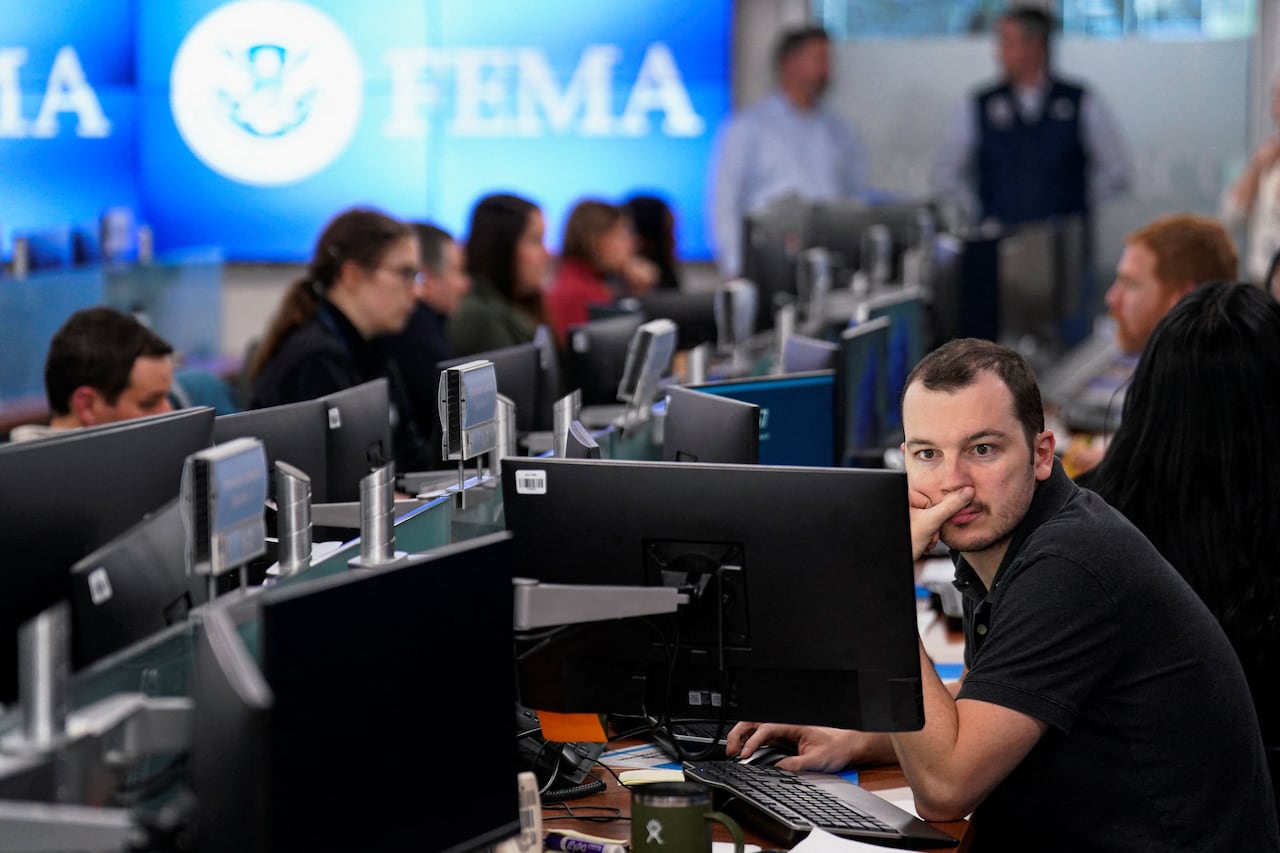 Federal Emergency Management Agency (FEMA) employees work ahead of a news conference at the FEMA National Response Co-ordination Center in Washington, D.C., on Saturday. (Nathan Howard/Reuters)
“It’s going to be very, very cold,” Noem said. “So we’d encourage everybody to stock up on fuel, stock up on food, and we will get through this together.”
She added, “We have utility crews that are working to restore that as quick as possible.”
The number of outages continued to rise. As of 7:23 a.m. ET on Sunday, more than 500,000 U.S. customers were without electricity, according to PowerOutage.us, with more than 100,000 each in Mississippi, Texas and Tennessee. Other states affected included Louisiana and New Mexico.
Energy Department orders backup resources
The Department of Energy on Saturday issued an emergency order authorizing the Electric Reliability Council of Texas to deploy backup generation resources at data centres and other major facilities, aiming to limit blackouts in the state.
On Sunday, the department issued an emergency order to authorize grid operator PJM Interconnection to run “specified resources” in the mid-Atlantic region, regardless of limits due to state laws or environmental permits.
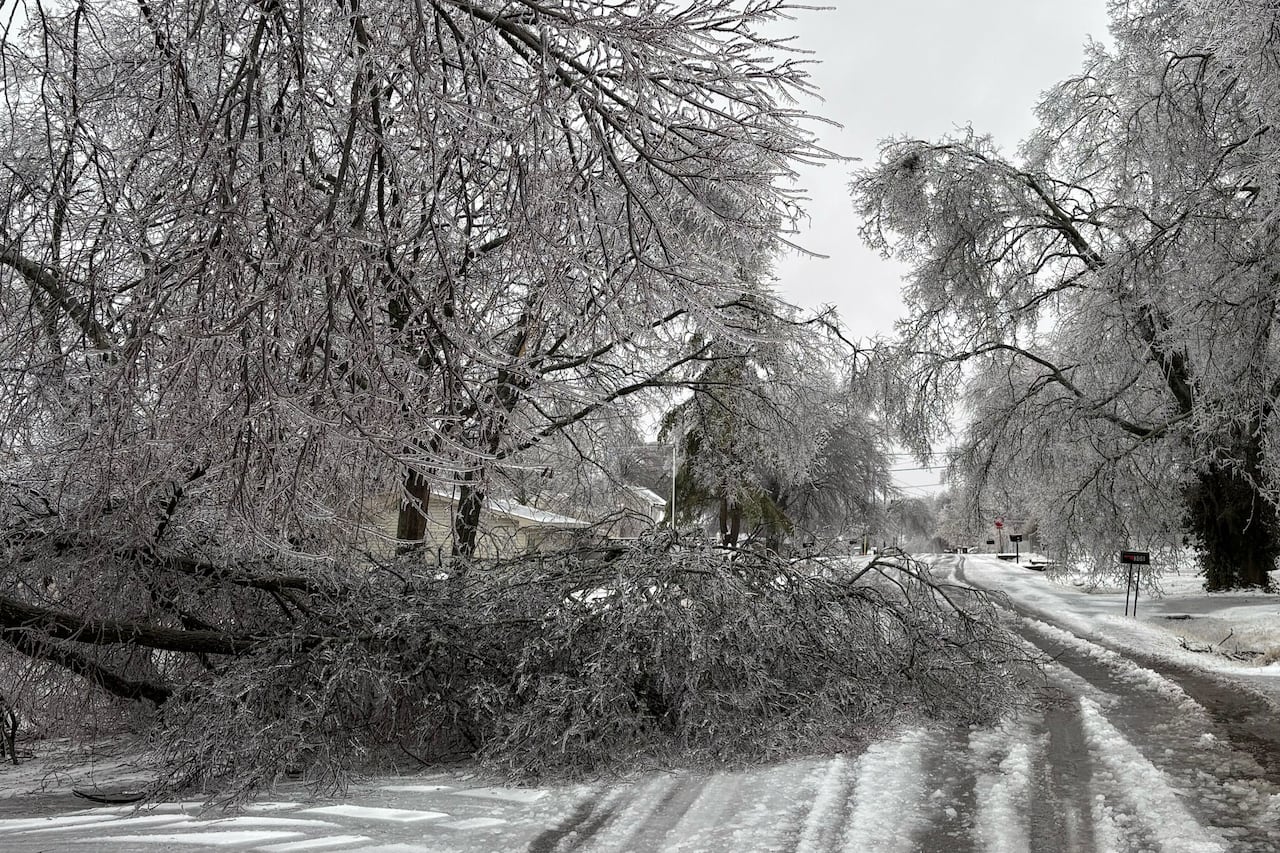 Splintered and downed trees lie across a neighbourhood street as a winter storm moves through Nashville on Sunday. (Holly Meyer/The Associated Press)
The U.S. National Weather Service warned of an unusually expansive and long-duration winter storm that would bring widespread heavy ice accumulation in the southeast, where “crippling to locally catastrophic impacts” can be expected.
Weather service forecasters predicted record cold temperatures and dangerously cold wind chills descending further into the Great Plains region by Monday.
Airlines, grid operators scramble to prepare
More than 10,000 flights had already been cancelled on Sunday and another 8,000 have been delayed, with over 4,000 flights cancelled on Saturday, according to the flight tracker flightaware.com. The biggest hubs hit so far were in Philadelphia, Washington, D.C., Raleigh-Durham in North Carolina, New York and New Jersey.
At Philadelphia International Airport, inside displays registered scores of cancelled flights and few vehicles could be seen arriving on Sunday morning.
Even once the ice and snow stop falling, the danger will continue, meteorologist Santorelli warned.
“Behind the storm, it’s just going to get bitterly cold across basically the entirety of the eastern two-thirds of the nation, east of the Rockies,” she said. That means the ice and snow won’t melt as fast, which could hinder some efforts to restore power and other infrastructure.
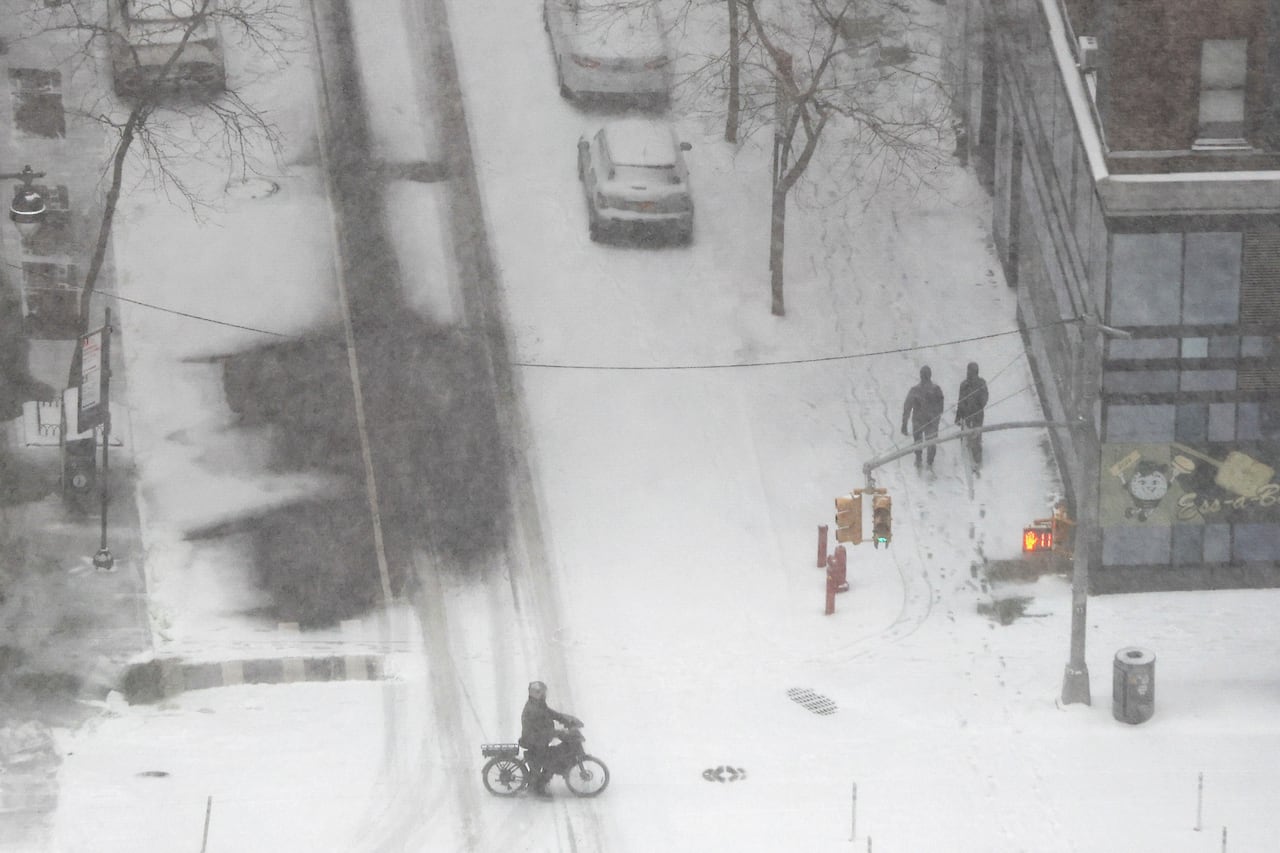 People walk, and another person rides a bike, as heavy snow falls in New York on Sunday. (Heather Khalifa/The Associated Press)
Nashville and the surrounding area were seeing ice accumulations of 1.3 centimetres (half an inch) or more, with icicles hanging from power lines and overburdened tree limbs crashing to the ground.
“We typically say that once you start seeing, you know, roughly a half an inch of ice, that’s when you’re going to start seeing the more widespread power outages,” Santorelli said.
In Oxford, Miss., police on Sunday morning used social media to tell residents to stay home as the danger of being outside was too great. Local utility crews were also pulled from their jobs during the overnight hours.
“Due to life-threatening conditions, Oxford Utilities has made the difficult decision to pull our crews off the road for the night,” the utility company posted on Facebook early Sunday.
“The situation is currently too dangerous to continue,” it said. “Trees are actively snapping and falling around our linemen while they are in the bucket trucks. We simply cannot clear the lines faster than the limbs are falling.”
Icy roads also made travel dangerous in north Georgia.
“You know it’s bad when Waffle House is closed!!!” the Cherokee County Sheriff’s office posted on Facebook with a photo of a shuttered restaurant. Whether the chain’s restaurants are open — known as the Waffle House Index — has become an informal way to gauge the severity of weather disasters across the U.S. South.