
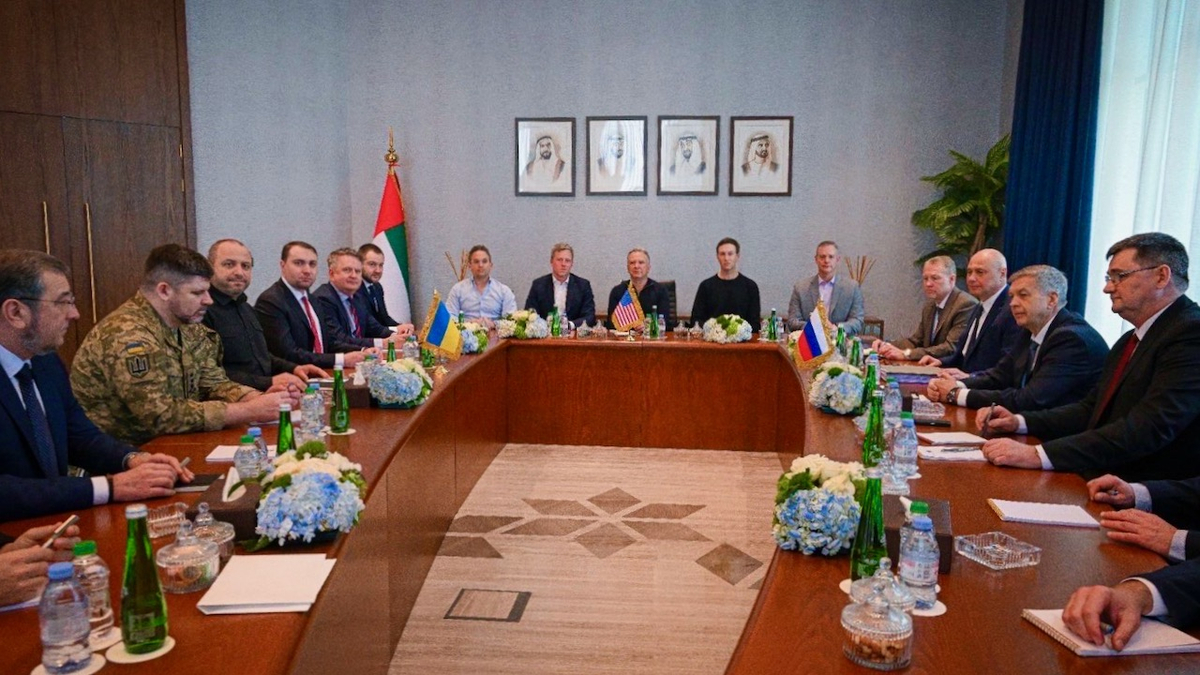
WASHINGTON DC – In a sequestered coastal retreat far from a Kyiv still smoldering under Russian fire, American envoys spent 48 hours of grueling shuttle diplomacy coaxing Ukrainian and Russian delegations back into the same room.
They emerged with a fragile, yet undeniable, conviction: The war’s diplomatic permafrost is finally beginning to crack.
JOIN US ON TELEGRAM
Follow our coverage of the war on the @Kyivpost_official.
US officials, briefing reporters on a background call Saturday, characterized this inaugural trilateral summit between Washington, Kyiv, and Moscow as “constructive” and “unexpectedly fluid.”
While no formal peace treaty was signed, the sessions yielded tangible progress on security frameworks and economic incentives, securing a commitment for a follow-up round of negotiations next Sunday.
For a conflict that has defined the global order for nearly four years, the mere sight of the belligerents at the same mahogany table represented a tectonic shift.
“Getting them to agree to the room was the breakthrough,” said one senior US official, granted anonymity to discuss the sensitive, closed-door deliberations. “Once they were seated, the posturing faded. They actually started solving problems.”
European diplomats, however, are watching the American-led initiative with a mixture of hope and mounting dread.
While they described the sessions to Kyiv Post as the “most serious engagement since the invasion,” they warned that the entire architecture of a future peace hinges on one volatile variable: the depth of Washington’s willingness to underwrite Ukraine’s survival.
Other Topics of Interest
Putin’s 30-Year War and the New World Order
Europe’s second “30-Year War” is nearing an end, and the outcome remains unclear. It is a catastrophe that could have been prevented if only agreements had been upheld.
‘Gold standard’ guarantee
Behind the heavy curtains of the Abu Dhabi suite, the most contentious debates didn’t center on the past, but on the “Day After.” Specifically, how to ensure that any silence of the guns isn’t merely a tactical pause for a future Russian onslaught.
The friction point remains the nature of the “backstop.” In Davos, European capitals floated the idea of a multinational monitoring force, with France and Germany signaling a willingness to put a limited number of boots on the ground to police a ceasefire.
US President Donald Trump, meanwhile, has remained steadfast in his public refusal to deploy American combat troops, opting instead for a menu of “over-the-horizon” support: high-end intelligence sharing, persistent surveillance, and a robust logistical pipeline.
Privately, US negotiators have been blunt: European promises, while welcome, are insufficient to satisfy a skeptical Kyiv.
One American official dismissed the talk of a European “Coalition of the Willing” as largely performative.
“They’ve got a handful of helicopters and some soft-power pledges,” the official said. “But if you’re sitting in Kyiv, there is only one gold standard. It’s the American security guarantee that keeps the lights on.”
European diplomats, briefed on the Abu Dhabi progress, begrudgingly concurred. “A ceasefire without a credible US kinetic backstop is a house of cards,” one senior EU diplomat noted.
“Everyone in the room understands that Washington holds the keys; Paris and Berlin are just here to decorate the door,” the diplomat added.
Land swaps, nuclear sovereignty
Despite the “maximalist” rhetoric radiating from the Kremlin and Bankova, negotiators waded into the visceral realities of the map: territory, de-escalation zones, and the fate of the Zaporizhzhia nuclear power plant.
For the first time, officials indicated that both sides moved past the “not one inch” talking points to probe the viability of land swaps and demilitarized lines of separation.
“The public theater is designed for domestic consumption,” one US official explained. “What mattered was the private reality. They were testing the elasticity of each other’s red lines.”
The Zaporizhzhia facility – currently a dormant, Russian-occupied powder keg – has moved from a military objective to a potential “confidence-builder.”
There is now a tentative, high-level understanding that future energy output from the plant could be shared between the two nations.
While the thorny questions of administrative control and oversight from the International Atomic Energy Agency (IAEA) remain unresolved, the dialogue itself is being treated as a proof-of-concept for broader cooperation.
“If they can find a common language on nuclear safety,” one diplomat remarked, “the logic is that they can find it on almost anything.”
‘Prosperity’ pivot
The US strategy appears to rely heavily on a “carrot-and-stick” economic model – what one official dubbed “selling the peace.”
Central to the talks is a US-backed “Prosperity Plan” for Ukraine, paired with the dangling of potential “business openings” for a post-war Russia.
It is a deliberate attempt to pivot the psychology of the delegations from the language of attrition to the logic of incentives.
The shift in atmosphere was reportedly jarring. After years of radio silence, Russian and Ukrainian officials engaged in “fluid” dialogue, even sharing meals and conducting breakout sessions between military and economic attachés.
“At moments,” one official observed with a hint of irony, “they almost looked like old colleagues discussing a difficult merger.”
A fragile horizon
Despite the momentum, the shadow of 2014 and 2022 looms large. European officials remain anxious that a deal brokered on American terms might leave the continent vulnerable if Washington’s commitment wavers after the ink is dry.
“The political cost for Zelensky and Putin remains astronomical,” warned one Western diplomat. “Neither wants to be the leader who conceded sovereignty or trusted the untrustworthy.”
The ultimate deal-breaker may remain the “no boots” policy. Without a physical US presence, some fear a “paper peace” will only invite a third invasion.
The delegations are set to reconvene next Sunday in Abu Dhabi, following a week of “intensive drafting” in their respective capitals.
While a high-stakes summit between Trump, Putin, and Zelensky is now whispered to be “within reach,” the reality on the ground remains bloody and unchanged.
“Trust is a non-factor right now,” a US official concluded. “But for the first time in years, we have a framework where trust could actually survive.”
The war hasn’t ended, and the killing continues.
But as the delegations head back to their bunkers to brief their bosses, the conversation has fundamentally shifted from how to win the war to how to survive the peace.
In the cold business of diplomacy, that is often where the end begins.