
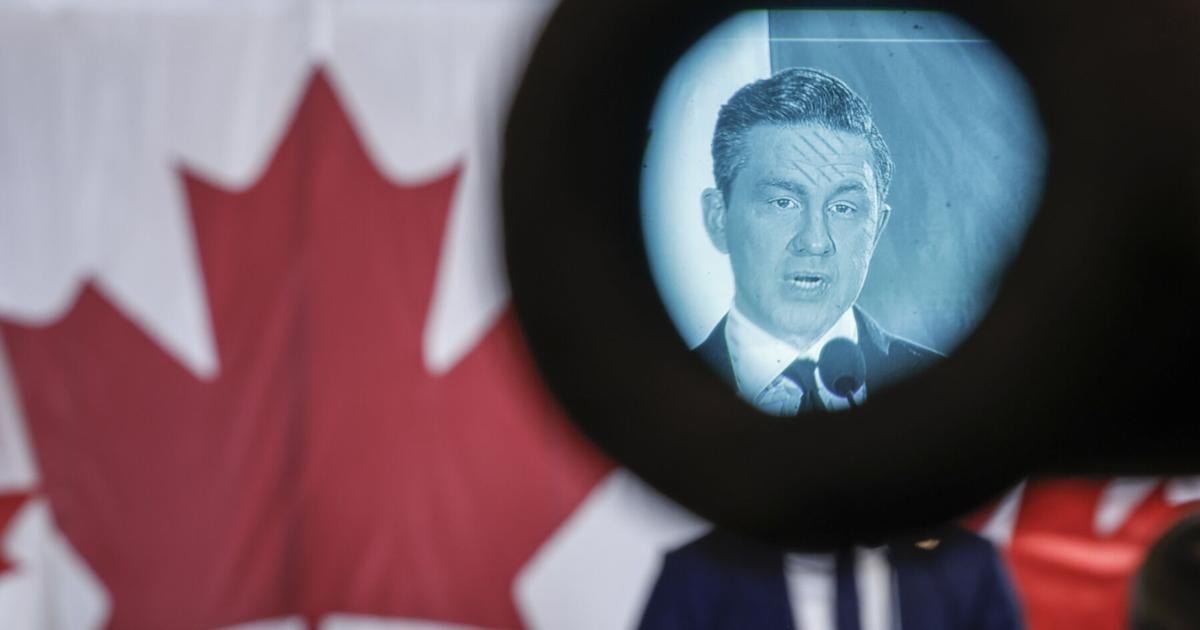
OTTAWA — You don’t need to look much further than Pierre Poilievre’s social media to see the sort of dilemma the Conservative leader is facing.
Earlier this month, he praised U.S. President Donald Trump for his extraordinary capture of Venezuela’s authoritarian leader, Nicolás Maduro. Two weeks later, he condemned the same president’s threats to acquire sovereign Greenland and backed Canada’s obligations as a member of the NATO alliance.
It’s not that it’s out of bounds for a political leader to see value in one move and denounce another. It’s that each response rankled different factions within the Conservative tent.
The first displeased some moderates, who felt Poilievre was applauding the American president to curry favour with the pro-Trump corner of his party’s base.
The second drew ire from a top conservative influencer — a YouTuber who drove tens of thousands of views to Poilievre’s campaign rallies — for his belief the post pandered to the anti-American Liberal set.
Those conflicting sentiments will collide next week, when members of the party’s grassroots kick off their national convention and decide whether Poilievre should remain their leader.
In Calgary, Poilievre will face the coalition he grew during last year’s campaign — a subset of the Canadian electorate that has become increasingly divided from the rest of the country, and even sometimes amongst themselves.
“It is a difficult job being the leader of the Conservative Party of Canada. It is a divided coalition of Conservatives who are coming to their support for the party, and their identity as a Conservative, in different ways,” said David Coletto, CEO of Abacus Data.
Poilievre, who coasted to a commanding victory in the Conservatives’ 2022 leadership contest, is entering his second convention at the party’s helm nine months after its election defeat and his loss of his longtime Ottawa seat. The ensuing months have seen the leader contend with the defections of two MPs to the government benches; the spectre of other exits; discontent about his messaging, tone, and leadership style; and more recently, Prime Minister Mark Carney’s glowing reception on the world stage.
With a referendum on his leadership less than a week away, Poilievre is putting in the time.
“I think whether you like Pierre Poilievre or you don’t like Pierre Poilievre … you’d be hard pressed to find a harder-working politician,” said Rob Batherson, a former Conservative party president.
“He’s meeting with delegates. He’s listening to their concerns, and I think people within the party respect the work ethic that he’s putting in and not taking anything for granted.”
Indeed, party insiders who spoke to the Star, some on the condition they not be named, say Poilievre and his team have been visiting delegates across the country, calling others to hear their concerns, and consulting more broadly than they did during last year’s campaign.
Those efforts have seen the leader call candidates who lost in the last election, and solicit opinions from those who backed his opponents in the 2022 leadership race.
“Senior MPs are calling (undecided) delegates to get a sense of their votes and their issues,” said Mark Johnson, a convention delegate who was a Conservative candidate in Toronto in 2021.
What appears undeniable is that within the Conservatives’ base, Poilievre is widely supported.
New data collected in a collaboration between the Star and Abacus Data suggests 79 per cent of the party’s base — people who would only ever vote Conservative — think Poilievre is an excellent or good leader. Sixteen per cent believe he’s done a “fair” job in the role, and only four per cent consider him poor or very poor.
(The polling firm’s latest survey was conducted with 2,008 Canadians from Jan. 12 to 16. Because respondents were surveyed online, the poll cannot be considered truly random. A comparable random sample of the same size would have a margin of error of plus or minus 2.3 percentage points, 19 times out of 20.)
When asked open-ended questions about what they liked about Poilievre, many cited the leader’s focus on affordability issues, the belief that he is aligned with conservative values, and his direct style. Many in the base said there was nothing they disliked, with only a small slice perceiving the leader as “too extreme” or prone to “tone issues.”
Given a hypothetical scenario in which they were voting in Poilievre’s leadership review, 76 per cent of the base said they would keep him.
But the picture changes when it comes to so-called accessible voters — those who don’t currently vote Conservative but would be open to doing so. Forty-three per cent of that group said they would oust Poilievre, tended to be more put off by his tone, and viewed leaders like Carney and Premier Doug Ford more favourably.
Those who do not identify as Conservative supporters, unsurprisingly, had an overwhelmingly negative view of Poilievre.
“I think what this data clearly underscores is that, as much as Poilievre may have turned off people outside of the Conservative universe, he is still largely liked, admired and seen as the best person to lead the party forward,” Coletto said.
But former Conservative leader Andrew Scheer — who resigned from the top job after the party’s election loss in 2019, and didn’t face his own leadership review — underlined that Poilievre has previously succeeded in growing the party’s base.
“I expect you’ll see people at this convention that have never been to any convention, and it’s because of Pierre’s inspirational leadership,” Scheer told the Star.
Not everyone sees Poilievre that way.
One party insider told the Star Poilievre is slow to pivot and respond to issues, especially those concerning Trump.
“Mark Carney’s out there talking about a new world order, and you’re still on ‘Bring home the catch,’ ‘Axe the tax,’” the source said, referring to other recent social media posts.
On the leadership vote, which most believe Poilievre is still expected to pass, the insider said they’ll be looking to see how much of that vote he secures.
“I think we should be concerned (about) how he responds, especially to that 70-to-80-per-cent range, because if he takes that as a ringing endorsement, then that’s going to be a problem,” the source said.
Johnson, the Toronto delegate, said Poilievre may not be in power, but he still drives Canada’s political agenda.
“He gets credit for injecting a lot of passion and energy into the party and into the political system,” he said.
The longtime Conservative said he’s unsure how to vote, partly because the timing is wrong for the party to hold a leadership race, given Poilievre has no clear successors.
“I’ve also had concerns about the angry, accusatory style and the right-wing, bomb-throwing, total-war approach to politics,” Johnson said.
“Ultimately it’s self-defeating because it exhausts your supporters, it galvanizes your opponents and it repels the very swing voters that you need to win an election.”
Other delegates are ready to throw their weight behind the leader, like Raphael Chang, who believes Poilievre is the best leader for younger Canadians finding their way.
“I’ve been organizing for Pierre just to make sure that he not only has enough delegates in our riding, but even if other ridings need help recruiting people, I’m happy to just support that effort as well,” said Chang, a delegate from Aurora—Oak Ridges—Richmond Hill, in a recent interview.
The party’s former interim leader, Candice Bergen, told the Star she believes Poilievre has “strong support,” and that members realize “we’re in really unprecedented times in terms of the challenges with Donald Trump (and) the challenges in how Canadians are viewing Prime Minister Carney.”
Bergen said that given the convention’s Calgary location, near where Poilievre holds his new seat, the issues of Western separatism and provincial autonomy will present a challenge next week.
“Our party is a very, very broad coalition of people with a lot of different views. We like to talk about our different opinions. We like to debate. We like to disagree, and then our challenge has always been disagreeing but then coming out united,” Bergen said.
Asked how he would compare the Poilievre Canadians saw during the last federal election campaign to the Poilievre of today, Scheer said he has always held core beliefs and is a “consistent” and “authentic” champion of Canadians.
Twenty minutes later, Scheer called back. There was something he wanted to add.
“Part of going forward is how to turn the support of the next tranche of Canadians that we’ll need to form government, and make some of those investments,” he said, “and I’m confident Pierre is doing that.”