
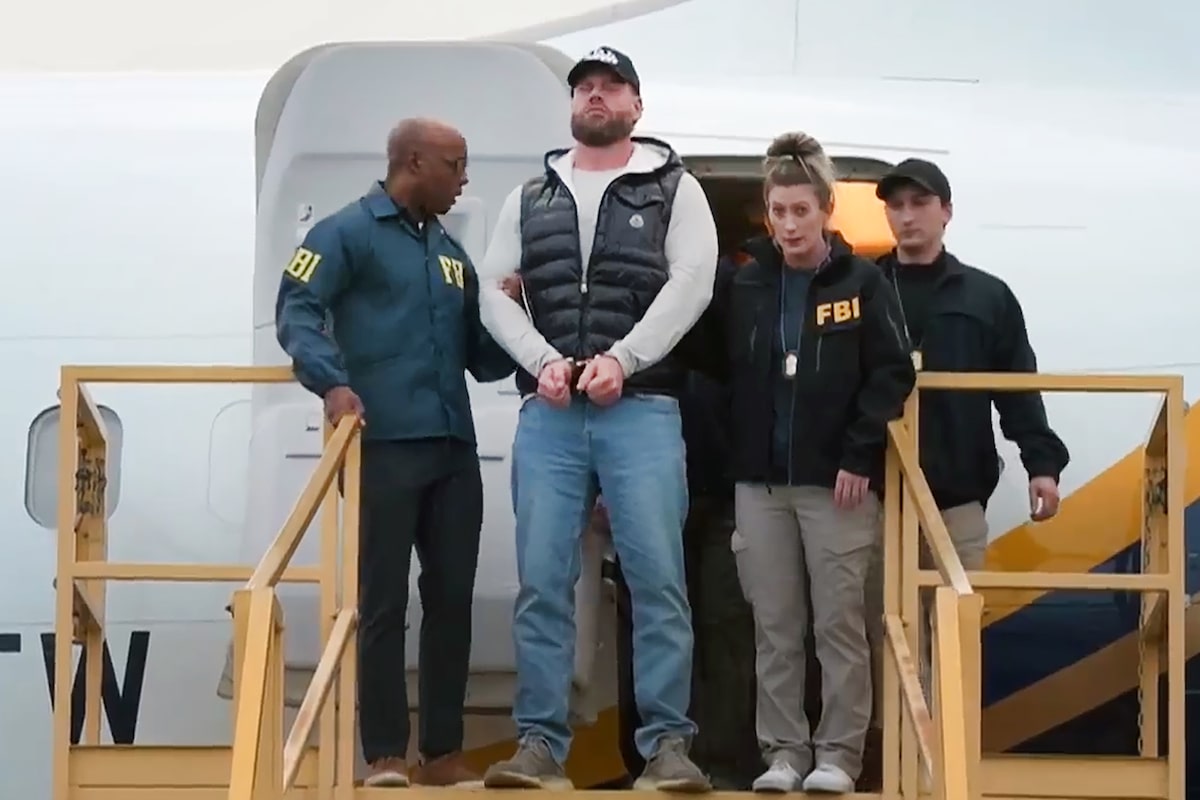
This still photo taken from video and provided by the FBI shows Ryan Wedding, a former Canadian Olympic snowboarder facing charges related to drug trafficking and the killing of a federal witness, as he is taken off a plane at Ontario International Airport in Ontario, Calif. on Friday.The Associated Press
Before Ryan Wedding was arrested last week as one of the FBI’s Top 10 most wanted fugitives, and before he was charged a decade earlier for masterminding a plot to sail thousands of kilos of cocaine up from the Caribbean to Canada’s East Coast, Canadian police viewed the former Olympic snowboarder as one of the many middling profiteers in Metro Vancouver’s massive underground cannabis trade.
It was 2006, and Mounties, acting on an anonymous tip given to the Vancouver police, raided a farm in the eastern suburb of Maple Ridge. There they found thousands of pot plants and dozens of kilograms of dried flower, worth roughly $10-million at the time.
The evidence the RCMP provided a judge to obtain a search warrant linked the operations at the two-hectare farm to Mr. Wedding and his friend, another former competitive snowboard racer, according to reporting from that era in The Maple Ridge News. (A civil suit from one of Mr. Wedding’s former business partners alleged he used his former brother-in-law as a straw man to act as the legal owner of his property.)
Twenty years ago, that quantity of cannabis signalled to investigators that the growers were likely trafficking “B.C. Bud” south to the United States, where it was often exchanged for cocaine that would return north.
But Mr. Wedding, then a 25-year-old who was four years removed from competing in Salt Lake City, Utah, was never charged. That was a common theme, according to local officers from that era who remember him as being on their radar but not a large enough player to devote resources to investigate further.
Swift transfer of Ryan Wedding from Mexico to U.S. raises questions
The onetime athlete, who was arrested in Mexico City on Jan. 22 after a decade on the run, is alleged to have been the head of a sprawling drug trafficking enterprise. The FBI said last week 36 people have so far been arrested for being part of Mr. Wedding’s alleged criminal network. Eight Canadians linked to Mr. Wedding were arrested in November and now face extradition to the U.S.
Mr. Wedding is expected to appear in court on Monday in Los Angeles to face multiple charges of drug trafficking and murder.
Court documents and news reports illustrate his alleged rise in the narcotrafficking world.
Two years after his grow-op was raided, he was arrested in Los Angeles trying to buy 24 kilograms of cocaine and sentenced to a brief stay in federal prison, which one of the FBI agents who arrested him described to Rolling Stone magazine as giving Mr. Wedding an “Oxford” education in the ins and outs of international drug smuggling.
After he was released and deported in 2011, he relocated to Montreal and, in 2015, was charged after the RCMP alleged he worked with the infamous Sinaloa cartel to ship $750-million worth of cocaine from Colombia and Mexico into Canada. He was never arrested on those charges and began a decade on the lam, with American authorities long suspecting he was staying in Mexico as a guest of that same cartel.
Bail decision for man accused of laundering Ryan Wedding’s money to come next month
The early days of his descent from middle-class snowboarding wunderkind to the alleged leader of a violent, international cocaine smuggling ring are symptomatic of the limits of the Canada’s war on drugs, according to officers tasked with taking down major traffickers when Mr. Wedding was viewed only as a regional player in British Columbia.
Former RCMP organized crime sergeant Bill Whalen, who once led a team at B.C.’s integrated gang unit, said the unique Wedding name came up in the monthly major case briefings he and other investigators would have had during that 2006-08 era. In those meetings, colleagues would explain who they were investigating and the various people that had entered their orbit because of their intelligence and surveillance.
“He came into files that we were working on, but he wasn’t one of our primary targets,” Mr. Whalen said in a recent interview. “He was a low-level person at the time, he wasn’t really one of the leaders.”
At that point, he said, Mr. Wedding didn’t meet the threshold the RCMP had for opening a specific case, which at that time focused on much larger players. Mr. Whalen said he had trouble getting buy-in to deploy resources to tackle the notorious Bacon Brothers and their Red Scorpion gang because they were only importing and selling roughly 40 kg of cocaine every three months or so.
Former Olympic snowboarder Ryan Wedding has been arrested in Mexico on multiple charges of drug trafficking and murder, authorities announced on Friday (Jan 23). Wedding was among the FBI’s most-wanted fugitives,
The Associated Press
Mounties had trained their sights on even larger targets, he said, such as the United Nations gang, which was flying hundreds of kilos into one of Vancouver’s eastern suburbs from Los Angeles every few months with its own plane.
Between 2007 and 2011, those rival gangs in the Lower Mainland jostled for control of the drug trade, leading to retaliatory shootings and the deaths of some innocent bystanders.
At one point, police had issued a $300,000 reward for the arrest of Jamie Bacon, who was accused of conspiracy to commit murder in connection with the deaths of six people in a Surrey, B.C., high-rise, including two innocent bystanders.
His brother Jonathan was murdered in a hail of bullets fired into his vehicle in Kelowna, B.C., in 2011.
Mr. Whalen and former regional RCMP leader Brad Desmarais said Crown prosecutors typically only had the resources to approve charges against the top five or so targets within any major drug-trafficking ring.
Surveillance is crucial to solve these cases, but there are very limited resources to do the 24/7 tracking of five or so suspects over the course of a couple months, they both said.
Mr. Desmarais said intelligence on larger, international trafficking rings operating in Canada and elsewhere often came from the U.S. Drug Enforcement Agency, which he said had informants all over Canada and the United States.
“They’re everywhere,” he said.
American agencies also don’t face the burden of disclosing every bit of pertinent evidence they uncover, as is the rule in Canada, where the defence begins receiving such information shortly after the first member of a ring is charged, Mr. Desmarais said.
In last year’s Globe and Mail investigation into why Canadian authorities rarely charge people after they discover fentanyl and methamphetamine labs, experts pointed to this requirement as severely hindering major drug cases.
Pat Fogarty, a former Vancouver police officer who led the organized crime section of B.C.’s gang squad for five years before retiring in 2013, said his Australian counterparts working the same case might have to submit 20 pages of evidence to get a warrant, and the Americans would file a dozen pages explaining their position. Meanwhile, he said, Canadian investigators would be required to submit 200 pages or more of their evidence.
“In Australia, if you gave a judge a 200-page affidavit, he says, ‘Cut this down,’” Mr. Fogarty said.
Still, he said, when he was with the RCMP, the Mounties did not do a good job of keeping investigators on complicated files over the long periods of time it took to organize all the reams of evidence needed to prosecute sophisticated organized-crime networks.
”The critical part of it is managing the paper.”
RCMP Commissioner Mike Duheme attended the news conference with FBI Director Kash Patel and other agents to announce the capture of Mr. Wedding on Friday, and noted it was a product of years of work and co-operation.
“The capture of Ryan Wedding after a years-long investigation and this most recent achievement demonstrates the importance of international collaboration and the success that can be achieved when law enforcement shares intelligence,” Commissioner Duheme said in a statement.
“Our work in disrupting organized crime continues. Organized crime transcends borders and continually adapts. International partnerships remain critical. Working alongside the FBI enables the RCMP to more effectively confront and disrupt criminal operations.”