
The confrontation between the Trump administration and Minnesota’s state government is shifting to a federal courtroom Monday in a case that could have significant legal and constitutional implications.
Minnesota’s Attorney-General, Keith Ellison, is suing the Trump administration, arguing that its surge of immigration enforcement in the state has led to rights violations, including racial profiling. It will also argue that what it views as federal-government overreach violates constitutional limits on federal power.
David Schultz, a university professor of political science and legal studies at Hamline University in Minnesota, said the case may eventually make its way to the Supreme Court.
Both sides dig in as Trump’s ICE crackdown on Minnesota shows no signs of letting up
“If the state of Minnesota were to win on this one, the implications would be enormous in terms of curtailing ICE activities and the curtailment of national power,” Prof. Schultz said.
“If the federal government were to win, I would say it puts states in a very precarious position, because they will be saying, ‘How do we protect ourselves?’ Many would say it would render states somewhat powerless in these kinds of disputes.”
It’s one of a number of political conflicts between the two levels of government playing out in Minnesota, a state that has become the focal point in the Trump administration’s effort to crack down on undocumented migrants.
On Saturday, a Border Patrol agent in Minneapolis shot and killed 37-year-old U.S. citizen Alex Pretti, an intensive-care nurse, in an altercation on the streets in Minneapolis. It’s the second killing of a U.S. civilian by federal Department of Homeland Security agents this month, after the death of Renee Nicole Macklin Good on Jan. 7.
In both cases, federal officials have asserted authority over the investigation of the killings, leaving local officials frustrated and unable to access evidence. The DHS is blocking Minnesota’s Bureau of Criminal Apprehension from investigating both deaths.
Minneapolis Mayor Jacob Frey has called for ICE to leave the city and on Saturday he again asked President Donald Trump to withdraw the federal agents, who outnumber Minneapolis police by a ratio of about five to one.
The DHS has sent 3,000 immigration-enforcement officers to Minnesota, a deployment that has created chaos in Minneapolis as citizens have engaged in dozens of protests against the presence of masked, armed agents on their streets.
Minnesota Governor Tim Walz has also called for ICE to leave the state. On Sunday, Mr. Walz, in a public statement directed at Mr. Trump, asked, “What do we need to do to get these federal agents out of our state?”
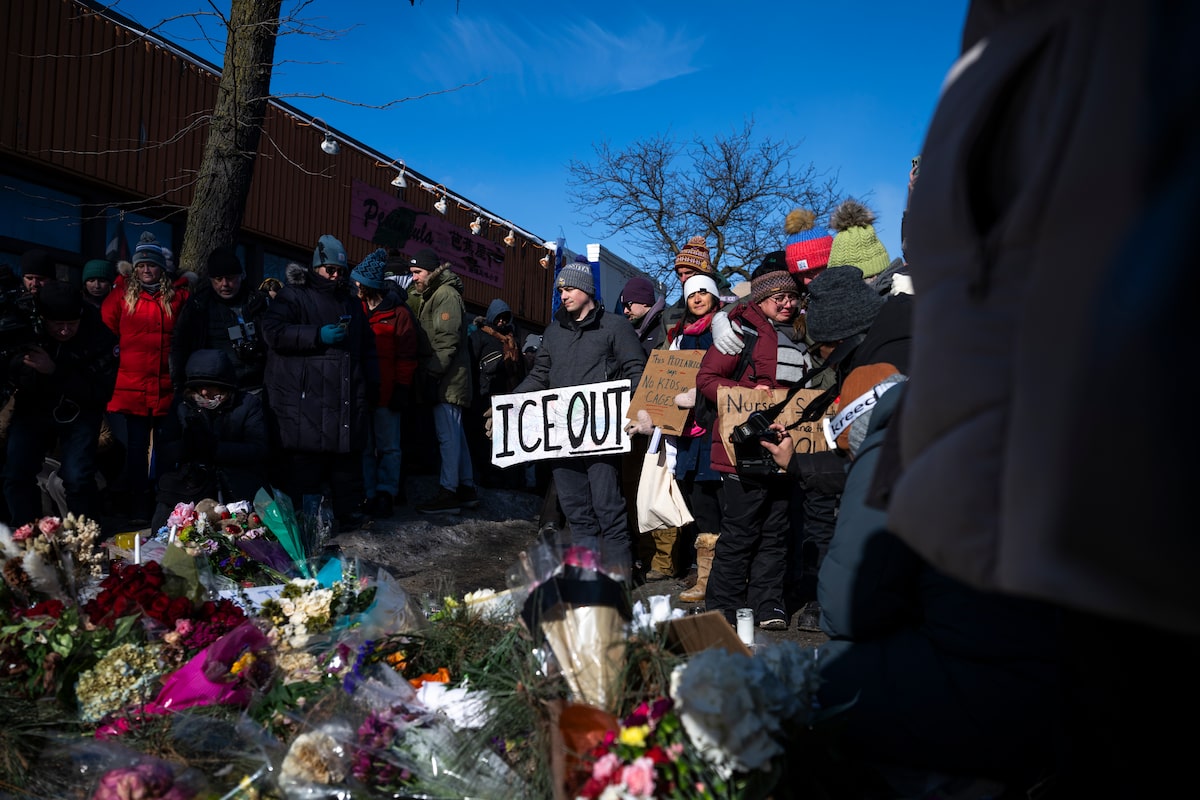
People gather during a vigil held by healthcare workers at a memorial for Alex Pretti on Sunday in Minneapolis, Minn.Stephen Maturen/Getty Images
The Trump administration has argued that the street-level conflicts involving citizens and DHS agents in Minnesota have been created by state and local officials who have been unable to maintain order. Federal agents have made more than 3,000 arrests in Minnesota since the start of Operation Metro Surge in December, according to the White House.
Over the course of the recent upheaval, federal and state officials have both talked of involving the military for their purposes. On Saturday, Mr. Walz activated the state National Guard. Mr. Trump has threatened to invoke the Insurrection Act, and troops have been placed on standby for deployment to Minnesota.
Prof. Schultz said the federal government has the authority to enforce immigration laws, even if the state doesn’t want them there. The principle of federal supremacy in the Constitution means that when there is a conflict between federal and state law, the federal government will prevail.
Left and right, Minnesotans look for a way out of chaos
However, the Tenth Amendment in the Bill of Rights says the federal government cannot coerce a state government into doing what it wants, Prof. Schultz said.
He said the Minnesota lawsuit will likely argue that the ICE deployment is effectively an attempt to compel Minnesota’s co-operation in a federal action, and that it makes it impossible for local officials to carry out basic law-enforcement functions, such as keeping the peace.
The state will be seeking a temporary restraining order to stop the current ICE mobilization, Prof. Schultz added.
What’s unusual, he said, is that typically the federal government is the branch that steps in to protect individual rights, as it did in the civil-rights era when Southern states tried, unsuccessfully, to assert a state-level right to resist desegregation.
“It’s a political and constitutional battle over how far the national government can go to compel states to take a particular ideological line when it comes to federal policy,” Prof. Schultz said.