

Listen to this article
Estimated 3 minutes
The audio version of this article is generated by AI-based technology. Mispronunciations can occur. We are working with our partners to continually review and improve the results.
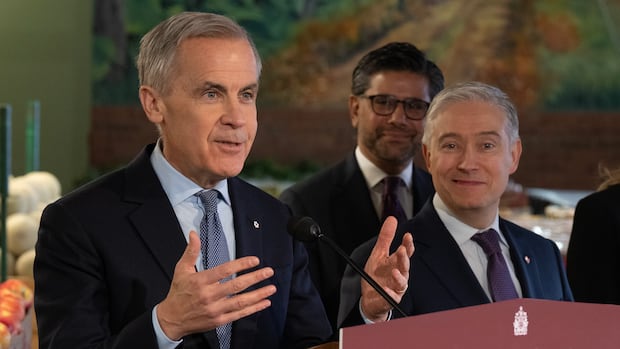
Prime Minister Mark Carney announced a suite of affordability measures on Monday that he says will help Canadian families struggling to cope with the rising cost of living.
The flagship measure in Monday’s announcement is the Canada Groceries and Essentials Benefit, which Carney said will boost what families and individuals receive through their GST rebate over the next five years.
“Canada’s new government is acting today to provide a boost to those Canadian families who most need one, while creating a bridge to longer-term food security and affordability,” Carney said in Nepean, Ont., on Monday.
The prime minister said that his government is using the GST rebate designed for Canadians with low and modest incomes, because groceries and other essentials make up a larger share of their family budgets.
In its first year, the benefit will give low- and modest-income Canadians eligible for the GST rebate a one-time boost that raises the $1,100 a family of four receives annually to $1,890 and increases the $540 an individual gets to $950.
Starting next year, and running for the next four years, the GST rebate is being increased by 25 per cent, which means a family of four will get up to $1,400 annually, while an individual will get about $700 a year.
“The rise in food prices means that a lot of those Canadians need more support right now,” Carney said.
Tackling food inflation
To help bring down the cost of groceries, which have been rising faster than inflation, Carney said he will direct $500 million from the government’s Strategic Response Fund to help food suppliers “expand capacity and increase productivity.”
It means food businesses looking to make capital investments to help strengthen their supply chains can apply to have some of those costs covered by the fund.
Carney announced a $150-million Food Security Fund that will help small- and medium-sized businesses to expand greenhouses and abattoirs, and strengthen food supply chains.
One immediate measure to help producers is a change that allows companies to fully write off greenhouses acquired on or after Nov. 4, 2025, that start being used before 2030.
“This measure supports increased domestic supply and investment in food production over the medium term,” a government statement said.
The prime minister also announced his government will direct $20 million in funding to the Local Food Infrastructure Fund to ease the pressure on food banks.
“This will help boost community food programs, helping them to deliver more nutritious food for families in need,” he said.
In addition to these measures, Carney said his government is developing a National Food Security Strategy to strengthen food production and improve access to affordable, healthy food.
“This strategy will include measures to implement unit price labelling so Canada can compare easily in this era of ‘shrinkflation,’ as well as support for the work of the Competition Bureau in monitoring and enforcing competition in our market,” he said.
The strategy will also include measures to help reduce food insecurity in Canada’s North.