
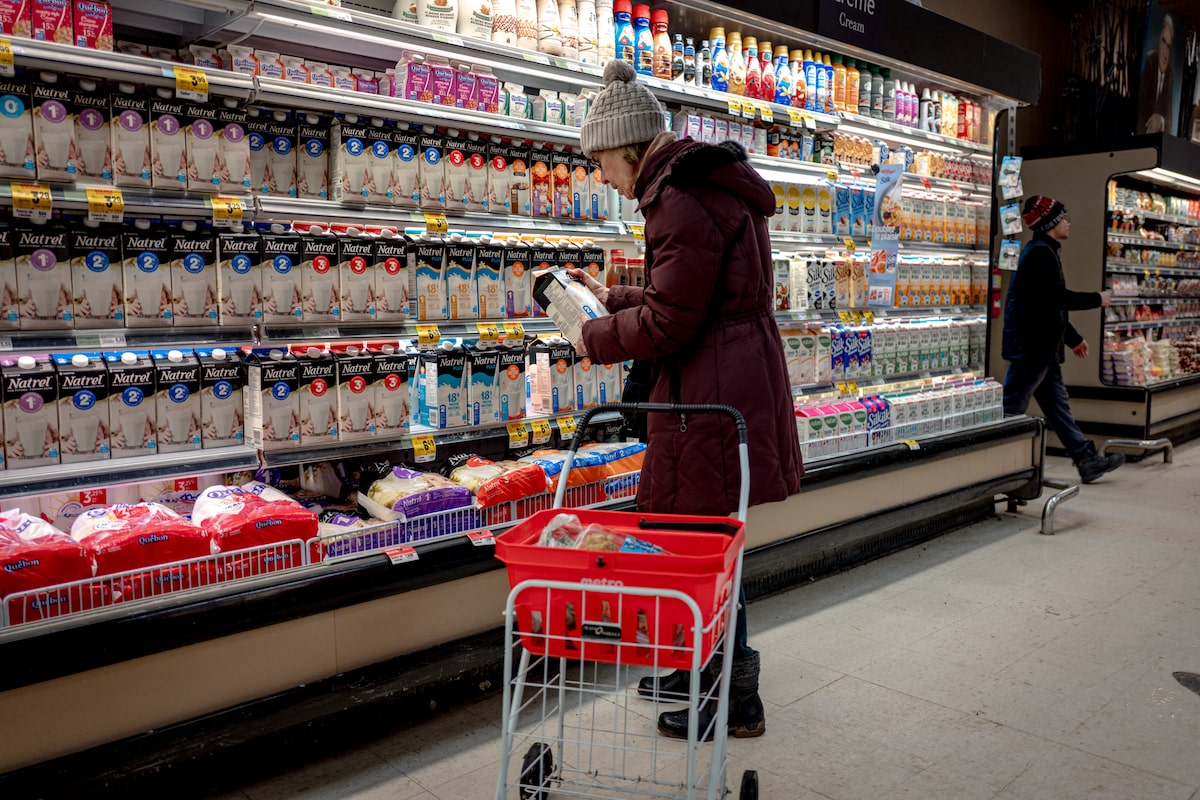
Canada’s Food Price Report for 2026 forecasts that grocery bills will go up by another 4 per cent to 6 per cent this year.ANDREJ IVANOV/AFP/Getty Images
To many economists, the affordability crisis is an illusion.
The financial pressure weighing so heavily on Canadian households over the cost of living doesn’t really show up in the numbers.
Since the start of the COVID-19 pandemic, incomes have grown faster than inflation. Average weekly wages have risen by 29 per cent since the end of 2019, according to Statistics Canada. The Consumer Price Index is up by 21 per cent over the same period.
It would appear as though the average household is in better shape, financially speaking.
This is tough to reconcile with how Canadians feel about their finances. Survey after survey shows how deeply cost pressures have taken root. Nearly half of Canadians feel like they’re barely hanging on, according to a recent Abacus survey.
But it’s not all in your head. Households are being squeezed, especially when it comes to food prices.
Inflation overall may have been wrestled back under control in the broader economy, but not in the grocery store. Food prices continue to rise at about double the rate of inflation, and that’s coming off the worst blow to food affordability in postwar history.
If you want to know what has spoiled the national mood, the grocery store is a prime culprit.
There are other pressure points, of course. Rent has risen by 32 per cent over the past six years. Home insurance by 45 per cent.
But grocery prices serve as a constant weekly reminder of the cumulative toll of nearly five years of excessive food inflation.
“Good evidence that groceries (and gas) prices drive sentiment and beliefs about inflation more generally,” University of Calgary economist Trevor Tombe said in an e-mail.
Many shoppers are still psychologically anchored to prepandemic grocery prices and every trip to the market strikes the same nerve.
They are attuned not just to rising prices, but also to other retail tactics, like “shrinkflation,” or when volume declines but the price stays the same, and “skimpflation,” when product quality declines.
“Canadians feel like they’re being cheated,” said Sylvain Charlebois, director of Dalhousie University’s Agri-Food Analytics Lab. When he started tracking grocery prices about 20 years ago, most people didn’t pay much attention to their food budgets, he said.
“The journey toward understanding the true cost of their food has been very painful for Canadians.”
There is more to the problem than just feelings and perception. Mr. Tombe calculated that the amount of food that can be purchased by the average family’s disposable income has fallen back to 2005 levels, after trending upward for several years.
The grocery store was at the leading edge of the inflation crisis of 2021-23, which has morphed from a temporary spike in prices to a permanent feature of day-to-day life. It’s not hard to be shocked by some of the prices shoppers encounter on grocery store shelves. Beef prices are up by 62 per cent since the end of 2019. Coffee has risen 63 per cent.
Opinion: What cost-of-living crisis? The data tell a different story
And now, food inflation has come roaring back. In December, groceries were up by 5 per cent year over year. Some of that had to do with the GST/HST holiday, which temporarily lowered food prices starting in December, 2024, making the gains since then appear even more pronounced.
Canada’s Food Price Report for 2026 forecasts that grocery bills will go up by another 4 per cent to 6 per cent this year.
There are lots of forces driving grocery prices ever higher. Russia’s invasion of Ukraine, part of the world’s “breadbasket,” had a big impact on wheat products, such as bread and pasta. And then the global supply chain buckled under the weight of pandemic lockdowns. Canadians’ food-purchasing power had its biggest one-year loss in the postwar era in 2022, Mr. Tombe calculated. The second-biggest decline was in 2023.
Climate forces Canada to be a heavy importer of food – about $70-billion annually – making it highly vulnerable to supply disruptions elsewhere in the world. Coffee prices rose to record highs last year owing to a mix of extreme weather, tariffs, and a weaker loonie, which makes imports more expensive.
Homegrown problems are part of the picture, as well. Beef prices have also risen to record highs, partly because extreme drought in parts of Western Canada have shrunk the total herd size to its lowest level since the 1980s.
Meanwhile, Canada has not made the manufacturing and supply-chain investments needed to improve the country’s food security, Mr. Charlebois said. Food manufacturing is under threat in Canada, he added. In August, Statistics Canada reported that the volume of food sold by Canadian manufacturers declined by 2.7 per cent.
These are not comforting trends for the Canadian shopper, who is already beleaguered by food expenses. The average family of four can expect to shell out about $1,000 more on groceries in 2026 than last year, according to the food price report.
If food prices are at the root of our discontent, the bad vibes aren’t likely to go away any time soon.